


Welcome to Sunday’s article for all subscribers.
Throughout the week, I write daily reflections for paid subscribers. Sundays are my opportunity to open the doors a little wider and share something with the whole Sacred & Secular community.
You may also be interested in my new book, Sacred & Secular: Find God in the Ordinary, which brings together some of the most popular and thought-provoking reflections from this journey so far. Amazon UK or USA.
We often slow down and read Bible passages more slowly here at Sacred & Secular. That is because the more familiar they are, the less we tend to hear what they are saying.
If that is true with individual passages, it must also be true when we think about Jesus, one of the best-known figures in history.
Even people who have never opened a Bible usually know something about him. They know that Jesus taught people to love one another, forgive, care for the poor and treat others as they would like to be treated themselves. They know about the cross, perhaps a few miracles, and probably at least one parable.
For those of us who have spent years around churches, the familiarity goes even deeper. We have heard phrases such as “love your enemies,” “turn the other cheek,” and “the last will be first” so many times that they barely surprise us anymore.
That is remarkable when you stop to think about it, because some of those ideas were revolutionary.
Place Jesus back into the world in which he actually lived, surrounded by Roman power, strict social hierarchies, religious boundaries and cultures where honour mattered enormously, and many of his familiar sayings begin to sound rather different.
Jesus was compassionate, certainly. But safe and predictable?
I am not sure the Gospels allow us that version of him.
So, for our Sunday reflection, here are seven reasons why.
❦
1. He told people to love their enemies
Being kind to people we like is relatively straightforward. Loving our enemies is another matter entirely.
The world Jesus inhabited was intensely tribal. Your family, community, religion and people mattered enormously. Rome maintained its empire through force, while occupied peoples naturally resented those who controlled them. Hostility between different communities could run through generations.
Into that world came one of Jesus’ most famous instructions:
“Love your enemies and pray for those who persecute you.”
We have heard those words so often that they can sound almost gentle.
They are anything but.
Jesus was not simply telling people to avoid taking revenge. He was asking them to seek the good of people who had wronged them. To pray for those who mistreated them and refuse to allow hatred to determine how they responded.
It is much easier to admire enemy-love when the enemy remains theoretical.
It becomes considerably more difficult when we imagine the person who betrayed us, the neighbour we cannot stand, the politician who makes our blood boil or the person online who has just informed us that we are an idiot.
Suddenly, Jesus sounds radical again.
❦
2. He completely redefined greatness
The ancient world understood status.
People knew who mattered and who did not. Wealth, family background, political influence and social position all affected where someone stood. Those at the top were served by those beneath them.
Even Jesus’ disciples seem to have absorbed this way of thinking. At one point, they actually argued among themselves about which of them was the greatest.
Jesus responded by turning their assumptions upside down.
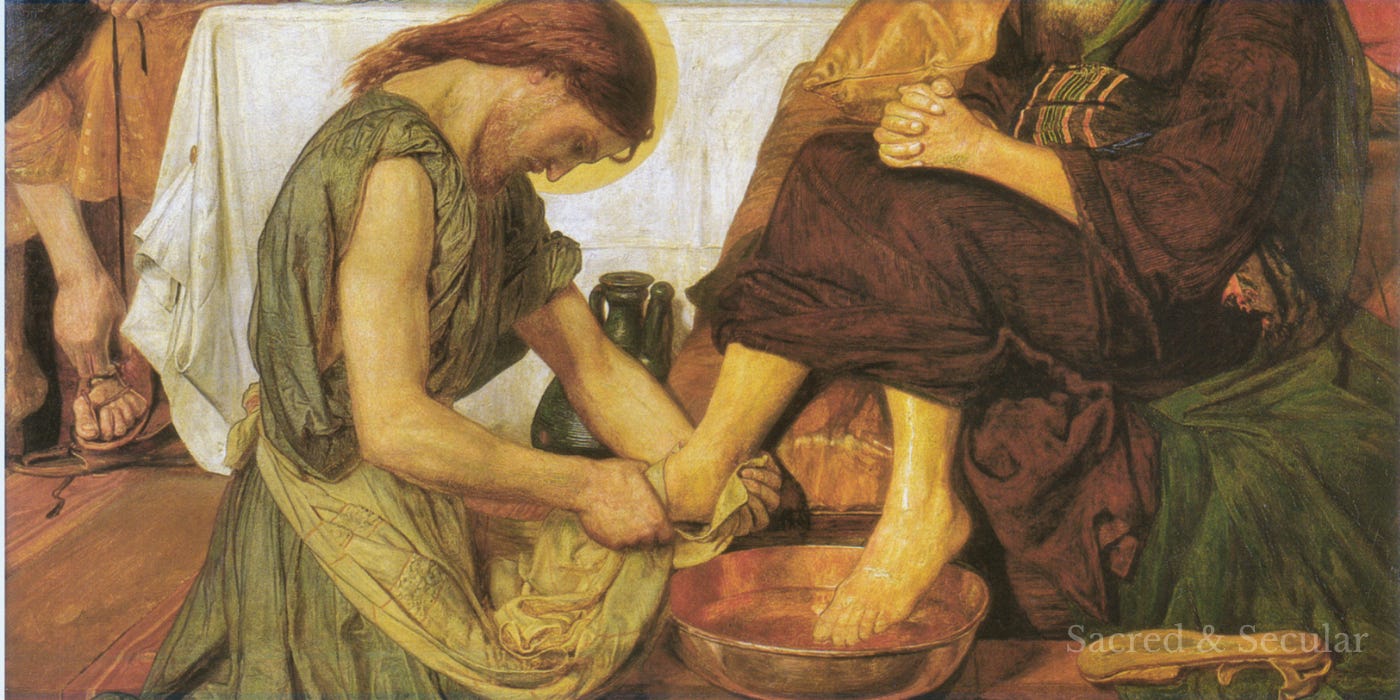
He placed a child among them. He told them that whoever wanted to become great must become a servant. Then, on the night before his death, he wrapped a towel around his waist and washed their feet, performing a task associated with servants.
We are so accustomed to phrases such as servant leadership that we can miss how strange this was. Jesus did not say that powerful people should occasionally remember to be humble. He redefined power itself.
Greatness was not about how many people served you. It was revealed by how willing you were to serve others.
The world said, climb higher.
Jesus kept pointing downwards.
❦
3. He crossed boundaries that other people defended
One of the things I find increasingly striking about the Gospels is the company Jesus kept.
He ate with tax collectors who were widely despised. He touched people others considered unclean. He allowed women to sit among his disciples. He spoke publicly with a Samaritan woman and made a Samaritan the hero of one of his most famous stories.
None of this happened accidentally.
Jesus repeatedly crossed lines that other people considered important. That did not mean he pretended differences did not exist. Jews and Samaritans really did have deep disagreements. Tax collectors really were part of a system that could exploit people.
Yet Jesus refused to allow those labels to become the final word about a person.
Perhaps the Good Samaritan captures this most clearly. The original question is essentially about where responsibility ends: Who is my neighbour?
Jesus turns it around.
Instead of asking who qualifies to receive our compassion, he asks what it means for us to become neighbours.
That remains an uncomfortable question in a world very skilled at dividing people into us and them.
❦
4. He made religion much harder to fake
It is sometimes suggested that Jesus rejected Judaism and replaced rules with a much easier religion based on love.
That does not really fit the Gospels.
The Hebrew Scriptures already spoke repeatedly about the heart, and Israel’s prophets had long criticised religious activity that was disconnected from justice, mercy and genuine devotion.
Jesus stood firmly within that tradition. If anything, he intensified it. It was not enough simply to avoid murder; Jesus asked what anger was doing inside us. It was not enough to remain technically faithful while treating another person as an object. Outward respectability could hide pride, greed, resentment and hypocrisy.
Suddenly, religion became much more difficult to perform for an audience. You could fool your neighbours, you could probably fool your religious community and you might even fool yourself. But Jesus kept returning to what was happening beneath the surface.
That creates an uncomfortable level playing field because it becomes much harder to divide humanity neatly into good people and bad people.
Jesus was not lowering the standard.
He was moving it somewhere nobody could hide from it.
❦
5. He turned society’s rankings upside down
Jesus had an irritating habit of noticing the wrong people. At least, they were the wrong people according to the normal social rankings of his day.
When children were brought to him, and the disciples tried to send them away, Jesus welcomed them. When wealthy people made impressive offerings, he drew attention to a poor widow giving a tiny amount. He repeatedly spent time with people whose presence damaged rather than improved his reputation.
Then he said things like:
“The last will be first, and the first will be last.”
We can spiritualise those words so quickly that they lose their force. Jesus was describing a kingdom in which the rankings human beings create simply do not carry the importance we give them.
Wealth does not make someone more valuable. Influence does not make someone more loved by God. Visibility does not equal significance.
Perhaps that is particularly challenging in our age because we have invented remarkably sophisticated ways of ranking ourselves. Followers, salaries, job titles, qualifications, houses, audiences and achievements all provide convenient little scoreboards.
Jesus seems remarkably uninterested in most of them.
❦
6. He rejected the usual way of gaining power
This may be one of the most surprising things about Jesus.
The world around him understood power largely in terms of control. Rome was very good at it. Armies, governors, taxation and the threat of violence kept the empire functioning. Many people hoped that Israel’s Messiah would finally defeat their oppressors and restore their nation.
Jesus chose a very different route.
He entered Jerusalem on a donkey rather than a warhorse. When Peter reached for a sword in Gethsemane, Jesus told him to put it away. He refused attempts to turn him into the kind of ruler people expected.
This does not mean Jesus lacked authority; quite the opposite. The Gospels repeatedly portray people astonished by his authority. What is unusual is how he used it. He invited rather than coerced. He served rather than dominated and, ultimately, instead of raising an army, he accepted a cross.
That is a deeply strange picture of power.
Christians have spent centuries proclaiming Jesus as king, yet it is worth remembering what kind of king the Gospels actually give us.
❦
7. He placed forgiveness above revenge
Most cultures understand revenge.
Something is done to us, so we want the balance restored. Someone hurts us, and part of us wants them to experience something of the hurt they caused.
The ancient Mediterranean world placed enormous importance on honour. An insult or injury could create an obligation to respond, and feuds could continue because every act of retaliation produced another reason for retaliation.
Jesus interrupted the cycle. Forgive, turn the other cheek, pray for your enemies, forgive not merely once, but repeatedly. None of that means wrongdoing does not matter. Forgiveness is not pretending that abuse, injustice or betrayal were acceptable.
It means refusing to allow the wrong done to us to determine what we become next.
That may be one reason forgiveness is so difficult. Revenge can feel powerful, but forgiveness often feels like surrender.
Jesus seems to suggest that sometimes the opposite is true.
❦
Perhaps the greatest irony is that many of Jesus’ most radical teachings no longer sound radical because they have become so familiar.
We put them on greetings cards, carve them onto church walls and quote them at weddings and funerals. We teach them to children, and familiarity gradually takes away their edge.
Yet perhaps one test of whether we are still really listening to Jesus is whether he ever makes us uncomfortable.
Because if Jesus always confirms what I already believe, approves of all my priorities, supports every group I support and dislikes precisely the same people I dislike, there is at least a possibility that I am no longer listening to Jesus at all. I may simply have created a version of him who looks remarkably like me.
The Jesus of the Gospels is harder to contain.
He tells us to love people we would rather dislike, serve when we would rather be recognised, cross boundaries we would rather defend, examine ourselves before judging others, notice people society overlooks, rethink what power looks like and forgive when retaliation feels far more satisfying.
Two thousand years later, I am not convinced those ideas have become any less radical. Perhaps we have simply become very good at hearing them without allowing them to surprise us.
And maybe that is the challenge. Not merely to ask whether we admire the teachings of Jesus.
But whether we are still prepared to let them disturb us.
A question to ponder: Which teaching of Jesus have I become so familiar with that I no longer allow it to challenge me?
Thank you for reading today’s reflection.
Paul.
What makes a thief? This week I have been challenged to forgive thefts from me and from people I know, but also to look into those thefts to see if something can be done about the mentally ill person I believe was involved in it and who probably had accomplices. I lost a gas-powered generator, never used, that cost me CAN$1035. A friend, who was lavishly gifted with gold jewelry when she was young, lost a necklace worth over US$5000 (a small part of her collection) for which her insurance company has rewarded her with less than US$700. My friend's young granddaughter, a young nursing student who tends women's nails as a side income, was robbed of several hundred dollars of manicure equipment from her car. A common thread running through these stories seems to be that the thieves think their thefts "justified" by the person they are stealing from being able to "afford" losing part of their means. They do not see a full financial picture of overwhelming debt or bitter lifetime losses or a struggle to make ends meet while getting an education. By the time the injured party has seen the police, an insurance company, or contemplated trying to replace the missing property, a further financial, time, and emotional burden has been incurred. I spent enough time on Facebook (thank you, Mark Zuckerberg) last night to put together the pieces of at least two families in tragic circumstances because the children had auditory problems affecting their ability to learn. While siblings were in college or other training, their opportunities had fizzled. Then, years blank of pictures when meth addictions set in to ruin the lovely smiles. I saw no signs of faith that might be a steadying influence, although one mother was working hard to celebrate family occasions, incapable of smiling. No sign of a father. Over those decades, I saw many signs of superficial values, such as an emphasis on appearance and style for the women, on mechanical power (cars, etc.) or trades for the men, and the occasional expensive holiday. Many people who cannot articulate their own values project them through captioned photos of pets or elaborate affirmations written by others that speak for their own longings. Pictures are worth thousands of words, but you get this picture so I won't go on. There is more to pity and to try to remediate in these thefts of property.
Funnily, I wrote my reply to your next comment before I saw your reply to this one. I am so blessed by your affirmation! You lift some of my burden with this affirmation!!!