


Welcome to today’s reflection.
Sunday reflections are for all subscribers. If you would like to receive daily reflections or have access to the database, I would love to welcome you as a paid subscriber.
Most people only see the finished article.
They see the headline appear in their inbox, read the words, perhaps leave a comment, and then move on with their day. What they rarely see are all the small, ordinary moments that made that article possible.
They do not see the abandoned drafts, the ideas that went nowhere, or the mornings when the words arrived reluctantly and had to be coaxed onto the page one sentence at a time.
They certainly do not see the hundreds of days spent simply showing up.
Over the past year, Sacred & Secular has become part of the rhythm of my life. Every morning, I sit down and write. Some articles are widely read. Others disappear into the internet with little fanfare. Most begin in exactly the same way: a blank screen, a cup of tea, Hank curled up beside me and the decision to show up once again.
The visible part is the published article. The invisible part is everything that came before it.
Recently, that thought made me look at the story of David and Goliath in a different way.
It is one of the most familiar stories in the Bible. Even people who know very little about Scripture usually know the outline. A shepherd boy faces a giant warrior and wins. It is a story that has become shorthand for impossible odds and unexpected victories.
Perhaps that familiarity is precisely why we miss something important.
We focus on the battle because it is dramatic. Like a movie scene. It is the moment everyone remembers. Yet the closer I look at the story, the more convinced I become that the real lesson lies somewhere else.
It lies in the years before David ever stepped onto the battlefield.
— • —
The story actually begins with fear.
That is one detail I had never fully appreciated when I first encountered it. The Israelites are often portrayed as lacking courage, but the text itself paints a more nuanced picture. Goliath is not merely a large man. He is a professional soldier, heavily armed and battle-tested. Everything about him communicates power and superiority.
The fear of Israel is not irrational. It is entirely understandable.
For forty days, Goliath issues his challenge. Morning and evening, he appears before them, and morning and evening, nobody responds. The people stand frozen, not because they are foolish but because they recognise the reality before them. They know what they are facing.
For a long time, I assumed the lesson was that they should simply have had more faith. Yet the story itself neither mocks nor dismisses their fear. It simply presents it. The giant remains a giant. The threat remains real. Nothing about the situation changes.
Then David arrives.
What is striking is that David sees exactly the same thing everyone else sees. He hears the same challenge. He looks at the same warrior. He understands the same danger. The difference is not that he possesses information nobody else has.
The difference lies in what has shaped him.
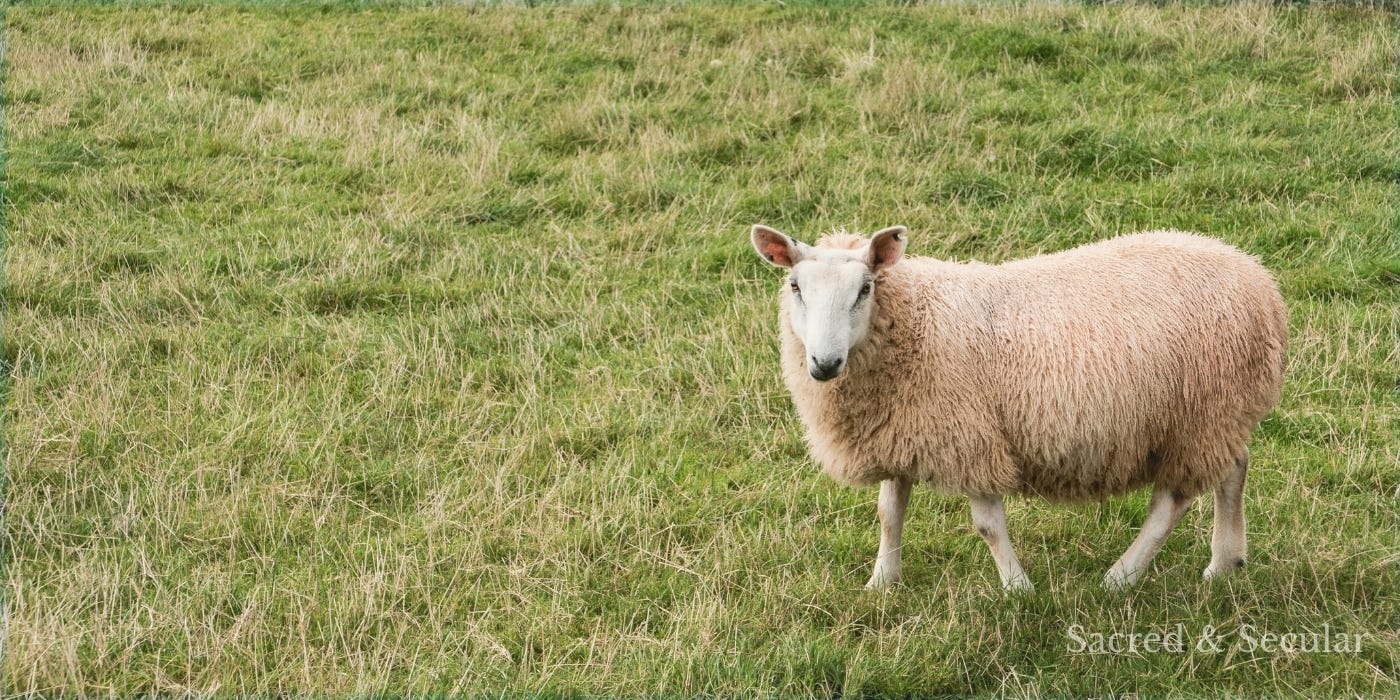
When Saul questions him, David does something unexpected. Instead of talking about the giant, he talks about sheep. He recalls protecting his father’s flock from lions and bears, and at first glance, the detail feels almost irrelevant. We want to get to the battle. David keeps dragging the conversation back to the field.
Yet that field is the key to understanding everything.
— • —
Long before David became famous, he was simply a shepherd carrying out ordinary responsibilities. Day after day, he watched sheep. Day after day, he dealt with problems nobody else noticed. Day after day, he learned what it meant to be faithful in situations that attracted no applause and generated no recognition.
Nobody was celebrating those years.
Nobody was writing songs about them.
Most people probably never knew they happened.
Yet those hidden years mattered. In fact, they may have mattered more than the battle itself.
As I reflected on that, I realised how often Scripture follows this pattern. Moses spends years tending sheep before confronting Pharaoh. Joseph spends years forgotten in prison before becoming one of the most powerful men in Egypt. Even Jesus spends the vast majority of his earthly life away from public attention.
Again and again, God seems content to work slowly.
Formation often takes place in seasons that appear entirely ordinary. We tend to focus on the visible moments because they are easier to identify. We notice promotions, achievements, breakthroughs, and successes. Those are the moments that attract attention and become stories people tell.
The quieter seasons rarely receive the same treatment.
The years spent raising children.
The decades spent faithfully turning up to work.
The countless acts of kindness that are quickly forgotten by everyone except the person who received them.
The ordinary routines that feel repetitive and uneventful.
Yet perhaps those are the places where character is formed.
The longer I write, the more convinced I become that this is true. People occasionally ask how I manage to publish so frequently. The answer is disappointingly simple. I sit down and write. Then I do the same thing the following day, and the day after that.
There is no secret formula.
What readers eventually see is only the visible tip of something much larger. Every article rests upon countless hours of practice, mistakes, revisions, reading, reflection, and persistence. The published piece is not really the story. It is simply evidence that another story has been unfolding quietly in the background for a very long time.
I wonder whether David and Goliath works in much the same way.
Looking back, I can see this pattern in my own life. The articles people remember are rarely the result of a single burst of inspiration. They emerge from hundreds of ordinary mornings spent reading, praying, thinking, and writing. Most of that work is invisible, yet without it the visible part would never exist.
— • —
We often treat the battle as the defining moment, but perhaps it is better understood as the revealing moment. The battlefield did not suddenly create David’s courage. It revealed what years of faithfulness had already produced.
That shifts the story's emphasis quite dramatically.
Instead of asking whether we would have the courage to face a giant, perhaps we should be asking what is shaping us right now. What habits are taking root in our lives? What values are being formed? What kind of people are we becoming through the countless ordinary moments that make up our days?
Those questions are far less dramatic than a giant standing on a battlefield, but they are far more relevant to most of us.
Very few people will experience a moment that changes history. Most of us will spend our lives doing ordinary things. We will care for families, serve communities, help friends, fulfil responsibilities, and strive to be faithful with whatever has been placed before us.
David’s story suggests that those ordinary moments are not separate from God’s work.
They are God’s work.
The sheep field mattered. The lonely hours mattered. The unnoticed responsibilities mattered. They were shaping a person long before anyone realised what was happening.
The battle is the part everybody remembers. The field is what made it possible.
Most of us are unlikely to stand before a giant tomorrow. Yet all of us will wake up to another ordinary day filled with seemingly small decisions and responsibilities. Scripture suggests that those moments are far more significant than they appear.
Because while we are busy living them, they are shaping the people we are becoming and those around us.
The question is not whether those ordinary moments matter.
The question is what they are making of us, long before anybody else notices the work taking place.
Thank you for reading today’s reflection.
I will be back tomorrow with another thought. You just need to put the kettle on!
Paul
Yes, faithfulness in the ordinary is massively important. Often faithfulness in the ordinary is harder than in the extraordinary.
There is another aspect to the story in that David was also faithful in the extraordinary. Long before Goliath he trusted the Lord to help him overcome lions and bears. How many shepherds in Israel depended upon the Lord to help them barehanded in some cases take on lions and bears? Probably not many. A man after God’s own heart did.
In this life we continually face hard situations. Some face personal cancer, cancer of loved ones, long covid, other illnesses, major injuries, lack of money, bullies, unfair court decisions and the list could go on. People who trust the Lord through it all, the ordinary and the extraordinary, become unafraid of the next extraordinary thing that comes along.
Thanks for continuing to show up and trusting the Lord with whatever is in front of you. A man after God’s own heart!
There is a tie between this article and your next one but I’ll make those comments there.
It’s tempting sometimes to think our ordinary days don’t matter. Your reflection here says otherwise. Thank you! So encouraging!