


Welcome to Sunday’s article for all subscribers.
Throughout the week, I write daily reflections for paid subscribers. Sundays are my opportunity to open the doors a little wider and share something with the whole Sacred & Secular community.
If you’ve recently joined us, you may also be interested in my new book, Sacred & Secular: Find God in the Ordinary, which brings together some of the most popular and thought-provoking essays from this journey so far.
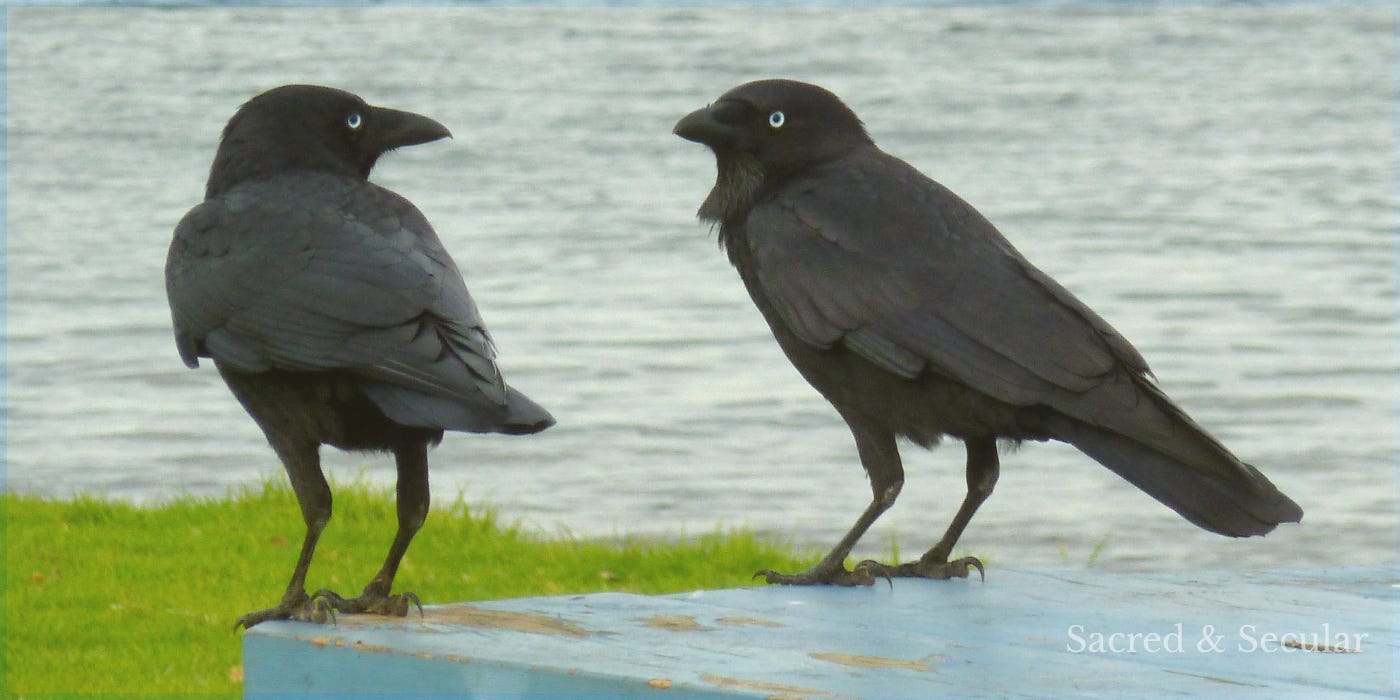
This morning, I found myself reading an article about scientists using artificial intelligence to study the language of crows.
It was one of those stories you glance at and then cannot stop reading.
Scientists are using machine learning to identify patterns within the enormous variety of sounds made by birds. They have not exactly developed a crow-to-English translator (yet), but they are beginning to connect particular calls with behaviours and social situations. We already know that crows can recognise individual human faces, remember people they perceive as threatening and pass that information to other crows.
In other words, crows appear to spend a considerable amount of time watching us and, in their own way, talking about us afterwards. Which is either fascinating or terrifying, depending on how you feel about crows.
What struck me was not simply the possibility that crows might be discussing us behind our backs. It was the fact that artificial intelligence had once again appeared somewhere I had not expected it.
AI now seems to be everywhere I look. It is built into our computers and smartphones, but its reach extends far beyond the devices in our pockets. It is transforming healthcare, finance, education, music, scientific research and the creative industries. We are genuinely living through a technological revolution that will reshape entire professions and alter many of the ordinary ways in which we work, create and communicate.
Some of those changes will be enormously beneficial. AI can widen access to knowledge, assist people with disabilities, analyse medical information and help scientists recognise patterns that would otherwise take years to uncover. By helping researchers explore the complex world of animal communication, AI may deepen our understanding of the creatures with whom we share the world.
Other changes will carry consequences we do not yet fully understand. The boundary between human and AI-generated work may eventually become so blurred that we struggle to tell where one ends and the other begins.
Understandably, these developments have generated considerable fear, both within the Christian community and beyond. But people of faith do not need to respond with fear alone. Gratitude and caution can coexist.
Some people speak about AI as salvation. Others speak about it as doom. Will it take our jobs? Will it replace artists? Will it become conscious? Will AI start writing your daily reflections?!
Most of these conversations revolve around one question: What will AI become?
When you read the Bible, it seems to invite us to ask a different, perhaps more uncomfortable question:
What are we becoming?
❦
Babel Was Never Really About Bricks
Of course, you will not find anything about artificial intelligence in the Bible. But its writers have a habit of asking deeper questions, not simply what our tools can do, but what our tools are doing to us.
Scripture is not anti-invention, anti-creativity or anti-progress. It is filled with builders, artists, musicians, farmers, metalworkers, cities, ships and tools. Human creativity is celebrated as part of what it means to bear the image of God.
The problem begins when our power grows faster than our wisdom. That is where the Bible starts to feel uncomfortably modern.
One of Scripture’s earliest stories about human technology is the Tower of Babel. A group of people settles on a plain, discovers a new way to build and decides to construct a city with a tower reaching towards the heavens. As they begin their project, they say, “Let us make a name for ourselves.”
That sentence is the heart of the story.
The problem is not that they made bricks or that they built upwards. The problem is what they hoped their technology would give them: security, identity, permanence and control. They were not simply building a tower. They were trying to build a version of themselves that would no longer need to be vulnerable.
The brick represents a genuine technological breakthrough rather than a throwaway detail. Babel is not a warning against innovation. It is a warning about innovation becoming self-exaltation.
That distinction matters when we talk about AI. Artificial intelligence is not evil simply because it is powerful. Bricks were not evil because they were useful, just as iron tools were not evil because they were stronger than stone. The deeper questions concern intention, trust and purpose.
What is this power for? Who does it serve? What does it promise us? And, crucially, what might it ask us to surrender in return?
❦
The Fear Beneath the Ambition
There is another detail in the Babel story that is easily overlooked. The builders are afraid.
They explain that they want to build their city and tower so that they will not be scattered across the earth. Beneath all their confidence and technological achievement lies a deep anxiety. They fear vulnerability, uncertainty and the loss of control.
Suddenly, the story feels much more human.
Many of the promises surrounding artificial intelligence are not really about technology at all. They are about overcoming the things that make us uncomfortable: ignorance, inefficiency, uncertainty, weakness and dependence. We want immediate answers because wrestling with difficult questions takes time. We want frictionless productivity because the limitations of human work frustrate us. We want systems capable of predicting the future because the future frightens us.
There are echoes of Babel in those desires, not because AI is inherently wrong, but because human beings have always been tempted to seek transcendence through technology rather than transformation.
We want the benefits of wisdom without the slow work of becoming wise.
The spiritual questions may therefore emerge in very ordinary moments. Am I using AI to clarify my thinking, or to avoid thinking? Is it helping me communicate more honestly, or simply more efficiently? Does it strengthen my creativity, or encourage me to surrender the difficult work from which creativity grows? Am I using it as a tool, or handing over the work of attention, judgement and imagination?
These are not arguments for rejecting AI. They are questions about using it without allowing it to use us.
❦
Information Is Not Wisdom
This may be the most important distinction the Bible offers in the age of artificial intelligence.
Scripture consistently distinguishes knowledge from wisdom. Knowledge concerns what we know. Wisdom concerns how we live, what we love and whether our knowledge is directed towards what is good.
An AI system can tell us how to maximise engagement, but it cannot determine whether manipulating people is morally right. It can help us optimise productivity, but it cannot decide what makes a meaningful life. It can generate a convincing apology, but it cannot make us sorry. It can compose a prayer, but it cannot pray.
AI may answer more questions than ever before, but it still cannot answer the question of who we should become.
That question belongs to the realm of wisdom, character and moral responsibility. No machine can carry it on our behalf.
Technology does not merely help us do things. It also shapes the people doing them. Our phones have changed how we pay attention. Social media has already changed how we present ourselves and relate to others. Recommendation systems influence what we watch, what we desire and what we believe deserves our concern.
None of this requires a sinister conspiracy. It is simply what powerful systems do. We create tools to serve us, and then slowly reorganise our lives around the tools we have created.
This is why the Bible’s warnings about idolatry remain so relevant. Idolatry is not merely about statues and temples. It begins whenever a created thing starts occupying a place that does not belong to it. A tool becomes an identity. A system becomes a source of meaning. A technology becomes a saviour.
The Bible’s concern has never been simply that human beings create powerful things. Its concern is that we eventually begin serving them.
❦
What Will We Become?
The danger of AI may not be that machines become too human.
It may be that human beings become less human: less patient with one another, less comfortable with mystery, less willing to wrestle with difficult questions and less capable of genuine attention.
None of that is inevitable. AI will help us serve our neighbours, steward our gifts and understand the world more fully. But greater capability does not automatically produce greater wisdom. Every increase in power creates a corresponding need for humility, discernment and moral responsibility.
Every generation builds with the materials available to it: brick and mortar, bronze and iron, steam and electricity, data centres and algorithms. We like to believe our technology is unprecedented. Perhaps it is.
But the Bible suggests that our temptations are not.
We still want to make a name for ourselves. We still dream of escaping vulnerability and constantly confuse greater power with greater wisdom.
So the deepest question raised by artificial intelligence is not whether machines will eventually become like us. It is whether, in giving more and more of ourselves to machines, we will remember what human beings are for.
A question to ponder: How might we use AI with wisdom and gratitude without allowing it to shape what we value most?
Thank you for reading today’s reflection.
Paul.
Thanks for the thoughts. I have great concern about AI, but am thankful it will never truly be in control, God always will be in control of the future. I have to continually remind myself of this.
I love AI for being able to sort through government verboseness and tell me concisely what is meant. I don’t believe it is a place of creativity.
History shows that the first use of any new technology is always war against other humans. We are seeing it again in our time.
The problem is not the technology but man’s prideful and greedy heart which has not changed since the fall in the garden.
I am writing about these issues at greater length, but will reflect my experience briefly here. My father was a chemical engineer, a very high achiever academically, and on the design team for the first atomic energy plant in Canada during WW II when the National Research Council became Canada's war machine. He advised the government on atomic energy. He was dismayed when what was to have been a deterrent was turned on civilians at Hiroshima and Nagasaki, the first atomic bombings in human history. He also was dismayed when I moved towards pacifism as preteen and when I joined the RC Church at 32. I gradually learned that he was not mentally normal although my mother, a high-achiever in her own right, was the stable personality. When I made extraordinary discoveries about the role of hearing in states of consciousness, I simultaneously learned that a mastoid infection in his right ear in his late teens undoubtedly was the cause of his bipolar disorder and ill health. However, I came to see that some occupations attract people who are mentally ill for other reasons, most often the genetics of inherited ear problems: audio-processing deficits that, because they have been mysterious to medicine, are fascinating and attractive to the general public.
My analytical mind was formed by that man. My religious beliefs were formed by both parents and the examples of their lives. I became intellectually independent during my university education and religiously independent soon after. By the time, a few decades on, I was editing a book on writing for engineers, I had come to think that every engineering "advance," from ancient times to the present, contains the conflicts you describe here, starting with the Tower of Babel and now most visible in warfare and in AI's domestic applications. The ego-centric demand of the engineers and inventors for power they covet for themselves always is involved in the work they do. Many Christians today have become opposed to The Machine on principle. Consider that The Cross is a machine for torture and execution. When you think about speed, whether the acceleration of knowledge or of transport, ask yourself if speed is an improvement over slower methods of learning or of accomplishing movement through space. What are the consequences to the human personality? What are the consequences to the environment essential to life of all persons and animals? You can learn more about crows by watching and listening to them. You can learn more about people by talking to them and praying for them. You can understand most circumstances better by slowing down, thinking long and hard, praying your way through the available research sources, and being willing to wait.
One of my discoveries about consciousness, which you touch on in "the still, small voice" discovered by Elijah as residing not in the environment but in the human brain, is that the types of "spiritual" states of consciousness within the human brain do not usually occur (notice I did not state "never") at the highest speeds of cerebral integration we feel as high alertness but at the slower speeds approaching sleep or even during light sleep. Then, you will notice how many bits of religious practice induce those slower speeds of integration, from closing one's eyes to the reduction of light inside buildings and with windows filtering light through stained glass and with candlelight over electric light even though electric light is available. The manipulations of music, of the body's balance mechanism through posture inclining from the vertical, and the restrictions on sound all play into a "meditative" environment that promotes "spiritual" experiences. My discovery that right-ear dominance can be conditioned so that people can gain greater control over their states of consciousness and their overall health may be more important to the world's people than AI, although I shudder to think how that knowledge also could be misused. Some engineering -- headphones and access to electronic sources of music -- is involved there, too. Caution is advised and certain rules apply. The potential for healing is quite astonishing, however.