


Welcome to Sunday’s article for all subscribers.
Throughout the week, I write daily reflections for paid subscribers. Sundays are my opportunity to open the doors a little wider and share something with the whole Sacred & Secular community.
You may also be interested in my new book, Sacred & Secular: Find God in the Ordinary, which brings together some of the most popular and thought-provoking essays from this journey so far.
I once asked a church what they thought heaven would look like. Apart from being surprised that I was expecting them to engage in a sermon, the answers they gave genuinely surprised me.
Given that this was a church service, I was expecting something vaguely theological. What I got, though, was a lot of the images from the past.
You probably know the ones.
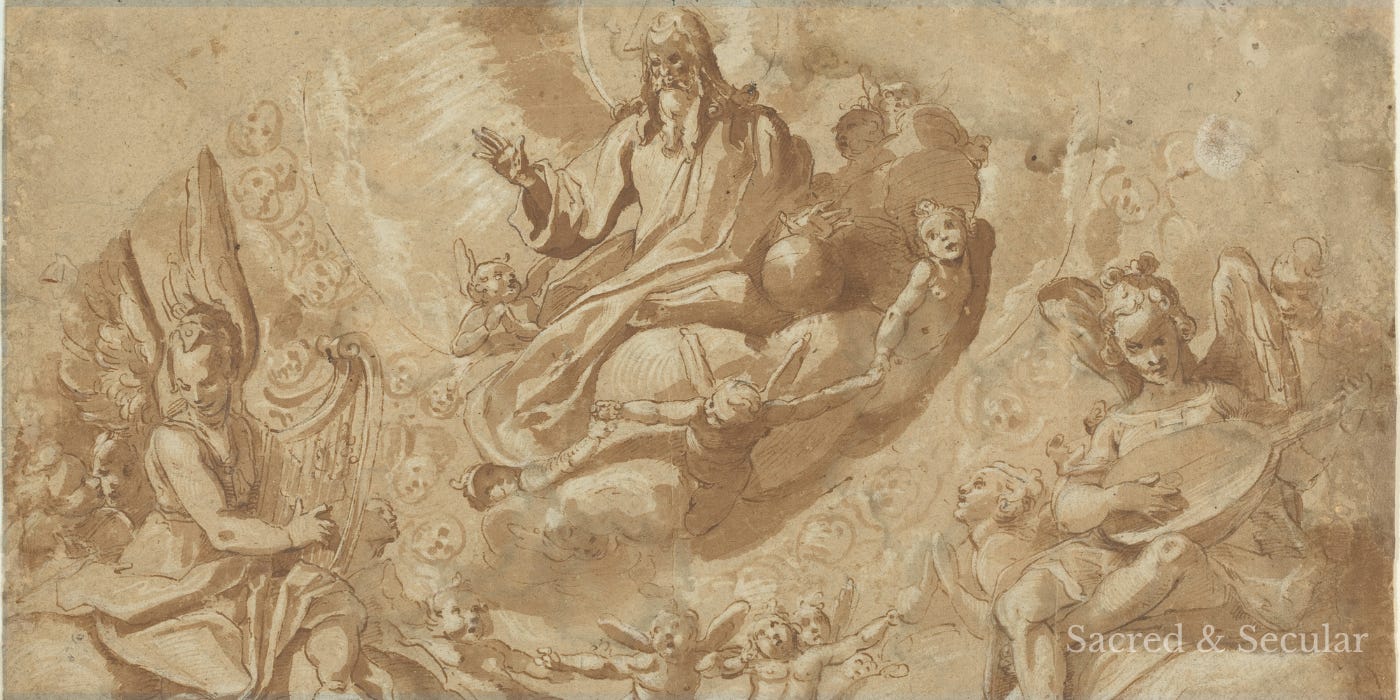
God, usually with a magnificent, long, flowing beard, sitting somewhere on a cloud and looking down at the rest of us. There may be a few angels nearby, perhaps one of them playing a harp, and almost certainly a great deal of white. St Peter at the pearly gates, checking people in one by one, clipboard in hand.
Even people who have little connection with Christianity often seem to carry some version of these images. Heaven is up there. God lives in it. When we die, we hopefully go there. We may even acquire wings along the way, although nobody seems entirely clear about when they are issued.
Of course, most of us know that these images are not meant to be taken literally. I doubt many Christians genuinely expect to spend eternity perched on a cloud while somebody plays the harp beside them. Yet images are powerful. They go deep into our imagination and shape what we expect until an idea becomes so familiar that we stop asking where it actually came from.
That is particularly true of heaven. But what if these images bear no relation to what is described in our Bible?
The more carefully I have read the Bible over the years, the more I have realised that some of our strongest assumptions about what happens after death are surprisingly difficult to find there. That does not mean the Bible has nothing to say about the future. Far from it. But if we can put aside some of the familiar imagery for a moment, something rather interesting begins to emerge.
The biblical hope may actually be much bigger, richer and ultimately more hopeful than simply going to heaven when we die.
❦
What We Become
One of the most familiar phrases we hear after somebody dies is that they have “become an angel.” I completely understand why people say it. Usually, it is an expression of love rather than theology. Someone precious has died, and we want to believe they remain safe, close, and somehow still involved in our lives. It is a comforting image, especially at a time when words often struggle to convey our feelings.
Yet the Bible never says that human beings become angels. Jesus does once say that people in the resurrection will be like the angels, but the context matters. He is answering a question about marriage and explains that resurrected people will no longer marry or die.
Like the angels is not the same thing as becoming angels.
Throughout Scripture, angels and human beings remain distinct. Our future is not portrayed as slowly becoming less human until we eventually sprout wings and join the celestial workforce. The great Christian hope is something rather different. It is resurrection. That word matters because resurrection is not about escaping our humanity but about its restoration.
At the centre of Christianity, after all, is the extraordinary claim that Jesus did not merely survive death spiritually. His followers claimed that he was raised. They encountered someone recognisably Jesus, yet somehow transformed. He spoke, walked, ate and could be touched. Whatever resurrection means, the Gospels seem determined to tell us that it is not the abandonment of embodied life into some spiritual realm.
That has enormous implications for how we understand our own future.
❦
Where We Will Be
Perhaps the biggest surprise comes right at the end of the Bible.
Most of us have inherited a fairly simple picture of the Christian story. We live on earth for a while, die, and, if all goes well, leave this world behind and go to heaven forever. There are certainly passages in the New Testament that speak about being with Christ after death, and Christians have understood this in different ways. I do not think we need to pretend those passages are not there.
But that is not where the biblical story ultimately ends.
The final chapters of Revelation describe something much larger. John sees a new heaven and a new earth, and then he sees the New Jerusalem descending from heaven. That direction has always fascinated me because the story does not end with humanity disappearing upwards. Heaven comes down. God’s dwelling is described as being among humanity, and the voice from the throne announces that God is making all things new.
Not making new things.
Making all things new.
Paul speaks in similar terms. In Romans, he describes creation itself longing to be liberated from decay. In 1 Corinthians, his great discussion about the Christian future centres on the resurrection of the body. The hope is not simply that we survive. Creation itself is somehow caught up in redemption, and that changes the story considerably.
If God’s ultimate intention were simply to rescue souls from a doomed physical world, then perhaps the world would not matter very much. It would be little more than a waiting room we endure until something better begins. Yet the Bible repeatedly refuses to treat creation that way. The world is broken, certainly, but it is also loved. According to the Christian story, God does not abandon what is broken.
He restores it.
❦
How We Will Live
This makes the endless-cloud version of heaven rather difficult to sustain. Popular culture has done a remarkable job of convincing us that eternity consists largely of floating around. Everyone wears white, nobody seems to have anything particularly urgent to do, and occasionally somebody plays a harp. To be perfectly honest, that might be nice for the first few million years, but after that, it all sounds rather exhausting.
The Bible’s imagery is very different. Its pictures of the future include cities, rivers, trees, feasting, worship, service and meaningful activity. Revelation speaks about God’s servants serving him and of humanity sharing in God’s renewed creation. The images are symbolic, of course. Revelation is hardly an estate agent’s brochure for eternity. But the symbols matter because they suggest fullness rather than emptiness, activity rather than endless passivity, and embodied existence rather than souls drifting indefinitely through space.
Perhaps we have confused rest with inactivity. Most of us know from ordinary life that the best kind of rest is not necessarily doing absolutely nothing forever. It is being free from the things that make life exhausting. Imagine meaningful activity without frustration, relationships without fear, creativity without limitation, and love without the knowledge that one day death will interrupt it. That begins to sound rather more fulfilling than endless cloud.
Crucially, the Christian future is not presented as humanity becoming less human.
It is humanity finally becoming what it was always intended to be.
❦
Learning To Trust
There is another assumption I increasingly find myself questioning.
We sometimes talk about heaven as though the Bible gives us a detailed description of it, but it really does not. For something Christians have spent two thousand years discussing, Scripture remains surprisingly restrained. We receive glimpses, images, promises and visions, but remarkably little about many of the questions most of us would probably ask first.
Will we immediately recognise everyone? What age will we appear to be? Will Hank, my little dog, be there? What exactly will we do? How will time work? I have heard confident answers to all of those questions over the years, often delivered with the sort of certainty that suggests somebody has somehow obtained the advance information pack. I am simply not convinced that the Bible provides enough detail to support that confidence.
Perhaps there is wisdom in that. One of the recurring themes recently has been that human beings like certainty. I certainly do. Give me a mystery and part of me immediately wants to open several commentaries, search the Greek and find somebody who has written a reassuringly large book explaining exactly what it means.
Yet there are places where Scripture seems perfectly content to leave us with mystery.
Perhaps the point is not that we understand every detail of what comes next. Perhaps the point is that we learn to trust the God who holds it.
That feels rather different.
❦
Focusing on Now
The more I think about all this, the more I wonder whether our traditional picture of heaven has accidentally made Christian hope much smaller, reducing it to a cute story like Santa Claus. Clouds and harps may be harmless enough, but underneath them can sit a much deeper assumption: the idea that salvation means leaving. Leaving our bodies, leaving creation, leaving ordinary human life behind and moving somewhere entirely different.
The biblical story seems to move in almost the opposite direction. Jesus is raised bodily. Creation is liberated, death is defeated, God dwells among humanity and the world is made new. Other than that, I am increasingly suspicious of anyone who claims to have the entire timetable neatly organised.
But perhaps we do not need to know every detail to notice the shape of the promise. Christianity does not ultimately offer escape.
It offers renewal.
And I think that matters enormously for how we live now. If this world matters enough for God to redeem, then perhaps it ought to matter to us, too. Bodies matter. Creation matters. Justice matters. Relationships matter. Beauty matters. The small acts through which we repair, nurture, create and care for the world around us matter.
Christian hope is not an invitation to dismiss the present because somewhere else will eventually be better. It is an invitation to see the present as belonging to the God who intends one day to make it whole.
❦
The Ultimate Hope
I still enjoy some of those old paintings of heaven.
God sitting above the clouds has produced some magnificent art, and I have no particular desire to confiscate anyone’s harp. But perhaps we should allow the Bible to stretch our imagination beyond them.
The great Christian hope is not that we will one day finally escape everything we have loved here. It is that everything which makes love painful will finally be removed: the grief, the separation, the sickness, the fear, the decay and the death. Revelation’s promise is not that these things will finally be explained. It is that they will be gone.
Perhaps that is why the biblical vision feels increasingly hopeful to me. I do not particularly want an eternity in which I become less human. I long for one in which everything broken about being human is finally healed. I do not need every detail mapped out in advance to find hope in that. In some ways, I think the mystery is part of what makes the promise so powerful.
Maybe we need to think of heaven as never meant to be the end of the story. It may be part of a much bigger promise: a promise of resurrection, a promise of renewal, and a promise that the God who made this world has not finished with it yet.
And perhaps the final Christian hope can be expressed far more simply than all our clouds, gates, wings and harps.
Behold, I am making all things new.
A question to ponder:
Which picture of heaven have you carried with you, and where do you think it came from?
Thank you for reading today’s reflection.
Paul.
Such wisdom. Thank you, Paul.
Thank you for these words that express so well what I am coming to understand also.