


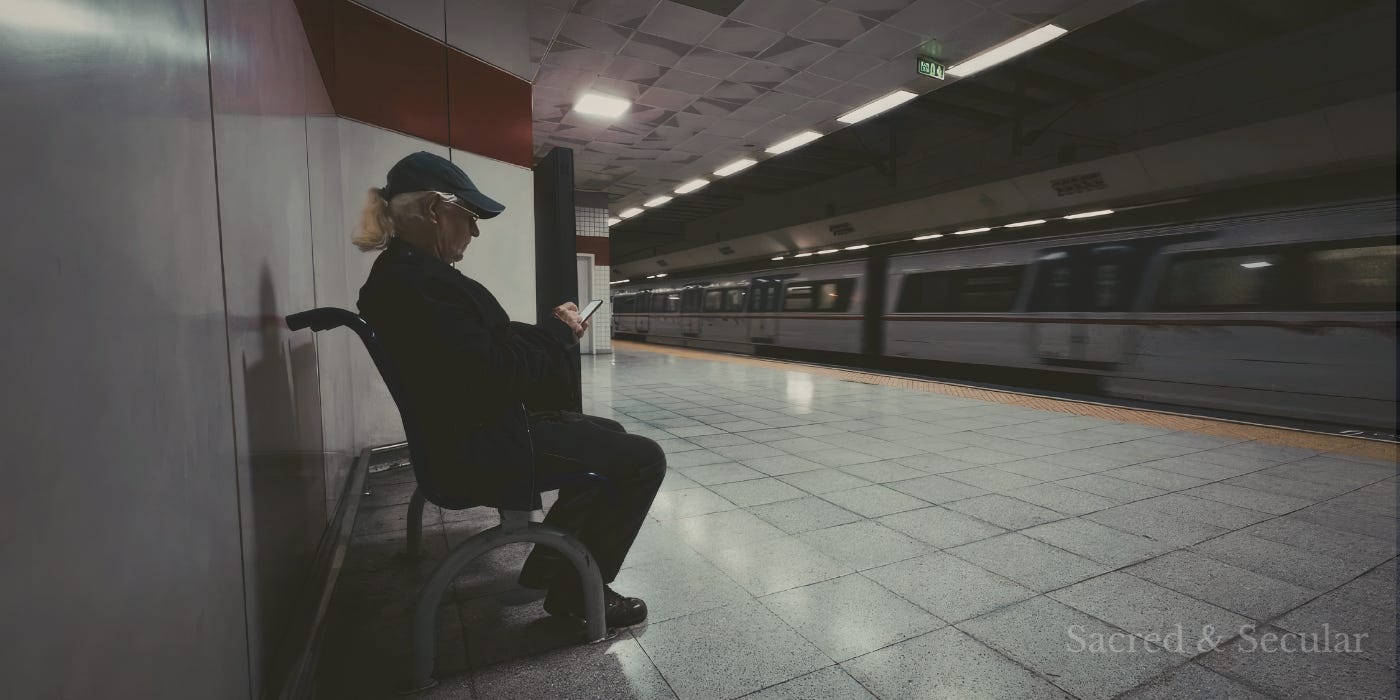
There are some sayings of Jesus that feel instantly comforting.
Love your neighbour.
Do not be afraid.
Come to me, all you who are weary.
Then there are the sayings that make people shift awkwardly in their seats when they are read aloud in church.
“Let the dead bury their dead.”
That one lands with a thud.
A man approaches Jesus and says something that sounds entirely reasonable:
“Lord, first let me go and bury my father.”
Most of us instinctively sympathise with him. It sounds compassionate, responsible, and deeply human. Family comes first. Grief comes first. Funerals, of course, come first.
Then Jesus replies:
“Follow me, and let the dead bury their own dead.”
It sounds abrupt.
Cold, even.
The kind of sentence that makes you wonder whether you have somehow missed a nice, softer tone hidden between the lines.
Because we are uncomfortable with it, we often rush past it and explain it away quickly. We might be tempted to turn it into something symbolic enough to stop disturbing us.
But I have increasingly come to think that the discomfort is precisely the point.
Not because Jesus is dismissing grief.
But because he is exposing something many of us spend our lives doing.
Delaying.
— • —
When modern readers hear this exchange, we naturally picture a funeral.
We imagine a grieving son standing beside the body of his father, asking for just enough time to attend the burial before beginning this new life of discipleship.
Within that framework, Jesus comes across as cruel.
But first-century Jewish burial customs were not quite the same as our own.
Burial often happened in stages. There would be an initial burial, a formal mourning period, and, later, the gathering of bones into an ossuary. The process could stretch over a long period of time.
So when the man says, “Let me first bury my father,” he may not necessarily mean, “My father died this morning.”
He may mean:
“Let me fulfil my family obligations first.”
“Let me wait until this chapter of my life is settled.”
“Let me deal with everything before I follow.”
And suddenly the exchange feels very different.
Jesus is not interrupting a funeral. He is interrupting a postponement.
That distinction changes everything.
— • —
What strikes me most about the man’s response is how reasonable it sounds. That is what makes it dangerous.
Very few people openly reject meaning, purpose, faith, change, or transformation.
Most people simply delay them.
We tell ourselves we will begin once life settles down.
Once the children are older.
Once work is less chaotic.
Once our health improves.
Once finances stabilise.
Once we feel more confident.
I recognise that instinct in myself far more than I would like to admit. There is always a temptation to imagine that real life begins later, after one more thing is sorted.
The trouble is that life has a habit of continuously generating new reasons to postpone itself.
There is always another obligation waiting politely at the door.
Jesus refuses to negotiate with “later.”
That may be what makes this saying feel so uncomfortable.
Because most of us instinctively understand exactly what the man is doing.
— • —
The line becomes even stranger when you notice that Jesus uses the same word twice.
“Let the dead bury their dead.”
Some are physically dead.
Others are alive in body, yet sleepwalking through inherited expectations, routines, obligations, and familiar patterns.
Functioning.
Busy.
Productive.
Yet never fully awake to the possibility that life could be different.
I do not think Jesus is condemning responsibility. Elsewhere in the Gospels, he speaks tenderly about family, grief, and compassion.
What he confronts is the quiet tendency to let obligation become an excuse for never responding to anything new.
There is a kind of existence that slowly becomes all maintenance and no movement.
And perhaps that is what Jesus is naming.
— • —
I suspect this passage still challenges people because it cuts directly across one of our favourite assumptions: the belief that transformation should wait until conditions become ideal.
He calls fishermen while they are working.
Tax collectors, while they are sitting at the booth.
Disciples, while they are in the middle of ordinary routines.
The call always arrives as an interruption. Not as a carefully scheduled life upgrade.
That feels deeply relevant now.
Many people live with the innate sense that they are managing life rather than inhabiting it.
Days become schedules, responsibilities, notifications, and maintenance.
You look up from a screen one afternoon and suddenly realise another year has passed. And somewhere beneath all the busyness is a persistent question:
“When exactly was I planning to begin?”
Jesus’ words force that question into the open.
Not gently.
But honestly.
— • —
One of the most interesting things about this passage is that the Gospel writers never explain it away.
They could have added clarification or inserted commentary. Instead, they leave the sentence sitting there in all its awkwardness.
I think that matters.
Because the saying is supposed to disturb us. It is meant to jolt us out of our way of thinking. And perhaps that force is necessary.
Because delay rarely feels dangerous while we are inside it.
It feels sensible.
Responsible.
Mature.
Even wise.
The tragedy is that entire lives can quietly disappear into endless preparation.
— • —
I do not think this passage is asking people to abandon compassion, neglect family, or reject responsibility.
It is asking something far more uncomfortable.
What if some of the things we call necessary are actually just familiar?
What if postponement has become so normal that we no longer recognise it?
What if the life we keep promising ourselves “later” is already trying to begin now?
Jesus leaves the question hanging.
The Gospels do not resolve the tension for us.
Perhaps because it is a question each person has to answer for themselves.
What are you still waiting to become before you allow yourself to fully live?
And how much of your life has already been spent preparing to begin?
— • —
If this reflection resonated with you, Sacred & Secular is a space where I explore the intersections between faith, doubt, culture, meaning, and ordinary life.
Every day, I publish reflections for readers who believe, readers who are unsure, and readers who simply find themselves asking deeper questions than they used to.
You can subscribe below to receive future reflections directly in your inbox.
Paul.
Much appreciated, Paul. My overall impression of holy scripture is that there is a subtle underlying narrative that emphasizes the ascending of individuals, tribes, nations or empires, only to be followed by their fall into destruction, especially into the hands of unbelievers, to be enslaved, tortured, killed or otherwise punished. And for some pretty nasty sins (Moloch), greed (Baal), and obsessive, unfaithful lust (Asherah - Billy Graham once eloquently detailed how this often happens in modern life).
Christ freed us from this if we but ask him into our hearts. But then again, purely for our edification, this greatest man whoever lived fell into the hands of unbelievers, was tortured and killed. So, in the scripture you address, His teaching was also that regardless of station in life, we alll die (usually under tortured circumstances). Your teaching, for me, subtly emphasizes this ironic paradox for all life by urging us to focus on achieving faith, hope and love in this life.
"There is a kind of existence that slowly becomes all maintenance and no movement." This statement beautifully summarizes what drove me half out of the church looking for something more vital, more likely to solve burning problems. I think it summarizes the main reason for the shuttering of churches in vast numbers over the past couple of decades.