


Thank you for being a free subscriber here at Sacred & Secular.
I am glad you are here. Free members receive a full reflection every Sunday, while paid membership unlocks daily reflections like this one and full access to an archive of more than 300 searchable reflections.
You may also be interested in my book, Sacred & Secular: Find God in the Ordinary (USA Link), which brings together some of the most popular and thought-provoking reflections from this journey so far.
I have been guilty in the past of skipping over Bible passages, particularly the Old Testament, largely because they seem so bizarre that I assume they would not bear closer inspection.
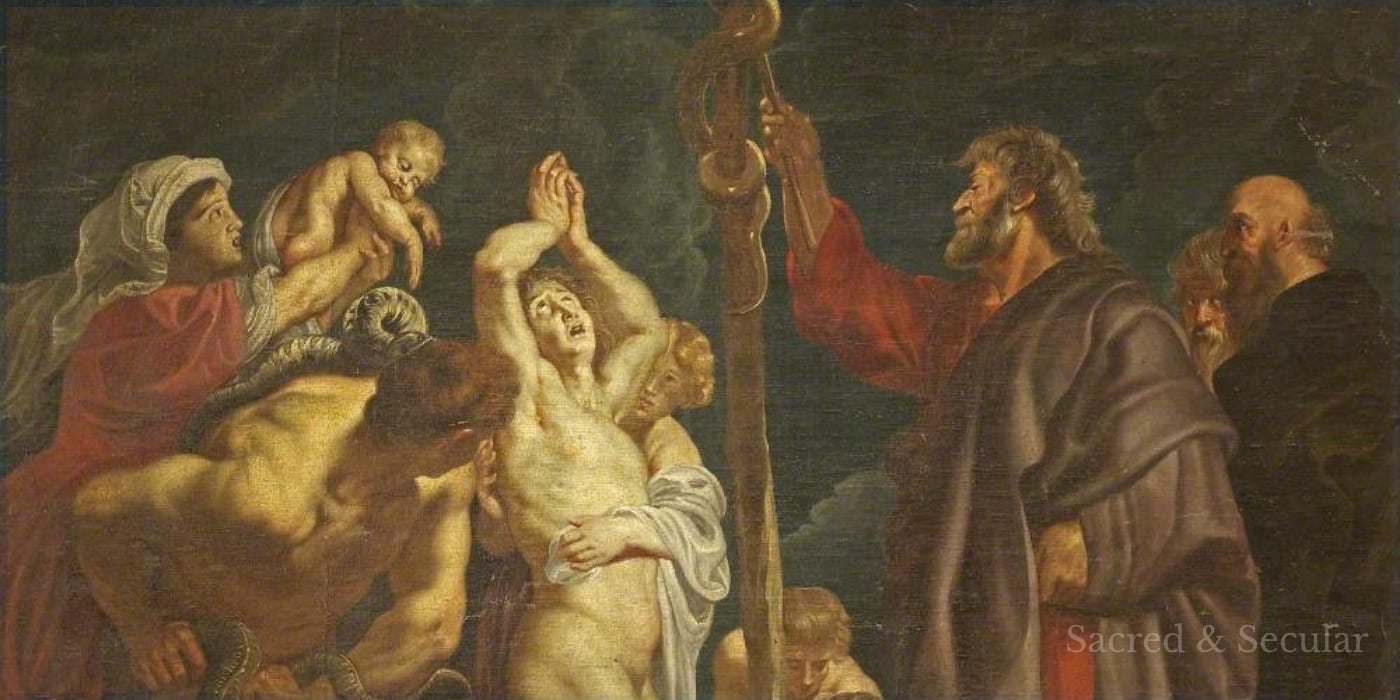
The story of the bronze serpent in Numbers 21 is one of them. Israel is travelling through the wilderness, the people become impatient and begin complaining against God and Moses, and the text tells us that God sends venomous snakes among them. People are bitten, and some die. Eventually, the people recognise what they have done and ask Moses to pray for them.
You might expect the next part of the story to be fairly straightforward.
The people repent. Moses prays. God removes the snakes, and that would be the end of this story.
Except that he doesn’t.
God tells Moses:
“Make a fiery serpent and put it up on a pole; anyone who is bitten can look at it and live.”
So Moses makes a bronze serpent and raises it where the people can see it. When someone is bitten, they look towards it and live.
The more I think about it, the more it seems like an extraordinarily strange solution that raises more questions than it answers.
But perhaps the strangest part is that the snakes are apparently still there.
