


Welcome to Sunday’s article for all subscribers.
Today I reflect on Bible Sunday and why the Bible has given me something far more valuable than the answers I once sought.
You may also be interested in my book, Sacred & Secular: Find God in the Ordinary, which brings together some of the most popular and thought-provoking reflections from this journey so far. Amazon UK or USA.
In the Church of England, today is designated as Bible Sunday, which seems as good a day as any to admit something. After decades of reading, studying, preaching from, and writing about the Bible, I still find parts of it absolutely strange.
There are passages I do not understand, stories I wish were not there, and verses that appear to sit awkwardly beside other verses. There are also things I once felt completely certain about that I now see very differently, and other questions where years of study have left me with considerably more possibilities than I had when I started. You might think that would make me less interested in the Bible, but the opposite has happened.
The more complicated it has become, the more fascinated I have become by it. Not because I enjoy making faith unnecessarily difficult, but because, somewhere along the way, I realised I had approached the Bible with an assumption I had never really questioned.
❦
A fresh-faced 20-something Paul viewed the Bible as a book of answers.
For a long time, that seemed entirely reasonable. If I had a question about God, suffering, morality, prayer or how life was supposed to work, surely Scripture would provide me with an answer. All I needed to do was to find the right passage, understand it properly and eventually everything would fit together. It worked for a while as well; it's surprising what you can turn into an answer by cherry-picking the odd verse or two.
That all ended when I met Job.
Obviously, I had encountered Job before. I knew the basic story: a good man loses almost everything, suffers terribly, argues with his friends and eventually encounters God. Somewhere in my mind I had filed it under biblical explanations for suffering. Then I started reading it more carefully and discovered that it does almost the exact opposite.
Job’s friends are the people with the answers. They understand how the world works, so they sit down and explain to Job the logic of what he is going through. Which, to be fair, is kind of unhelpful when you are suffering. They lay it out for him. God is just; therefore, good people are rewarded, and bad people suffer. Job is suffering; therefore, Job must have done something to deserve it. The reasoning is nice, logical and religious.
There is just one large problem with it: it is wrong.
Job refuses to accept their explanation. He knows his own life, and their theology does not fit his experience. So he protests, complains and demands answers from God. At one point, he even curses the day he was born. I remember being surprised that the Bible allowed him to speak like that. More surprising, though, is what happens at the end.
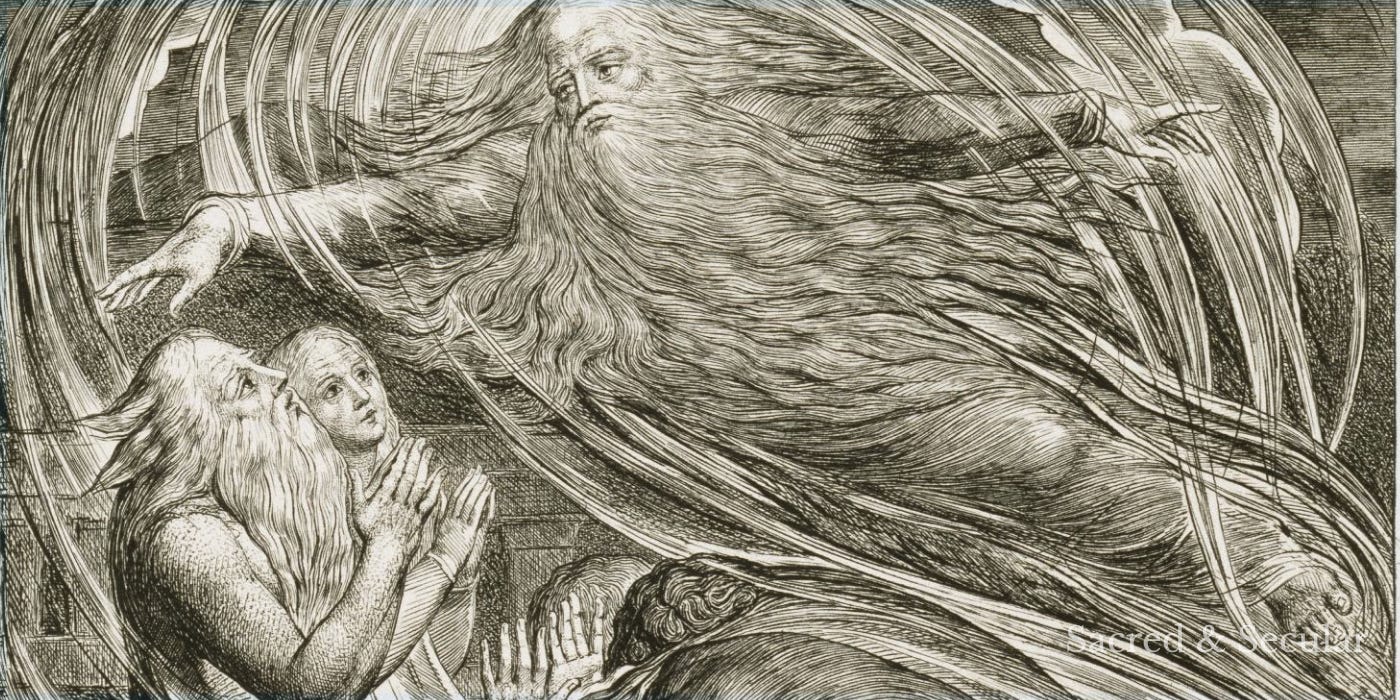
God finally speaks, but he never gives Job the explanation I expected. There is no neat disclosure of why everything happened or a heavenly diagram showing how suffering works. Instead, God takes Job on what feels like a bewildering whirlwind tour of creation.
Where were you when the foundations of the earth were laid? Have you travelled to the sources of the sea? Can you control the stars? Do you understand the wild creatures, the weather, the enormous and untameable world around you?
Job had asked a perfectly reasonable question: So why did God feel the need to shut him down in this way?
It was only later I realised that God’s answer was actually deeply fascinating.
❦
The friends imagined that reality could be reduced to a simple formula. Behave well, and good things happen. Behave badly, and suffering follows. They had constructed a world they could understand and then tried to force Job’s experience inside it.
Instead, God blows apart that thinking.
Reality is so much bigger than their formula. Creation is wilder, stranger and more complicated than any of them understand. And then comes perhaps the most uncomfortable part of all: God rebukes Job’s friends for what they have said about him. The people who spent chapter after chapter defending God are told that they have spoken wrongly.
I think that was the point that I realised that faith was not about reaching the point where I had an explanation for everything. Perhaps sometimes the faithful response was actually admitting that I didn’t.
❦
Once I noticed that in Job, I began seeing it elsewhere. There are prayers in the Psalms that ask God why he seems absent, and Psalm 88 goes further than most. I wrote about it recently because, unlike many lament psalms, it never turns towards reassurance. It simply ends in darkness.
That matters to me. Somebody decided that this unresolved prayer belonged among the prayers of God’s people. It reminds me that faith does not always need to manufacture an answer simply because silence makes us uncomfortable. Sometimes “I don’t understand” can still be a prayer.
Sometimes the Bible does something even stranger. In Proverbs 26, two consecutive verses give apparently opposite advice.
Do not answer a fool according to his folly.
Then immediately:
Answer a fool according to his folly.
I love that, not because contradiction is somehow clever, but because life really is like that. Sometimes responding to foolishness simply drags us into it, but sometimes remaining silent allows it to go unchallenged. Wisdom is not memorising the correct rule and applying it mechanically. Real wisdom is learning to recognise which moment you are standing in.
Perhaps I once wanted the Bible to be an instruction manual. Increasingly, I think it is trying to form people who can discern, and those are not the same thing.
❦
I went looking for answers and instead found better questions. I wanted certainty and discovered mystery. I wanted rules that would tell me precisely what to do, and I found stories that forced me to think more carefully about people, circumstances, and consequences. What surprises me now is how far that way of thinking has extended beyond the way I read the Bible.
I am less troubled than I once was by saying “I don’t know” and much more suspicious of explanations that fit everything together like a jigsaw. I am always more willing to listen when somebody’s experience does not fit the assumptions I have carried with me, without jumping in to correct them. As a result, I have changed my mind about a lot of things and continue to do so.
There was once a time when I probably regarded changing my mind as evidence that I had not understood something properly the first time. These days, I increasingly see it as evidence that I am still learning, still growing and still being formed.
That feels far more liberating.
❦
None of this means I think the Bible can mean whatever we want it to mean. I think it is the opposite; part of taking Scripture seriously is allowing it to resist us.
Sometimes it confirms what I already believe. Sometimes it really challenges me, and occasionally it annoyingly refuses to answer the question I brought to it at all, and that may be one reason I keep reading.
A book that simply repeated everything I already believed would eventually become a bit boring, and the Bible has never given me that problem. Even now I can read a passage I have known for decades and suddenly notice something I had somehow missed. A question appears where I thought there was an answer. A character I had dismissed becomes interesting. A verse I had confidently quoted turns out to sit within a conversation much more complicated than I remembered.
Perhaps that is what I reflect on the most when Bible Sunday comes around.
We have inherited this extraordinary library of stories, arguments, prayers, poems, laws, letters, protests, hopes and unresolved questions through which generations of people have wrestled with God and with what it means to be human.
I began reading it because I wanted answers. I keep reading because it has given me something deeper. It has changed the way I think, and continues to do so. It has made me more comfortable with uncertainty, more curious about what I may have missed and more willing to admit that the world, other people and God himself may be considerably bigger than the explanations I have constructed for them.
The Bible is strange, difficult and sometimes uncomfortable. After all these years, I still cannot imagine being finished with it.
Question to ponder:
Has there been a passage of Scripture that did not answer your question, but changed the way you thought about the question instead?
Thank you for being part of Sacred & Secular. Whether you have been reading for a long time or have only recently joined us, I am genuinely grateful that you choose to spend a little of your time here.
I publish a new reflection every day. Sunday reflections are open to everyone, while the daily weekday reflections are available to paid subscribers, whose support makes it possible for me to keep writing and developing Sacred & Secular.
If you are already a paid subscriber, thank you. Your support means a great deal to me. And if you are reading on the free tier and would like to receive the daily reflections as well, you are very welcome to join us.