


Welcome to Sunday’s reflection.
Some gospel stories are unsettling not because they are unclear, but because they are too clear.
This one refuses to stay safely in the past. It confronts fear, evil, and restoration head-on, and then turns the question back towards us. As you read, you might notice it isn’t really about demons, pigs, or even a man living among tombs.
It’s about who we think is beyond hope… and what happens when love disagrees.
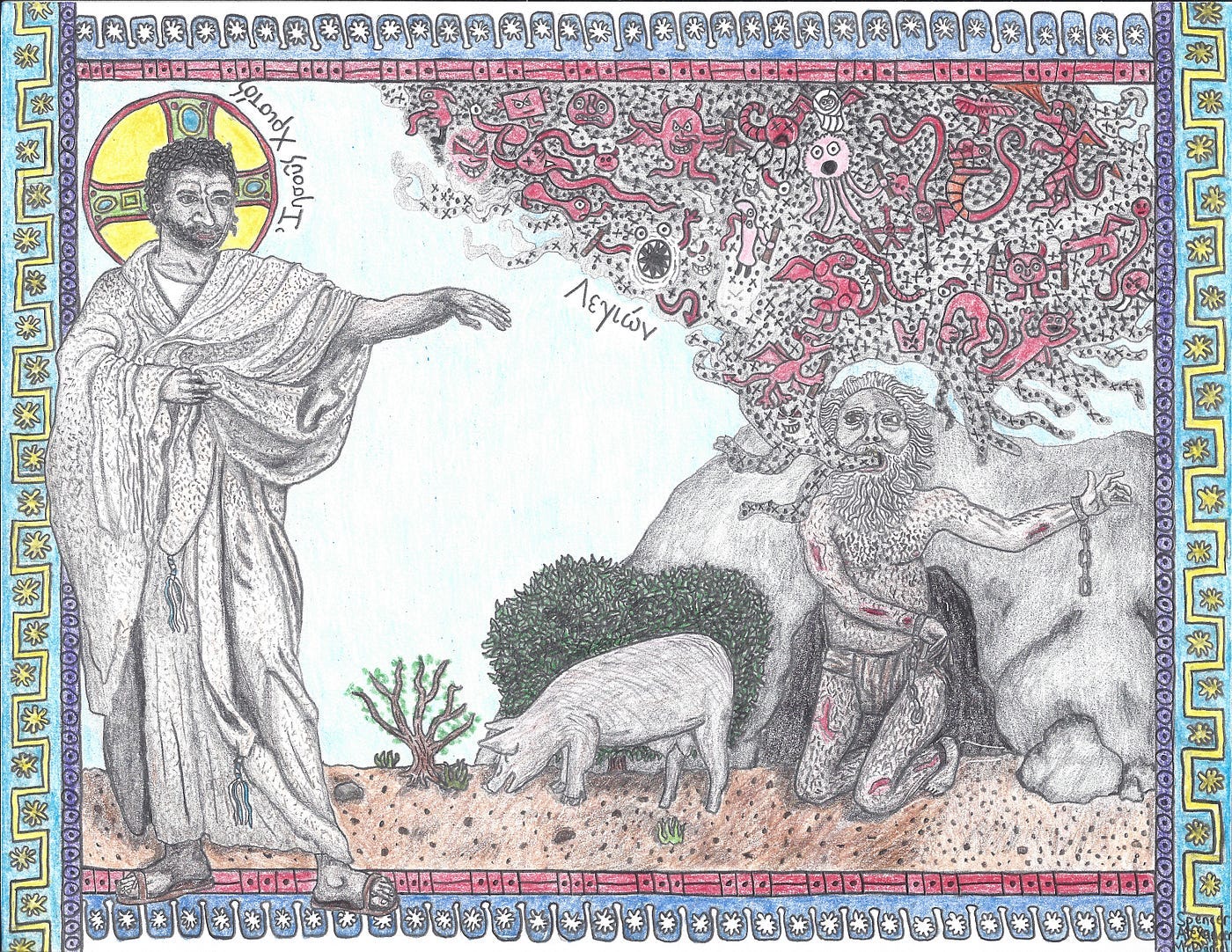
In the gospels, we meet a man who is demon-possessed, naked, living among tombs, and often chained because no one can control him.
He screams at Jesus, recognising Him instantly as “Son of the Most High God.” The demons inside him, terrified, beg Jesus not to cast them out. When Jesus asks for a name, the reply is chilling: “Legion”, a word usually describing thousands of soldiers.
Jesus drives the demons into a herd of pigs, which immediately stampede into a lake and drown. The man, restored to his right mind, begs to follow Jesus. Instead, Jesus sends him home to tell others what God has done for him.
It’s an unforgettable story and one that leaves us with more questions than answers.
It’s Not About the Pigs
Yes, the pigs drown, and that troubles modern readers. But this story isn’t about animal cruelty. For the people hearing it first, pigs were already considered unclean. To get the point, swap pigs for something we wouldn’t feel sentimental about, perhaps rats, pigeons or cockroaches.
The real shock isn’t the livestock, it’s the power on display here.
The power of Jesus’ name.
The power to confront evil.
The power to restore someone who has been completely written off.
Evil Is More Than an Idea
Talking about “demons” can sound strange to modern ears. Was this man just mentally ill? Some think so. But the Bible refers to evil as more than a diagnosis.
The “devil” in Scripture isn’t a cartoon figure with horns and a pitchfork; it’s the reality of destructive evil in the world. Evil that shatters lives. Evil that can be passed through families. Evil that robs people of their identity. We know this evil today.
That’s what had happened to this man in an extreme form. His humanity was gone. He no longer even gave his own name, only “Legion.”
Jesus gives him that humanity back. Restores his dignity and sends him to tell his story.
Who Do We Cross the Road to Avoid?
We may not see many naked, raving people living in graveyards, but we do see people we’d rather not engage with.
Who are the people you cross the street to avoid?
Who makes you lower your eyes in the supermarket?
It could be the person sitting on the pavement, clutching a bottle, asking for change. It could be the neighbour whose life seems endlessly chaotic.
Our instinct might be to offer a token kindness and move on. But real restoration takes something deeper, entering into someone’s brokenness and walking with them towards wholeness.
The Challenge of the Story
The man wasn’t physically invited to follow Jesus. He was sent back into his own community, to the people who knew his past, to show them what transformation looks like.
That’s uncomfortable for us. It means the story isn’t just about a man in the first century; it’s about us.
We all have our own “Legions”, people whose names and dignity have been buried under layers of pain, trauma, and mistakes. The challenge is whether we will avoid them, pity them from a safe distance, or step into their world to help restore what’s been lost.
Why It Still Matters
The story of Legion forces us to face two uncomfortable truths:
1. Evil is real and still at work in the world.
2. Restoration is possible for anyone, no matter how far gone they seem.
It’s not an easy calling. But if transformation happened to the most feared man in the region, it can happen anywhere. And sometimes, the person most likely to bring hope is the one who has lived through the darkest places themselves.
This story does not ask us to neatly explain evil or solve suffering from a distance. It asks something quieter and far more demanding.
To notice.
To name people properly.
To believe that no one is finally reducible to their worst chapter.
Restoration rarely looks dramatic from the outside. Often it begins with being seen, with dignity returned, with a story retold in a different key. Sometimes, the most powerful witnesses are not those who escaped the darkness untouched, but those who learned to walk out of it, step by step.
That is an uncomfortable hope. But it is hope all the same.
Thank you for reading today’s reflection.