


Today’s reflection is about a story many of us think we understand… and a detail that changes everything.
There was a moment, not that long ago, when I decided to take my writing more seriously.
Not just the occasional article or scattered idea, but a genuine attempt to build something. To show up consistently, put my words into the world and see what might happen.
At first, I was very humbled and surprised that it worked.
There was a sense of momentum. A few articles landed well. People started reading, responding, and even subscribing. It felt, quietly but unmistakably, like something might be taking shape.
And then, just as quickly, the self-doubt crept in.
The numbers slowed. The ideas didn’t come as easily. I started second-guessing sentences I would have once trusted. That familiar internal voice showed up, asking who I thought I was to even try this in the first place.
Nothing dramatic had changed on the surface.
But internally, everything felt less certain.
It turns out, I’ve been here before. Just not in the way I expected.
Because there’s a story most of us know well that follows a very similar pattern. And there’s a detail in it that quietly changes everything.
— • —
The Story We Think We Know
The scene is vivid.
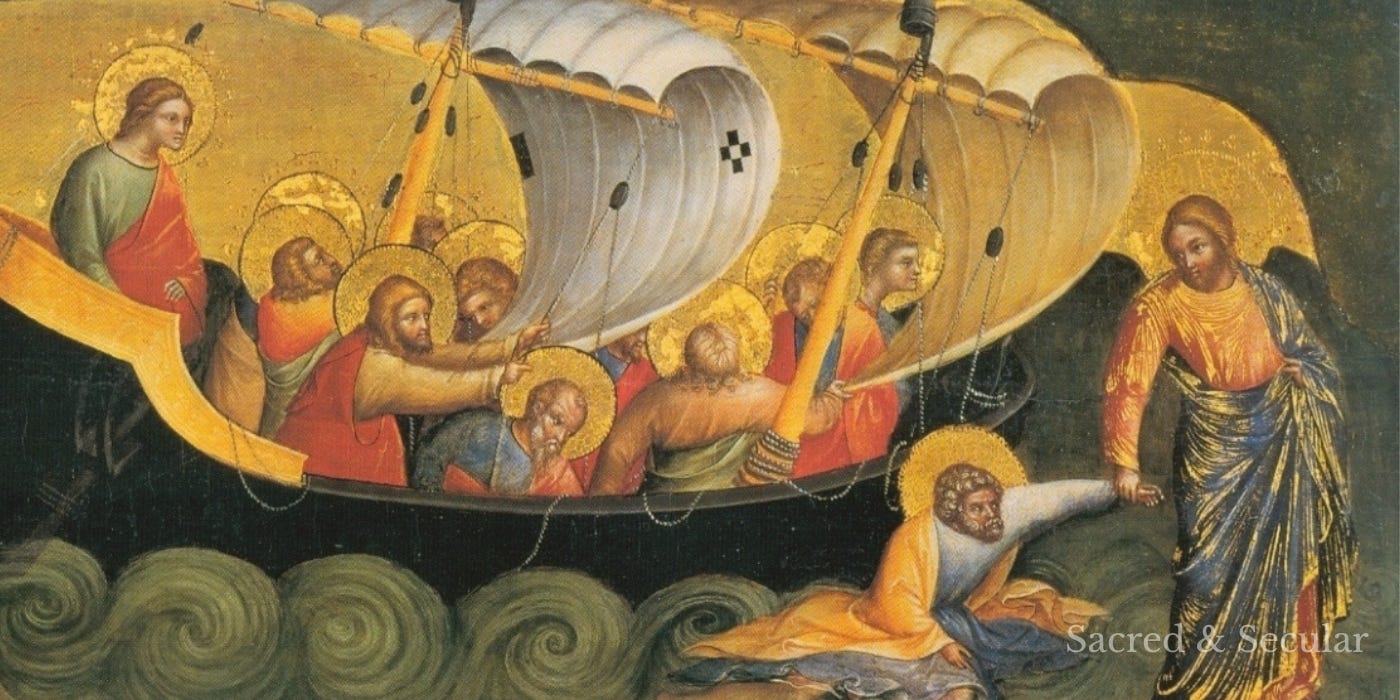
The disciples are out on the lake at night, battling wind and waves in a boat that suddenly feels far too small for the conditions. They are tired, strained, and more than a little afraid. Then, through the darkness, they see something impossible.
A figure walking towards them on the water.
Their first instinct is panic. They assume it must be a ghost. But then the voice comes:
“Take courage. It is I. Don’t be afraid.”
And then Peter, in a moment that feels both impulsive and strangely profound, responds:
“Lord, if it’s you, tell me to come to you on the water.”
Jesus replies with a single word.
“Come.”
Peter climbs out of the boat and begins to walk towards him.
Then comes the part we remember. He notices the wind. Fear takes hold. He begins to sink.
Jesus reaches out, catches him, and says:
“You of little faith, why did you doubt?”
That’s usually where we land. Peter failed. Jesus saves. Lesson complete.
Except that isn’t the whole story.
— • —
The Detail We Miss
We tend to read this story as a failure. A cautionary tale about what happens when faith falters. But there’s a problem with that reading. We’ve already decided how the story ends.
Peter walks on water.
It’s easy to rush past that, because we know what happens next. But slow it down for a moment.
He actually steps out of the boat and stands on something that should not hold him. He takes steps across a surface that should give way beneath him.
The miracle works.
In the Hebrew imagination, the sea often represents chaos, danger, and forces beyond human control. It is something only God commands. So when Jesus walks on water, he is not just performing a miracle. He is embodying authority over chaos itself.
Which makes what Peter does all the more remarkable.
He joins him.
Out of twelve disciples, only one leaves the boat. Only one responds to the invitation and experiences what it feels like to stand, however briefly, in a place that should have been impossible.
The others stay where it feels safe.
So the real surprise in this story isn’t that Peter sinks.
It’s that he walks at all.
— • —
When Courage Meets Reality
Peter’s mistake isn’t stepping out. It’s what happens next.
Matthew tells us that when he notices the wind, fear takes hold, and he begins to sink.
His focus changes.
Instead of looking at Jesus, he starts paying attention to everything around him. The waves. The wind. The very real possibility that this should not be happening.
And once that shift happens, everything else follows.
In Scripture, faith is rarely about certainty. It is about trust in response to a call. Peter doesn’t step out because he understands how water works. He steps out because Jesus speaks, and he trusts his voice.
Fear enters when that trust is replaced by calculation. When he starts measuring the situation instead of responding to the call that brought him there.
If we’re honest, this is painfully familiar.
I’ve seen this in my own writing. I can begin something with clarity and energy, only to find the questions creeping in later. Is this sustainable? Is it working? What do other people think? What happens if this falls apart?
Nothing external has necessarily changed.
But internally, the wind has picked up.
And once your attention shifts in that direction, it’s very hard to ignore.
— • —
The Ones Who Stay in the Boat
There’s another part of this story that often goes unspoken.
What about the disciples who never got out?
We rarely criticise them. In many ways, they are the sensible ones. They stay where it feels secure. They don’t take unnecessary risks and avoid the possibility of failure altogether.
But they also never experience what Peter experiences.
They never feel the shock of something impossible holding their weight. They never discover what it might have been like to trust the invitation.
It’s possible to stay safe and still miss something essential.
There is a version of faith, and of life more generally, that never risks anything. That remains contained, careful, and controlled.
But it also never steps into the unknown.
Peter sinks, yes.
But Peter also walks.
And that matters.
— • —
Jesus Reaches Before He Corrects
There’s a small but significant detail in how the story unfolds.
Jesus doesn’t stand back and let Peter struggle. He reaches out immediately and catches him. Only then comes the question of doubt.
Rescue comes before correction.
Grace comes before challenge, which is not how most of us expect things to work.
We often expect it the other way around. We assume that failure will be met with distance, or disappointment, or some kind of silent judgement. But the pattern here is different.
Jesus restores first. He steadies Peter before he speaks to him. The question that follows is not a condemnation as much as an invitation to reflect.
“Why did you doubt?”
Not: “Why did you get out of the boat?”
Not: “Why did you try?”
The issue is not the step itself. It is what happened to Peter’s trust along the way. And even then, he is not left to deal with the consequences alone.
He is held.
If I’m honest, that is the part I find myself coming back to most.
Because the fear of getting it wrong is often what keeps us from stepping out at all. The assumption that if we falter, we will be left there.
This story suggests otherwise.
— • —
Why This Still Matters
Most of us can locate ourselves somewhere in this moment.
Some are still in the boat, sensing that they might need to step out, but hesitating.
Some have already climbed over the side, full of energy and hope.
Some were walking just fine until fear crept in and everything started to wobble.
And some feel like they’re already going under.
The circumstances vary. Work. Health. Relationships. Creativity. Faith itself. But the pattern is often the same.
We begin with a sense of call or possibility. Something draws us forward. For a while, it holds. Then the questions come.
The wind picks up, and we wonder if we’ve made a mistake.
The hidden detail in this story is that Peter didn’t fail immediately.
He succeeded first.
And even when fear overtook him, he wasn’t left to sink.
— • —
The Real Point of the Story
We often treat this passage as a warning about weak faith.
But that feels like an incomplete reading. Perhaps it is better understood as an invitation.
An invitation to step out when we sense the call, even if we don’t fully understand how it will work. An invitation to trust that fear may come, but that it doesn’t have to define the outcome.
The final image is not Peter drowning.
It is Jesus holding him and bringing him back to the boat.
The storm is still there.
But now they face it together.
— • —
So What About Us?
I’m glad I pushed through the doubts and kept writing. I’m still surprised, and grateful, that people choose to read and support this work. But I am sure that doubts will creep in again at some stage.
When it does, I will re-read this story and ask myself the same questions that most of us face when reading this account.
What would it look like to take that step, not perfectly, but honestly?
To trust the call enough to move, even if the outcome feels uncertain?
The story doesn’t promise that we won’t wobble.
It doesn’t suggest that fear will stay silent.
But it does offer something else.
That when we do step out, and when the wind inevitably rises, we won’t be left there.
Sometimes the bravest thing isn’t walking without doubt.
It’s getting out of the boat in the first place… and trusting you won’t be left there.
Thanks for reading Sacred & Secular.
If this reflection stayed with you, consider sharing it or passing it on to someone who might need it today. And if you’re new here, you’re always welcome to join us for more reflections like this.
What a stunning message! Thank you. Perfect timing.
“Me too.” Thank you for reaching out each day.