


Walking has become something I have to think about.
Not in the abstract, but in the small, practical decisions that shape a day. How far is it? Is there somewhere to sit? Do I take the stick, the wheelchair, the scooter, or try without?
Over the past few weeks, I have been quietly pushing back against the idea that I need help. In an ideal world, I would not have anything extra to juggle.
It has not gone well.
— • —
This may be why I have found myself drawn to a particular Gospel story.
It begins, as many stories do, with a crowded room. The house is already full. There is no space left or polite gap at the back, no easy way in. Everyone wants something from Jesus, or at least wants to be close enough to say they were there.
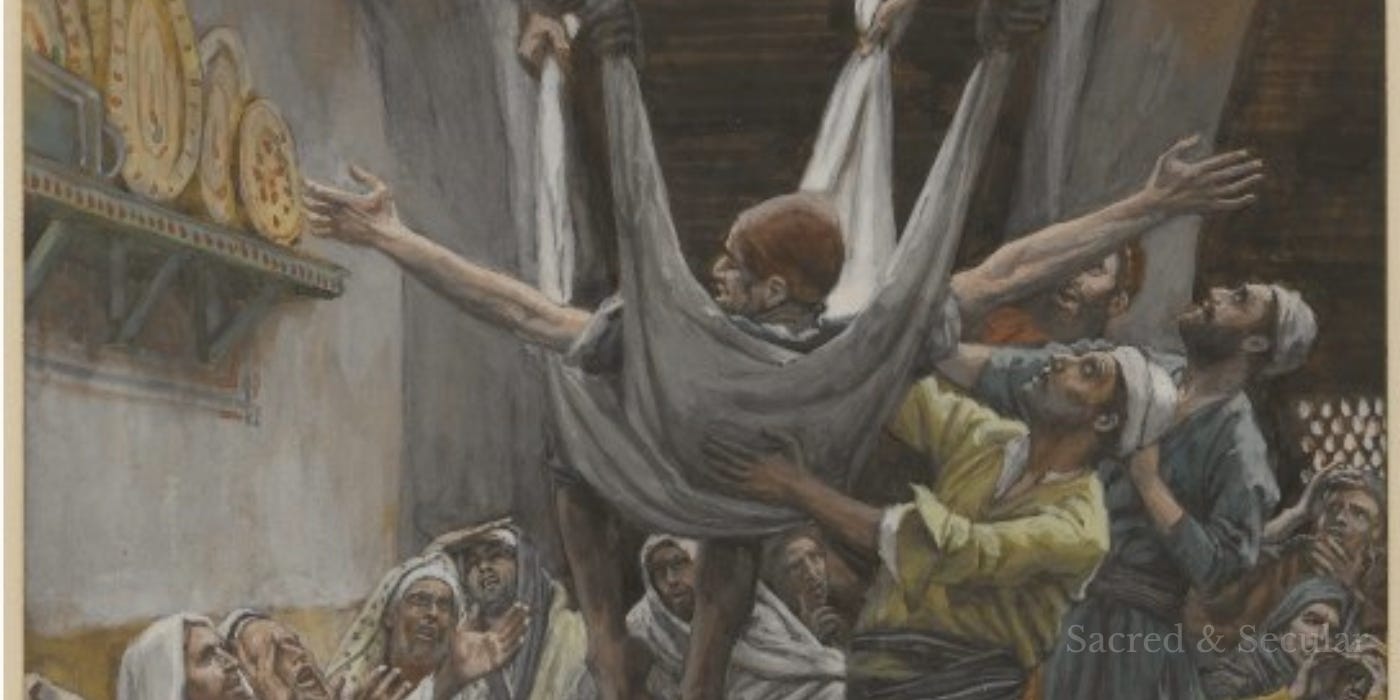
Outside, four men arrive carrying a fifth.
We tend to call him the paralytic, which already tells you something about how easily a person becomes a condition. He is introduced to the story lying down, defined by what he cannot do.
They try the door. It does not open.
They try the crowd. It does not part.
At that point, the story could have ended. Many stories do. The obstacles are real, the limitations obvious. The moment passes.
But not this time.
This time, they climb.
I have often heard this part of the story turned into a motivational lesson. If the door is closed, find another way in. If your faith is strong enough, then nothing can stop you.
But it is worth pausing and imagining the scene properly.
Roofs in first-century Palestine were not symbolic. They were simply practical. You did not dismantle them lightly. This was someone’s home. Someone’s shelter. Tiles are lifted. Dust begins to fall. The people in the room below look up, first confused, then irritated, then indignant. Maybe even a little angry.
Faith, it turns out, is not always tidy or polite.
The man on the mat says nothing. We are not told whether he agrees with the plan or protests it. He does not deliver a speech about hope or perseverance. He is simply carried, hauled, lowered, and placed at the centre of a room he did not choose to enter.
A hush. Then Jesus speaks.
“Son, your sins are forgiven.”
Wait, what? It is not what anyone expects.
This man was not brought there for forgiveness. He was carried because he could not walk. The crowd did not gather for an absolution. They came for healing, for a show, for something visible.
Yet Jesus begins somewhere else.
It is tempting to tidy this up quickly and say that Jesus is addressing the deeper issue. But the story resists that kind of neat explanation. Because Jesus does not dismiss the body. He goes on to heal him. He simply refuses to treat it as the deepest truth about the man.
And the reason he does this is quietly unsettling.
“When Jesus saw their faith…”
Not his.
Their faith.
The man contributes nothing visible to this moment except that he is there and in need. He does not need to prove his belief or articulate trust. No mention of the importance of resilience.
He is present because other people have decided to believe on his behalf.
Faith, it seems, does not always begin inside us.
Sometimes it travels in other people’s arms.
— • —
I used to read that part of the story as background detail.
Now it feels like the centre of it.
Because needing help sounds simple until it becomes very specific.
Until it involves distances, uneven pavements, doorways, and waiting.
Until it confronts you with how deeply you have absorbed the idea that strength means independence.
Mobility aids have changed how I move through the world. They give me freedom, and for that I am genuinely grateful. They allow me to go further, to do more, to participate in precious things I would otherwise miss.
At the same time, they make me visible.
They invite questions I am not always ready to answer, and turn ordinary moments into small negotiations with pride. They announce something about me before I have had the chance to say anything myself.
I can feel grateful and exposed, usually at the same time.
For a while, I tried to push against all of that. I thought that if I just tried harder, planned better, pushed further, I might not need them as much.
What I have learned is that I still depend on them. Probably more than I would like to admit.
And that has been harder to accept than the physical limitation itself.
Reading this story now, I notice something I used to miss.
The man on the mat is not healed because he demonstrates courage. He is not praised for endurance or congratulated for his patience.
He is simply carried.
And Jesus does not shame him for it.
What I am still learning is how difficult it is to be the one who is carried.
