


Welcome back to Sacred & Secular.
These reflections are part of the daily rhythm of this space, slowing down long enough to notice where faith meets ordinary life, often in places we might otherwise overlook.
Thank you for being here, and for making this kind of writing possible.
It was the day after the first lockdown had been lifted during the pandemic.
I remember standing outside a small café, looking in through the window. People were sitting at tables, drinking tea, eating cake, talking as though nothing had happened. It all looked so normal.
But I wasn’t.
The news about Covid had been stark. It was a dangerous virus, and I had not stepped into a public indoor space for a long time. Something as simple as walking through a cafe door suddenly felt like a major decision.
I paused there longer than I needed to, wanting to go in but unsure what might happen if I did.
I took a breath and headed in.
Of course, it was fine.
Nothing dramatic happened. Just a cup of tea, a table, and the slow realisation that the space I had been hesitating over was not closed to me in the way I had imagined.
But that first step is something I have never quite forgotten.
Because sometimes the barrier is not the door itself.
It is what we imagine is waiting on the other side.
— • —
There is a line in the Gospel of John that I have read many times, yet every so often it challenges me in a different way.
Jesus does not say that he will show the way to the gate or lead people towards it. He says something far more direct:
“I am the gate.”
It is the kind of phrase that is easy to read past, but once you reflect on it, the very idea of Jesus being the gate changes.
I suspect many of us instinctively hear the word “gate” in a defensive way.
A gate sounds like something that keeps people out, a boundary or a dividing line where someone stands and decides who belongs and who does not. It is not a long step from there to reading the passage in terms of insiders and outsiders, of those who make it through and those who are turned away.
The problem with that interpretation is that it makes this passage much smaller than it really is.
Because the passage itself pushes in a different direction. Jesus immediately describes those who enter through him as people who “come in and go out and find pasture.” That is not the language of restriction or confinement. It is the language of movement, freedom, and provision.
The gate is not presented as a static boundary but as something dynamic, something that leads somewhere.
In the world Jesus is speaking into, that image would have felt much more concrete.
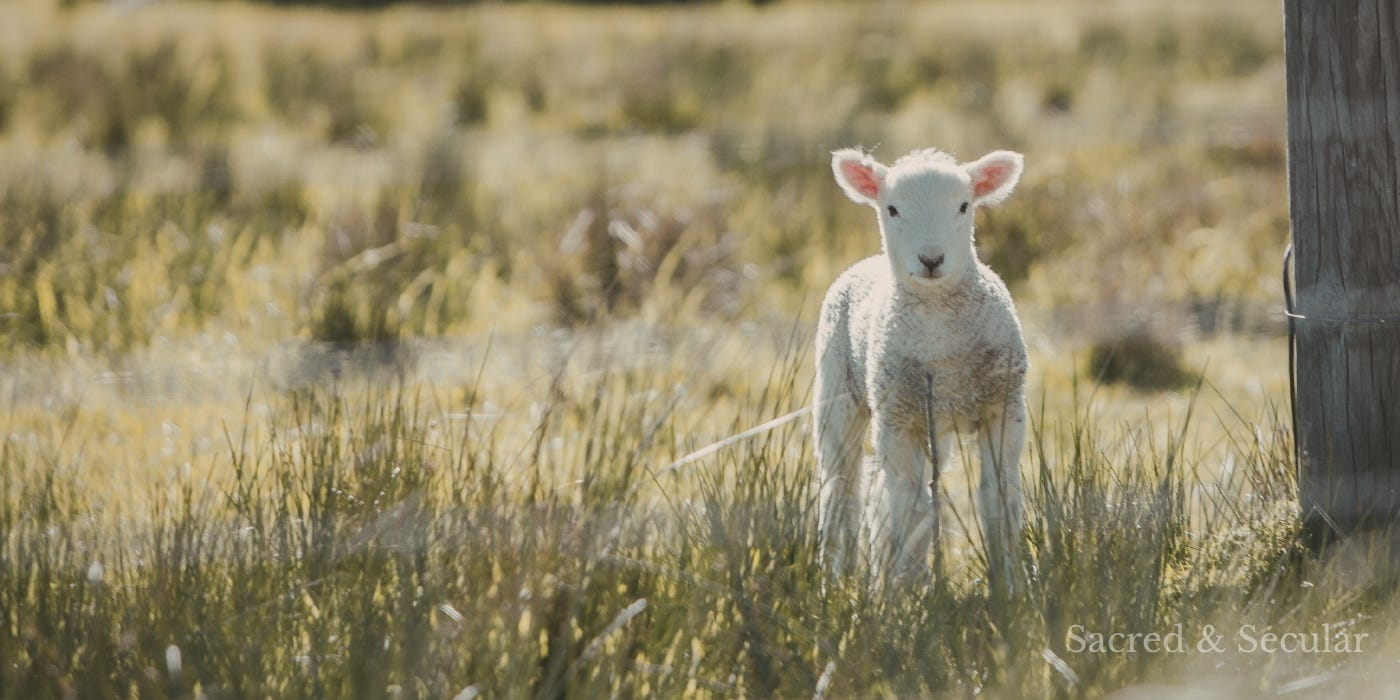
Sheepfolds were often simple enclosures made of stone, open to the sky, with a single narrow opening. In some cases, there was no physical gate at all. The shepherd himself would lie across the entrance at night, quite literally becoming the barrier between the sheep and anything that might harm them.
So when Jesus says, “I am the gate,” he is not pointing to a structure but to himself as the place of both protection and access. The image becomes relational rather than mechanical.
A gate you don’t just pass.
A gate you can trust.
— • —
This also changes how we understand what is happening at that threshold.
It is not a checkpoint where individuals are examined and assessed before being allowed through. Instead, it is a place defined by recognition and trust. The sheep know the shepherd’s voice. They are called by name. They follow not because they are forced, but because they recognise something familiar and life-giving in what they hear.
The movement begins with the shepherd, who calls and leads, and the response flows from that relationship.
At the centre of the passage is a line that holds everything together: “I came that they may have life, and have it abundantly.” That is where the emphasis rests.
The contrast Jesus draws is not primarily between different groups of people, but between what gives life and what diminishes or destroys it. The thief comes to steal, kill, and destroy; the shepherd comes to give life in its fullness.
Not who is in and who is out.
But what gives life… and what takes it away.
— • —
