


Thank you for being a subscriber.
Paid subscribers can continue with the full reflection. If you would like to receive these weekday reflections in full, I would love to welcome you as a paid subscriber.
You may also be interested in my new book, Sacred & Secular: Find God in the Ordinary, which brings together some of the most popular and thought-provoking reflections from this journey so far.
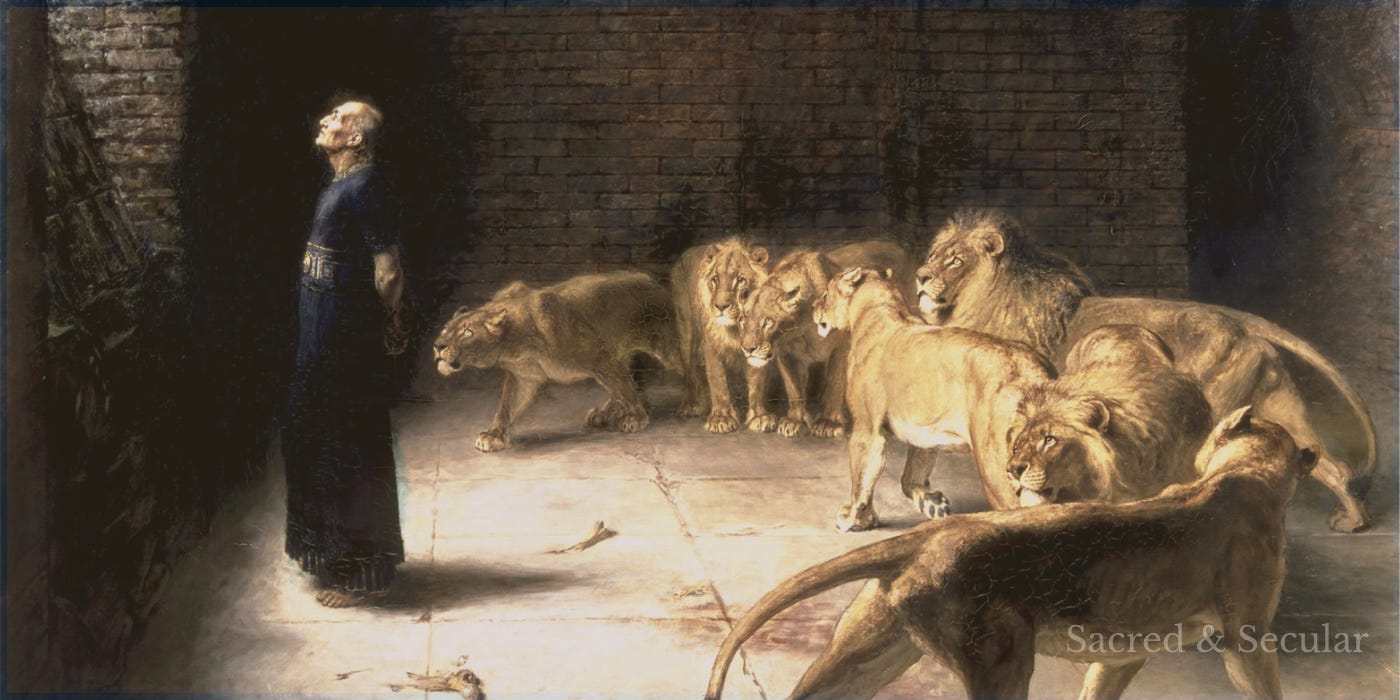
Most of us know what happened when Daniel was thrown into a den of lions.
God protects him through the night, and the king discovers him alive the following morning. It is one of those biblical stories that many of us first encountered as children, usually accompanied by pictures of a remarkably relaxed Daniel surrounded by lions that looked considerably friendlier than I suspect real lions would have been.
But the lions only appear because of something that happens earlier, and it has something to do with an open window.
Daniel has risen to a position of considerable influence within the new regime, and some of the other officials resent him for it. They search for evidence of corruption or negligence that could be used against him and find nothing. Eventually, they realise that the only reliable way to trap Daniel is through his faith.
So they persuade King Darius to issue an extraordinary decree. For thirty days, nobody is permitted to make a petition to any god or human being except the king. Anyone who disobeys will be thrown into a den of lions.
Daniel hears that the decree has been signed, and then he goes home.
The book tells us that he enters an upstairs room where the windows are open towards Jerusalem. Three times a day, he kneels there and prays to God.
That is the open window I had always misunderstood. In my imagination, it was always an act of magnificent defiance.
Daniel discovers that prayer has effectively been outlawed, marches upstairs, throws open the windows where everyone can see him and kneels down anyway. It is almost the biblical equivalent of saying, “Just try and stop me.”
It makes for a wonderful scene, but there is only one problem. The text does not actually say Daniel opened the windows in response to the decree. It says that the room had windows open towards Jerusalem. Then comes the detail that changes everything: Daniel knelt and prayed, “just as he had done before.”
The windows were not suddenly opened because somebody had forbidden him to pray; this was already his habit, and I think that changes the story.
Daniel is not staging a protest or deliberately trying to provoke the authorities by turning his prayer into a public demonstration. Nor does he appear interested in hiding what he is doing.
He simply carries on doing what he has always done.
There is something about that which I find far more challenging than the version I had imagined.
