


Welcome to this Sunday edition of Sacred & Secular.
Each week, I make one reflection freely available to all readers. The rest of the week, paid subscribers receive daily reflections exploring the quiet intersections between faith, doubt, culture, and ordinary life.
If this piece resonates with you, I’d be delighted to have you join us.
Since 2021, when long COVID forced me into early retirement, life has slowed in ways I never expected.
For much of my adult life, I lived with a fairly clear sense of momentum. There were plans to make, projects to complete, and assumptions about what the future would look like. Illness disrupted that certainty. Suddenly, ordinary tasks required more thought and energy than before.
Yet there has been an unexpected gift hidden within that slowing down.
I have begun to notice moments that would previously have passed me by.
A shaft of light across the garden. The quiet companionship of Hank, my Cavalier King Charles Spaniel, sitting beside me as I write. A hymn that seems to say exactly what I needed to hear. A conversation that leaves me with a renewed sense that God is, after all, present.
These moments rarely last long.
The washing up still needs doing. Symptoms return. Questions about the future remain.
But for a few minutes, life feels clearer, and my instinct is always the same.
I want to stay there.
I want to preserve the moment before it fades.
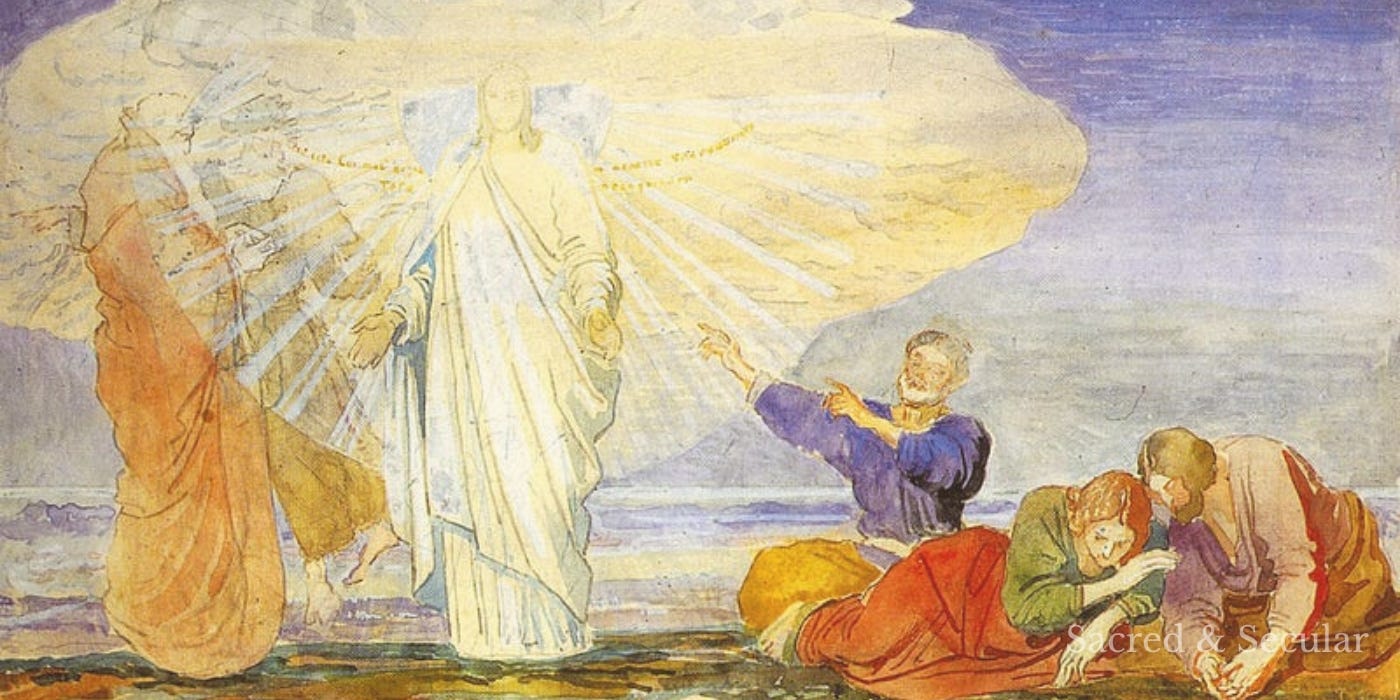
That, I suspect, is something like what Simon Peter felt on the mountain when he saw Jesus transfigured before him in radiant light.
For a brief moment, everything made sense. And his first instinct was profoundly human: to build something that would allow him to remain there.
The story of the Transfiguration of Jesus speaks to that longing in all of us.
The desire to hold on to those rare moments when the world seems more luminous, faith feels more certain, and the presence of God seems unmistakably close.
— • —
The Transfiguration is one of the most visually striking moments in the life of Jesus.
Jesus takes Peter, James, and John up a high mountain. His appearance changes. His face shines. His clothes blaze with light. Moses and Elijah appear beside Him. A cloud descends. A voice speaks from heaven.
It reads like a brief unveiling of divine glory.
Because of that, many readers treat the story primarily as a proof of Jesus’ identity, and it is certainly that.
But if you slow the story down and notice the hidden details woven through it, another meaning begins to emerge.
The mountain is not the point of the story.
In fact, the mountain may be the place the disciples misunderstand the most.
— • —
Overwhelmed by what he is witnessing, Peter blurts out:
“Lord, it is good for us to be here. If you wish, I will put up three shelters—one for you, one for Moses, and one for Elijah.”
It is easy to read this as nervous rambling. But his suggestion reveals something deeper. Peter is trying to preserve the moment. He wants to build structures around glory. To contain what he is experiencing. To make the encounter permanent.
If it were happening today, he might say, “Hold on, let me get my phone. We need to capture this.”
We understand that instinct immediately.
We build programmes around encounters. Institutions around movements. Systems around moments that once felt alive.
We try to live on the mountain.
Peter is not being foolish.
He is being profoundly human.
— • —
Before Peter can finish speaking, a cloud descends.
Throughout Scripture, the cloud signals the manifest presence of God.
And from the cloud comes a voice:
“This is my Son, whom I love; with him I am well pleased. Listen to him.”
Notice the timing. Peter is still speaking when heaven interrupts him. There is something gently corrective in this moment.
Peter wants to build. God calls him to listen.
We want to preserve the experience. God invites us to pay attention to the person.
The interruption is not rejection.
It is redirection.
— • —
Standing beside Jesus are Moses and Elijah.
The Law and the Prophets.
They represent the whole story of Israel, all of it converging on Christ. Then, just as quietly as they appeared, they vanish, and only Jesus remains.
The symbolism is profound.
The Law and the Prophets were never the destination. They were simply signposts. Necessary, sacred, God-given signposts.
But signposts are not the final destination.
The voice from heaven narrows our attention to one person.
Listen to Him.
— • —
The disciples fall to the ground in fear.
Then comes one of the most moving lines in the Gospels:
“Jesus came and touched them.”
No thunder.
No proclamation.
Just touch.
The Father’s voice overwhelms. Jesus’ hand restores. He tells them to rise and not be afraid, and when they look up, they see no one except Jesus.
Just Christ.
— • —
Then comes the final and most important detail.
They go down the mountain, and no shrine is built. No sacred site is established. Jesus leads them back into the valley, toward crowds, suffering, misunderstanding, and ultimately the cross.
This descent is not an afterthought. It is the point.
Mountaintop moments are real. God does give us glimpses of beauty, clarity, and grace. But they are never meant to become permanent dwellings. They are moments of illumination, not places of residence.
The mountain reveals who Christ is.
The valley reveals what it means to follow Him.
— • —
If Peter had succeeded, the story would have frozen in the wrong place.
Glory without suffering.
Light without the cross.
Revelation without redemption.
The disciples needed to see the radiance of Christ. But they also needed to follow Him into the cost of His mission. The Transfiguration was not an escape from what was coming; it was preparation for it.
A strengthening glimpse before the long road ahead.
Because faith cannot live on spectacle alone.
It must learn to walk through the shadow as well.
— • —
We still try to build shelters.
We remember retreats, church services, conversations, or quiet mornings when God seemed unusually near.
When faith felt vivid and prayer felt effortless. When the world briefly made sense.
Of course, we want to stay there, but the story will not let us. Because the deepest work of transformation rarely happens on the mountain.
It happens in the valley.
In ordinary faithfulness.
In unanswered questions.
In costly obedience.
The mountain reveals glory.
The valley reveals discipleship.
— • —
When all these hidden details are held together, the Transfiguration becomes more than a supernatural display. It becomes a pattern for the Christian life.
We are given moments of clarity. We glimpse something of God’s beauty, and we want to stay there.
But Jesus leads us on.
Back into ordinary life.
Back into uncertainty.
Back into the places where faith is not merely felt, but lived.
The same Jesus who shines in uncreated light is the One who walks dusty roads, touches fearful disciples, and leads them patiently down the mountain.
Where faith is lived.
Where suffering is met.
Where redemption unfolds.
And where glory, though less visible, is no less real.
Thank you for reading Sacred & Secular.
I write daily reflections on faith, doubt, and the hidden grace of ordinary life.
If this piece resonated with you, consider subscribing to receive future reflections in your inbox. And if someone came to mind as you read, feel free to share this post with them.
It is not clear from your reference to COVID if you are suffering from "long COVID." If that is the case, I will write and post about chronic fatigue syndrome, fibromyalgia, and myalgic encephalitis, which is what the medical profession variously called the consequences of "Asian flu" in the late 1980s. A correspondent in New Zealand pointed out to me that an expert in the university there identifies those syndromes as the same malady as long-COVID.
Your insights about those "mountain top experiences" are deeply true. The amazing moments of God's closeness shine in memory, keeping us steadfast in the right path. God is certainly blessing us through you on the unexpected turn in your journey.
In a bit I will drive up a NW CT mountain to the Chapel where we gather each Sunday. I always find it hard to pull away and drive back down to the valley where we live. Today I understand why. Thank you.