


I’ve found myself noticing something this week that I’ve probably overlooked for years.
There are people whose faith rarely draws attention.
They are not the ones speaking at the front or shaping the direction of things in obvious ways.
Yet, quietly and consistently, they hold more together than we often realise.
This reflection is about that kind of faith.
When we picture the early church, we tend to think in highlights. We imagine apostles preaching in public squares, debates unfolding in synagogues, crowds responding, and authorities pushing back.
It is a story filled with movement, courage, and risk, and rightly so. Without those willing to speak publicly about Jesus in dangerous contexts, the Christian story would not have travelled far.
Yet the book of Acts repeatedly refuses to stay at that level alone. Just when the narrative seems to gather momentum, Luke slows it down. He draws our attention away from large-scale conversions and dramatic preaching, and into something far more ordinary.
He takes us into a house. A private space marked not by dramatic proclamation and power, but by care and grief.
He takes us to a person who quietly goes about work that contributes to one of the most astonishing movements in human history.
— • —
When the Story Slows Down
Peter, one of the central figures of the early church, is summoned to Lydda, around ten miles away. There is no crowd waiting for him and no platform prepared. Instead, he is brought into the home of a woman called Dorcas (also called Tabitha), who has died.
Dorcas is not an apostle, nor a preacher, nor a recognised leader. She does not appear to have held any public role at all. In fact, she would barely register in the wider story if it were not for Peter’s involvement at this precise moment, and yet Luke pauses the narrative to tell us about her life. That pause alone signals that something important is happening here.
— • —
A Life Woven with Faith
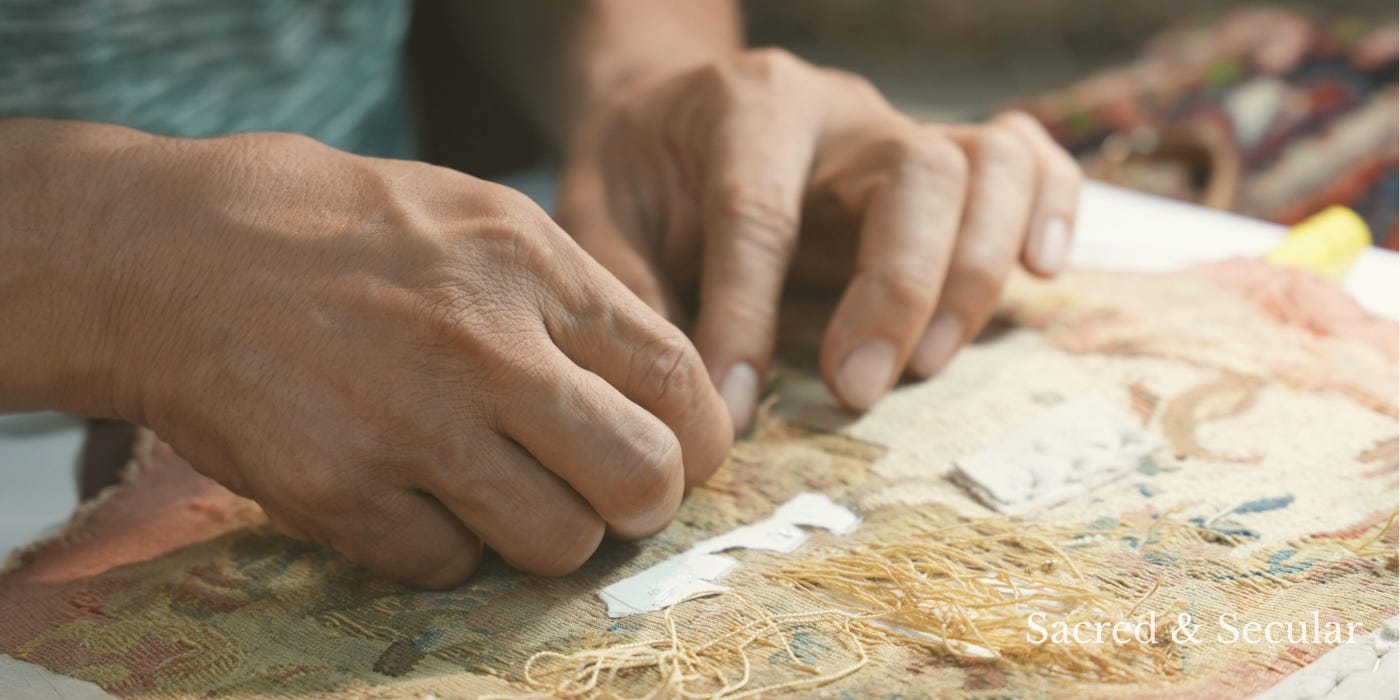
Luke tells us that Dorcas was devoted to good works and acts of charity. Then he draws our attention to something very specific: the clothes she made, the garments she stitched and repaired. Luke is not offering sentimental detail or filler. He is showing us what faith looked like in this home. It was patient, skilled, and practical. Faith expressed through hands that worked quietly for the sake of others.
The room is filled with widows, and again Luke chooses his words carefully. Widows were becoming an important part of the life of the early church. Many carried deep grief, having lost not only a spouse but security, stability, and status. These were people who knew vulnerability at a profound level. Yet, here they are together, holding up the clothes Dorcas had made for them, pointing not to abstract kindness but to tangible love they could still touch.
This, Luke seems to suggest, is church.
There’s a part of this that feels closer to the surface than I usually write about.
