


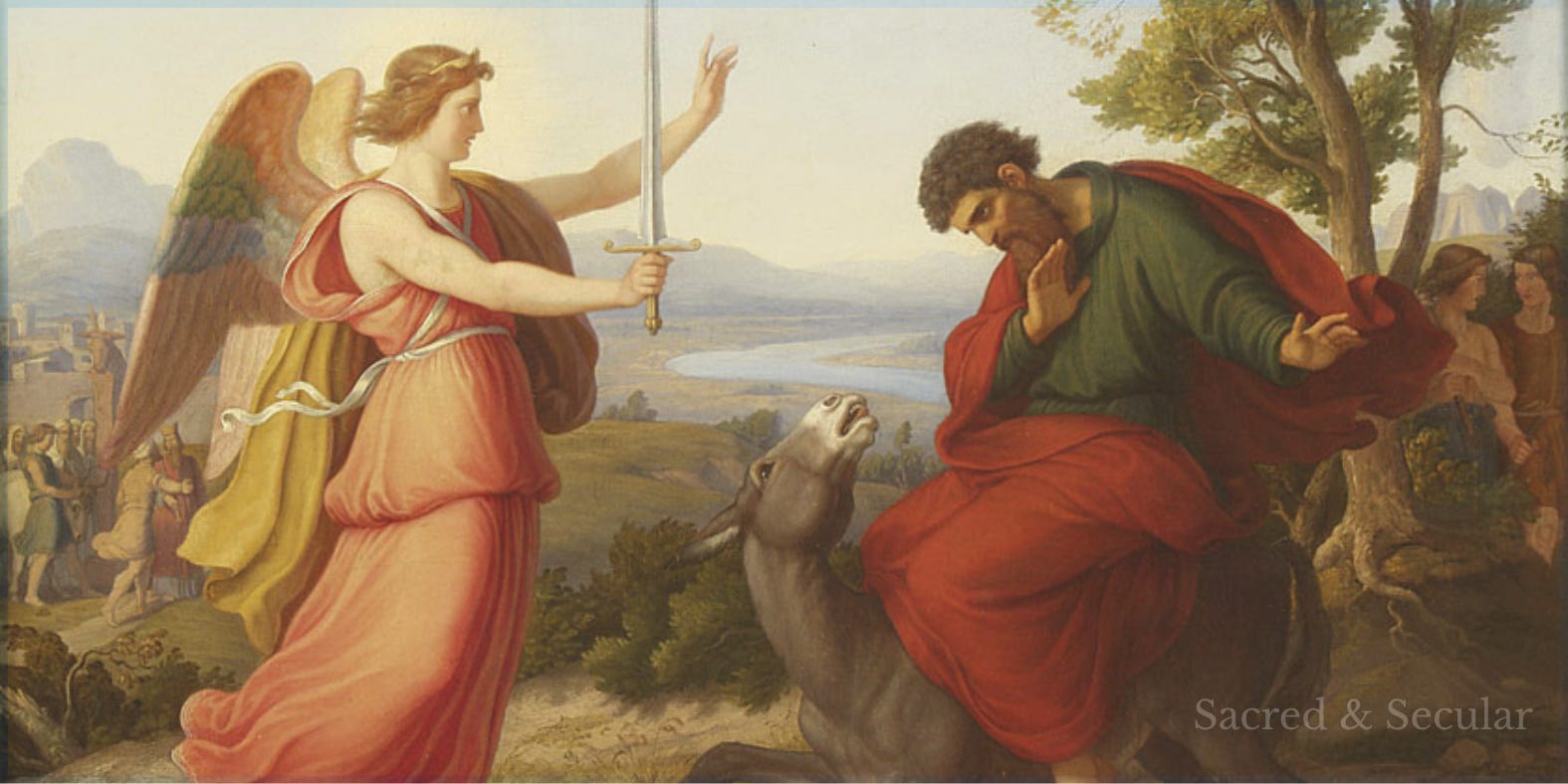
Welcome to Sunday’s reflection.
Today I reflect on an embarrassing chapter of my life, along with a talking donkey!
Articles are available to all subscribers every Sunday. If you would like to receive daily articles, please consider becoming a paid subscriber. These reflections are designed to form a short part of your day, preferably with a cup of tea.
One summer morning in 2017, I woke up utterly convinced that God wanted me to become a football referee.
Looking back, this was a terrible idea.
This might sound surprising coming from someone who enjoys football. The problem was that I was a slightly unfit, overweight parish priest with little spare time. I had no refereeing experience and no particular desire to spend my weekends being shouted at by players, coaches, and spectators.
Rachel, my wife, was supportive but unconvinced.
She gently pointed out that referees receive a remarkable amount of abuse and that my weekends were already rather busy. It was sensible advice. Unfortunately, I was so convinced of my newfound calling that I paid little attention.
I signed up with the local FA and attended the training course. When I arrived on the first day, I found myself surrounded by fit, young adults in shiny tracksuits who seemed slightly puzzled by the appearance of a middle-aged vicar in joggers among their ranks.
Somehow, I passed.
A few weeks later, I took charge of my first match.
It did not go well.
I missed obvious fouls. Players became increasingly frustrated. Tempers rose throughout the game. By the time a large fight broke out shortly before half-time, Rachel had already gathered up the children and wisely retreated to safety.
At the end of the match, the coach walked over.
“Thanks for the effort,” he said, “but you are the worst referee we have ever had.”
My refereeing career lasted precisely one match.
— • —
What I remember the most is not the embarrassment, although there was plenty of that. It is the memory of how completely convinced I was that this was something I should be doing, while Rachel remained unconvinced and, as it turned out, entirely correct.
Over the years, that experience has helped me understand one of the strangest stories in the Bible.
The one with the talking donkey.
For a long time, I skimmed past it; perhaps you do, too.
Some passages of Scripture feel immediately relatable. Others require a little work. Then there are stories like this one, where a donkey suddenly starts talking as though this sort of thing happens every day.
It feels odd. Slightly awkward. The kind of passage that many of us file away under “Bible things I would rather not have to explain.”
For years, I assumed the talking donkey was the strangest part of the story. Then I read it more carefully, and now I am convinced it is not.
— • —
The story appears in the book of Numbers. Balaam is a prophet of sorts, known throughout the region as someone whose blessings and curses carry spiritual weight.
When kings want divine assistance, Balaam is the man they call.
A neighbouring king wants to curse Israel and sends messengers to hire him.
Eventually, Balaam sets off on the journey.
Everything appears straightforward. He has a destination, a purpose, and a clear sense of where he is going.
Then his donkey stops.
There is no visible obstacle in the road. Nothing appears to be wrong. Yet the animal refuses to continue. Balaam becomes frustrated and forces it onwards. A little later, the donkey swerves into a wall. Again, Balaam becomes angry. Then the donkey lies down altogether.
By now, Balaam is furious.
From his perspective, he is dealing with an uncooperative animal that is preventing him from doing something important. The donkey is an obstacle to be overcome.
What Balaam cannot see is an angel standing directly in front of him, a drawn sword in hand. The donkey sees the angel, but Balaam does not.
Three times, the donkey reacts to a reality that remains completely invisible to its owner. Three times it attempts to stop him from continuing along a path that appears perfectly sensible to him.
Then comes the moment everybody remembers.
The donkey speaks.
“Why are you beating me?”
What makes the scene even stranger is that Balaam answers. There is no indication that he is shocked or surprised. He does not stop to question why a donkey is suddenly engaging him in conversation. He simply argues back. The story moves on as though this is entirely normal.
For years, that was the detail that captured my attention. Now, it barely seems like the main point. Because when you step back, something far more challenging is happening.
The prophet is blind.
The donkey sees clearly.
— • —
Balaam is supposed to be the spiritual expert. He is the one who discerns divine things. He is the one people consult for insight and wisdom.
Yet in this moment, he cannot see what is directly in front of him, while the animal can.
That reversal feels intentional.
The story invites us to laugh at Balaam for a moment before gently turning the mirror towards us. Because most of us assume we would have seen the angel, or imagine that if God were trying to get our attention, we would notice.
The trouble is that Balaam probably thought exactly the same thing.
His problem is not ignorance; it is certainty.
He is so convinced he is heading in the right direction that every interruption appears to be a nuisance rather than a message. Every delay feels like something to overcome rather than something to pay attention to.
The more certain he becomes, the less able he is to recognise that something might be wrong.
That is what makes the story uncomfortable.
Certainty often feels like clarity.
But sometimes it is actually a blind spot.
— • —
Looking back, that was certainly true of my refereeing adventure. I had decided what I was meant to do.
Once I had reached that conclusion, every warning sign became easy to dismiss. Rachel’s concerns felt like obstacles. The differences between the young trainees and me seemed irrelevant. The fact that I had no real experience did not trouble me nearly as much as it should have done.
I interpreted every hesitation as resistance and never considered that those hesitations might be trying to actually tell me something.
Thankfully, the consequences were limited to one disastrous football match and a bruised ego.
Life is not always so forgiving.
Many of us can look back and identify moments when we pushed ahead despite warning signs. We ignored the advice. We dismissed concerns. We convinced ourselves that we knew best.
At the time, the interruptions seemed irritating. Only later did we realise they might have been protecting us.
That is partly why I find the Balaam story so fascinating.
It offers a different way of thinking about guidance. We often speak as though the challenge of faith is that God is silent. We wonder why direction seems difficult to find and wish things were clearer. Sometimes that is true.
Yet, this story raises another possibility.
What if the issue is not that nothing is being said?
What if the issue is that we have already decided what we expect to hear?
— • —
Balaam is not lacking guidance. In a sense, he is surrounded by it. His journey is interrupted repeatedly. His path is blocked, and events are conspiring to slow him down.
Yet he interprets every one of those moments as an inconvenience. The problem is not the absence of direction; it is his inability to recognise it.
I suspect many of us know that feeling.
The conversation we did not want to have.
The opportunity that unexpectedly disappeared.
The plan that stubbornly refused to work.
The nagging feeling that something was not quite right.
We often assume that meaningful guidance arrives dramatically, accompanied by certainty and confidence. The Balaam story suggests otherwise.
Sometimes guidance arrives disguised as frustration.
Sometimes it looks like a delay.
Sometimes it sounds remarkably like the voice we least expected to hear.
And perhaps that is why the donkey matters. It represents the overlooked things we are tempted to dismiss.
None of those things fit our expectations of how wisdom should appear. Yet they may be the very places where insight is waiting.
Eventually, Balaam's eyes are opened, and only then does he see what has been there all along. The danger was never hidden from him; he simply lacked the ability to recognise it. The moment of clarity arrives, but only after the interruptions he had spent so much energy resisting.
That feels familiar, too.
Most of us understand our lives in hindsight.
The patterns become visible afterwards. The lessons become clearer later, and we look back and suddenly see what we could not see at the time.
Perhaps that is why this strange story has endured for so long.
Not because a donkey talks. As remarkable as that is, what resonates with me is how easy it is to believe we are seeing clearly while missing what is right in front of us.
It happens in our faith, our relationships, our work, and our ambitions. It happens whenever confidence hardens into certainty.
Perhaps the real question raised by Balaam’s story is not whether God is speaking, whether we are paying attention.
Because sometimes the problem is not that nothing is being said.
It is that we have already made up our minds, and in doing so, we miss what has been standing in front of us all along.
Thank you for reading today's reflection.
I will be back tomorrow with another.
Paul.
If you live among animals as I do (11 dogs, innumerable cats, at various times goats, chickens, turkeys, rabbits, and assorted other pets) you gain a sense often of what they are communicating to you and to others with their barks, meows, grunts, gobbles, chirps, and body language. If you have prophetic sensibilities, that communication can seem even more like spoken language. A "talking" donkey is not so far-fetched in a folk tale. Furthermore, I am grieving the death of the lovely donkey (I hear that phrase with an English accent from a children's TV show featuring a donkey) that ran into my car to its death one week ago. Although the police, the insurance company, and the other motorists agree that I was not at fault, the part of me that can prophesy keeps searching the split seconds in that fatal encounter for clues that I might somehow have avoided the collision. Now, some friends are prodding me to sue the owners for invisible stress and damage to me, while I consider the fact that I still am alive and OK a mighty act of God. The negligence of the owner of the poor beast is certain. But I would have to lie to claim damages to myself. The car is a total wreck, I believe. The financial gap may come when I try to replace it, and it was not yet fully paid for. How much of that gap do the negligent donkey owners owe me?
However, a far more serious event occurred while I was pregnant with our third child and undertook to build a set of eight bookcases (a wall unit) for our growing library. I borrowed my father's noisy table saw to help with the job. My mother and my husband both warned me about doing such a thing while pregnant. But I was "today's woman" and rejected their warnings. Sixteen years later, when that child was being treated for dyslexia at The Listening Centre in Toronto, I came to realize that I had maimed the baby's hearing in utero. Pretty much everything about his learning problems, family relationships, addictions, and the schizophrenia that developed soon after treatment, came back to my arrogant insistence on building those bookshelves. My life's work became the research and study that brought to light a new anatomical system: the importance of right-ear dominance in the functioning of the CNS, vagus, and parasympathetic nervous systems. If we walk as "children of the light" we may "redeem the times that are evil," but that includes the times when, like Balaam, we are part of the problem.
Wisdom. Thank you!