


Most of us carry memories we cannot fully explain.
A place. A smell. A fleeting moment from childhood that somehow survives while entire years fade away.
Today’s reflection explores memory, family stories, faith, and the surprising ways we carry people and experiences with us through life.
The full reflection is for paid subscribers, whose support helps sustain Sacred & Secular and allows me to continue writing every day.
Thank you for being part of this community.
My earliest memory is strangely unremarkable.
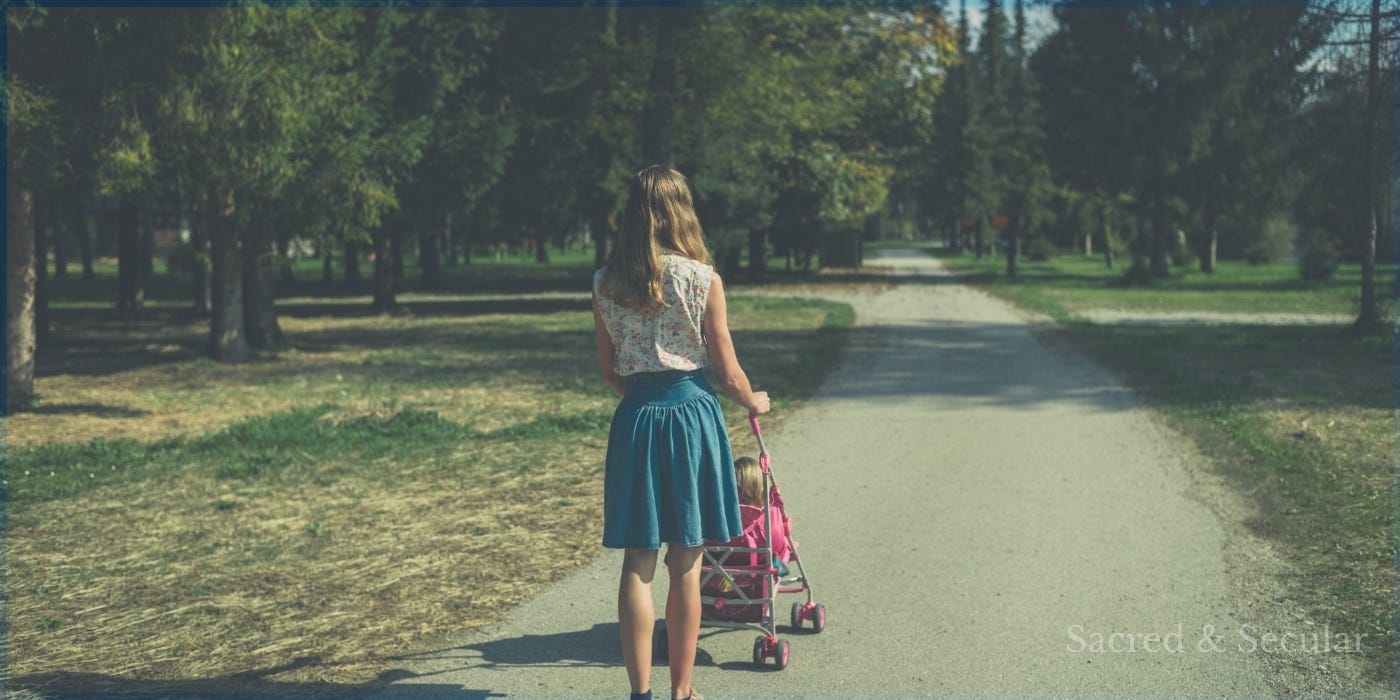
I am sitting in a buggy.
I must have been about five years old. I remember where we were, roughly what period of my childhood it must have been, and the sensation of being pushed along. Absolutely nothing dramatic happened. There was no family celebration, accident, or great revelation. It seemed like an ordinary moment on an ordinary day.
Yet somehow, more than fifty years later, I still remember it.
At least, I think I do.
That is where things become interesting.
How do I know I am remembering it correctly?
I have become fascinated by memory. Some events disappear almost completely. I can barely remember entire years of my childhood. Faces blur. Conversations fade. Places that once seemed important now seem difficult to picture.
Yet tiny fragments remain, like a broken mirror.
A buggy.
A street.
A smell.
A hot day.
A particular shaft of sunlight through a window.
Sometimes I experience those memories through my younger eyes. At other times, I seem to be watching them from outside, as though a camera were following the scene. They feel vivid and real. I can almost step back inside them.
— • —
Modern psychology tells us that memory is not as straightforward as we like to imagine. We do not store our experiences like files in a cabinet. Every time we remember something, we reconstruct, fill in the gaps and connect fragments. We shape a story from pieces that remain.
Which raises an uncomfortable possibility.
What if some of the things I remember never happened exactly as I remember them?
The question may seem challenging, but it might not be as concerning as it appears.
After all, most of life depends upon memory.
Families are built upon remembered stories. Entire identities are shaped by things we have been told about ourselves. We remember holidays, friendships, losses and achievements. We tell those stories again and again, often refining them each time we do.
When families gather around a table, it is remarkable how often the same stories emerge.
Do you remember when…
Everyone laughs.
Someone corrects a detail.
Someone else remembers something different.
Gradually, a fuller picture appears.
No one has a transcript of the event, nor was anyone taking notes at the time. Yet together they preserve something that matters deeply to the whole family.
The story survives because it is shared.
I think this is why I am curious when people speak about memory as if it were useless unless it is perfect.
The truth is that none of us lives that way.
I cannot tell you the exact words spoken on my wedding day. I cannot reproduce conversations I had at school or quote my grandparents word for word.
Yet I have no doubt that those moments happened. More importantly, I have no doubt about what they meant. I remember the love. I remember the joy. I remember the sense of belonging. The precise words may have faded, but the significance remains.
There is a difference between remembering every detail and remembering the truth of an experience.
I think that distinction is important.
When my children were younger, there were countless ordinary moments that felt insignificant at the time. Family walks. Meals together. Sometimes stressful school runs. Random conversations in the car.
I suspect they remember some of those moments differently than I do. Perhaps they remember things I have forgotten entirely. That does not mean one of us is lying; it just means memory is a shared act of preservation.
We hold different pieces of the same story, and when we come together, we get a more complete picture.
— • —
