


Welcome to today’s reflection.
Today, we delve into a surprisingly ancient problem.
Most of us think addiction is a modern problem.
We picture crowded city centres on a Friday night, bottles hidden in kitchen cupboards, online gambling apps, social media feeds designed to keep us scrolling, or entire industries built around helping us forget how stressed, lonely, or exhausted we feel.
The modern world certainly offers more opportunities for escape than any previous generation could have imagined.
Yet the more I read Scripture, the more I realise that human beings have always been remarkably similar.
The technology changes, the methods change, and the substances change. But the ache underneath remains much the same.
One of the surprises waiting in the Bible is how often alcohol appears, not simply as a gift to be enjoyed, but as a way people attempt to cope with life itself.
Take Noah.
The first vineyard in Scripture appears shortly after one of the most traumatic events imaginable. Noah has survived the flood, watched the destruction of the world he once knew, and emerged into a landscape filled with loss and uncertainty.
The very next thing we hear is that he plants a vineyard, makes wine, becomes drunk, and ends up lying naked inside his tent.
The Bible offers remarkably little commentary on the event. It simply tells the story and allows us to draw our own conclusions. Yet it is difficult not to notice that one of humanity’s earliest post-flood actions involves intoxication.
Then there is Lot.
Having escaped the destruction of Sodom, Lot finds himself living in isolation with his daughters. Once again, alcohol enters the story. His daughters deliberately intoxicate him so completely that he loses awareness of what is happening around him.
The consequences ripple through generations.
— • —
The point is not that wine itself is evil. Scripture never says that. The point is that alcohol repeatedly appears at moments when people are vulnerable, frightened, traumatised, or desperate.
That pattern continues throughout the Bible.
The Book of Proverbs contains some of the most realistic observations ever written about drinking. One passage asks:
“Who has woe? Who has sorrow? Who has strife? Who has complaints?”
The answer comes quickly:
“Those who linger long over wine.”
The writer goes on to describe red eyes, confusion, poor decisions, and the strange determination to keep drinking despite the damage being done.
Reading it today feels surprisingly modern.
The details may have changed, but the psychology remains instantly recognisable. What is fascinating is that the Bible never seems particularly interested in alcohol alone.
It is interested in what lies beneath it.
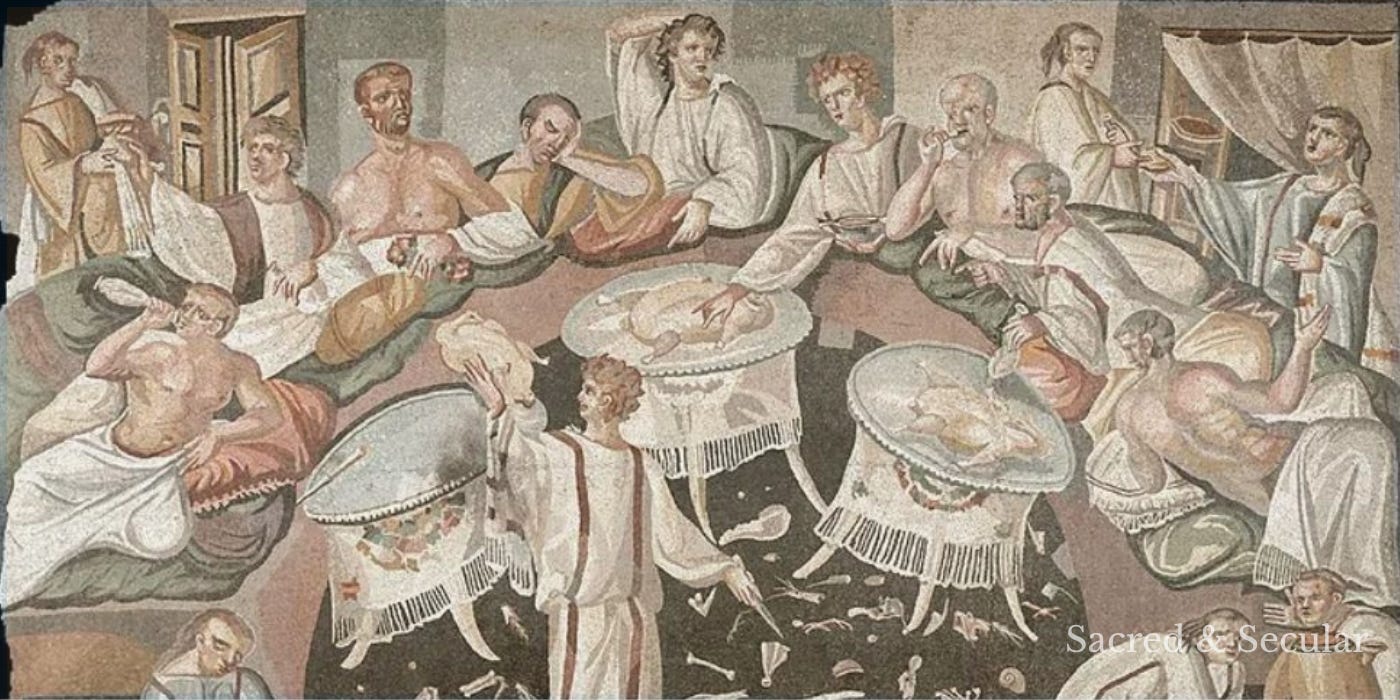
After all, the ancient world was hardly sober. By the time we reach the New Testament, drinking cultures were deeply woven into everyday life. Wine was safer than much of the available water, served at meals, used in celebrations, and consumed at religious festivals.
— • —
Some of those festivals centred around Dionysus, the Greek god of wine, ecstasy, and intoxication.
The goal was not simply drinking.
It was pure escapism.
Participants sought release from ordinary life through any means possible. This included intoxication, music, dancing, and altered states; they pursued freedom from anxiety, responsibility, and pain.
Sound familiar?
We sometimes flatter ourselves into thinking modern society invented this struggle.
We did not.
We merely updated the technology.
The apostle Paul understood exactly what was happening around him. Writing to Christians living in cities saturated with these influences, he famously tells them:
“Do not get drunk on wine, which leads to debauchery. Instead, be filled with the Spirit.”
For years, I read that as a simple moral instruction: drink less, pray more. Now I suspect Paul is making a deeper comparison.
Even the church at Corinth struggled with this. Paul has to rebuke believers who were becoming drunk during the Lord’s Supper itself. What was intended as a celebration of grace had become another opportunity for excess.
Human nature, it seems, has always been creative in its search for escape.
— • —
Modern psychology helps us understand something the biblical writers observed long before neuroscience existed.
Addiction is rarely about the substance alone. People become dependent for complicated reasons that can include pain, loneliness, trauma, anxiety, loss, and habits that gradually become necessities.
What begins as relief can slowly become captivity.
The Bible recognises this reality without using modern clinical language. Again and again, it points beneath the behaviour towards the deeper hunger driving it.
Many people drink because they are trying to cope with something painful. For some, that pain is emotional. For others, it may be loneliness, trauma, anxiety, grief, or circumstances that feel impossible to carry.
The method differs, but the longing remains.
It is important to say that recognising the spiritual dimension of addiction does not mean ignoring the medical one. Many people need counselling, treatment, support groups, medication, or professional help. There should be no shame in that. The church is at its best when it walks alongside people on that journey rather than judging them from a distance.
Christianity offers something remarkably radical.
Presence instead of escape.
Community instead of isolation.
Hope instead of numbness.
Meaning instead of distraction.
This does not make addiction simple. It remains a complex mixture of biology, psychology, environment, and circumstance. Anyone who has struggled with dependency, or loved someone who has, knows that willpower alone is rarely enough.
Compassion has to come first.
Yet the Bible continues to ask a challenging question that feels just as relevant today as it did three thousand years ago:
What are we really trying to escape?
Perhaps the ancient addiction problem hidden in Scripture is not ultimately about alcohol at all.
Perhaps it is about the human tendency to seek relief in things that can never fully heal the deeper wounds we carry.
The names change.
The substances change.
The centuries pass.
But the search remains the same.
Thank you for reading.
If you’re new to Sacred & Secular, I publish daily reflections exploring faith, Scripture, doubt, history, and the overlooked details hiding in familiar stories.
If you’d like reflections like this delivered straight to your inbox, I’d love to welcome you as a subscriber.
Paul