


Welcome to Sunday’s article for all subscribers.
Throughout the week, I write daily reflections for paid subscribers. Sundays are my opportunity to open the doors a little wider and share something with the whole Sacred & Secular community.
You may also be interested in my new book, Sacred & Secular: Find God in the Ordinary, which brings together some of the most popular and thought-provoking reflections from this journey so far. Amazon UK or USA.
When my son was three years old, he developed epilepsy.
It arrived suddenly. One day, he was a healthy, energetic little boy. Next, he was having convulsions every hour.
As you can imagine, it was a frightening time for our family. Suddenly, our lives revolved around hospital appointments, medical conversations, sleepless nights and the constant uncertainty of wondering when the next seizure would come. Like any parents facing a crisis, my wife and I poured enormous amounts of time and energy into helping him through it.
But we also had other young children.
They were watching their brother suffer while also watching their parents become distracted, worried and exhausted. They still needed meals, bedtime stories, reassurance and all the ordinary things children need. They needed to know that, while something frightening was happening within our family, the family itself remained secure.
Looking back, one of the things that strikes me most is that caring intensely for one child did not mean we stopped caring about the others.
If anything, we became more aware of them.
We knew that one child needed something particular from us at that moment, but love was never being transferred from one child to another as though we only had a limited supply. The whole family mattered.
Thankfully, the epilepsy eventually passed. But I have been thinking about that experience again recently while re-reading one of Jesus’ most familiar parables.
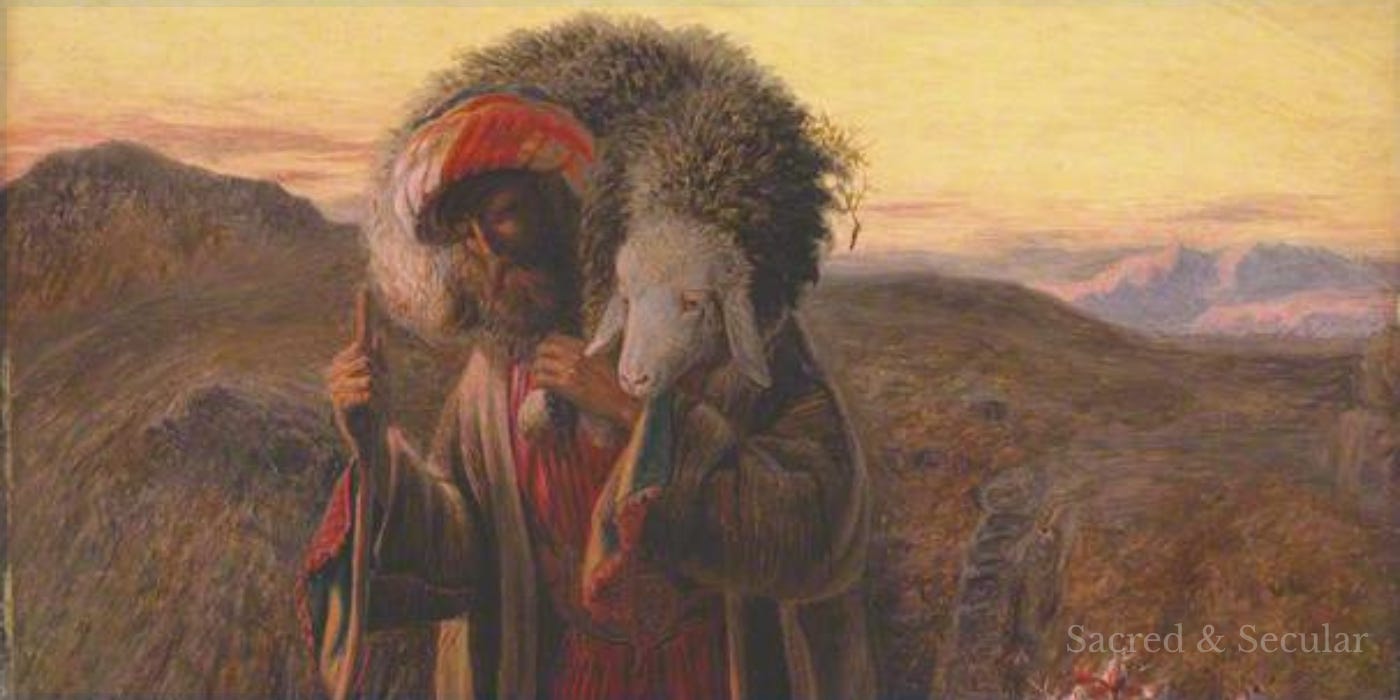
You will know how it goes. A shepherd has a hundred sheep. One goes missing. The shepherd leaves the ninety-nine and goes searching for the one.
It is a story many of us have known since childhood. Yet, hidden inside it is a question I suspect many people have wondered about.
What happened to the ninety-nine?
❦
Once you notice the question, it is rather difficult to unnotice it.
Jesus tells us that a shepherd discovers one of his sheep is missing, leaves the other ninety-nine and goes searching until he finds it. Let’s be honest, to modern ears, that can sound slightly irresponsible.
If I owned a hundred sheep and announced that one had disappeared, I suspect nobody would be particularly impressed if my solution was to abandon the remaining ninety-nine in a field and wander off on an epic search. Yet Jesus does not seem remotely concerned about this.
There is no reassuring explanation of the practical arrangements. No second shepherd appears. No sheepdog is mentioned. There isn’t even a risk assessment. Jesus simply tells us that the shepherd leaves the ninety-nine and goes looking for the one that is lost.
For years, I think I unconsciously filled in the gap myself. I imagined ninety-nine vulnerable sheep standing around, wondering where their shepherd had gone. But then I noticed something embarrassingly obvious. Jesus says the shepherd leaves them; he never says he abandons them.
Those are not necessarily the same thing.
Jesus does not tell us whether another shepherd remained with them, whether they were somewhere relatively secure, or whether his listeners simply understood something about shepherding that we do not. Perhaps that is because none of those details matters to the story he is telling.
This is not a lesson in livestock management; Jesus wants our attention somewhere else.
There is one sheep missing.
And the shepherd notices.
That is the part of the story we usually concentrate on, and rightly so.
The lost sheep matters.
The shepherd does not shrug and conclude that ninety-nine out of a hundred is a respectable success rate. He notices the absence and goes looking. He keeps searching until he finds what has been lost, and when he returns, the story's mood is not irritation but celebration.
❦
That is a beautiful picture of God.
But I increasingly wonder whether there is something else here for those of us who sometimes identify more easily with the ninety-nine. Because there are times when someone else’s need becomes urgent, and ours does not.
Someone else receives attention because they are going through a crisis. Another person is being searched for, helped, supported or celebrated. And somewhere inside us, if we're really honest, we ask a question we might feel slightly ashamed to admit.
What about me?
It happens in families, workplaces, friendships and churches. Attention shifts towards the person whose need is most obvious, while someone standing nearby quietly wonders whether anyone has noticed them too.
I suspect many of us know what it feels like to be one of the ninety-nine.
We are not necessarily lost because we are still there. But we sometimes wonder whether being the one who stayed means becoming the one who is overlooked.
❦
Perhaps that is where we accidentally make God too much like ourselves.
Human attention is limited. I can concentrate on one conversation properly or three conversations badly. I have a limited amount of time, energy and emotional capacity. If one part of my life suddenly requires more of me, something else usually has to receive less.
Most of us live within those limitations every day.
And because this is how our love works, we can begin imagining that God must operate in much the same way.
If God is caring for someone else, perhaps there is slightly less care available for me. If someone else needs rescuing, perhaps I ought not trouble God with something smaller. If another person’s prayers appear to be answered while mine remain unresolved, perhaps they have somehow moved ahead of me in the queue.
We would probably never put it quite like that, but I think we sometimes feel it.
The parable offers another possibility. The shepherd’s search for the one does not tell us that the ninety-nine have become less valuable. It tells us that neither one has become less valuable.
That distinction matters.
The lost sheep does not suddenly become more precious than all the others because it was already precious. Its absence simply means that love now takes a different form.
For ninety-nine sheep, the shepherd’s care may look like staying within the flock. For one sheep, it looks like being searched for across the hillside.
Perhaps that is part of our difficulty. Rescue is dramatic, while being held safely within the flock rarely feels dramatic at all. We notice the search party. We do not always notice the ordinary grace of remaining somewhere secure. Yet both may be expressions of the same care.
The need is different.
The love is not.
❦
That takes me back to those frightening months when my son was ill.
One child required extraordinary attention. There were appointments to attend, medicines to understand and nights when sleep seemed impossible. Our other children did not need those things during that time. They needed something different.
They needed ordinary life to continue, reassurance, and to know that Mum and Dad were still there. They needed to know that their brother’s illness had not somehow pushed them outside the circle of our focus.
We certainly did not get everything right. Exhausted parents rarely do. But our aim was never simply to care for the child who was unwell. It was to hold the whole family together while giving one child what he particularly needed.
I no longer see a shepherd choosing one sheep instead of ninety-nine. I see a shepherd refusing to accept that one member of the flock no longer matters simply because it has wandered away.
The flock remains one flock.
❦
There is another detail in the story that I love.
The shepherd rejoices.
He does not return carrying the sheep and give it a stern lecture about the inconvenience it has caused.
He celebrates.
In Luke’s version of the story, the joy spills beyond the shepherd himself. Friends and neighbours are invited to celebrate too. The story's destination is not rescue alone. It is restoration. Something that belonged within the community has been brought back into it.
Perhaps that is why thinking of ourselves permanently as either the one or the ninety-nine can be misleading. Life moves us between them.
There are seasons when we are the one. We lose our way, life overwhelms us or something happens that leaves us isolated, frightened or unsure how to get back.
At other times, we are among the ninety-nine. We are still standing, getting on with things as part of the flock. Perhaps watching someone else receive the attention we secretly wish would come our way.
Most of us will know both experiences eventually, and perhaps the good news of the parable is that neither position places us outside the shepherd’s care.
When we are lost, he seeks us.
When we are within the flock, we are still his.
One person’s need does not diminish another person’s worth. One person’s rescue does not mean everyone else has been forgotten.
The family remains one family.
The flock remains one flock.
And wherever we happen to find ourselves today, perhaps that is what the shepherd wants us to know.
A question to ponder: how easy is it to believe that you are still fully seen and valued?
Thank you for reading today’s reflection.
Paul.