


Thank you for being a free subscriber here at Sacred & Secular.
You are welcome here. Free members receive a full reflection every Sunday, while paid membership unlocks daily reflections like this one and full access to an archive of more than 300 searchable reflections.
You may also be interested in my book, Sacred & Secular: Find God in the Ordinary (USA Link), which brings together some of the most popular and thought-provoking reflections from this journey so far.
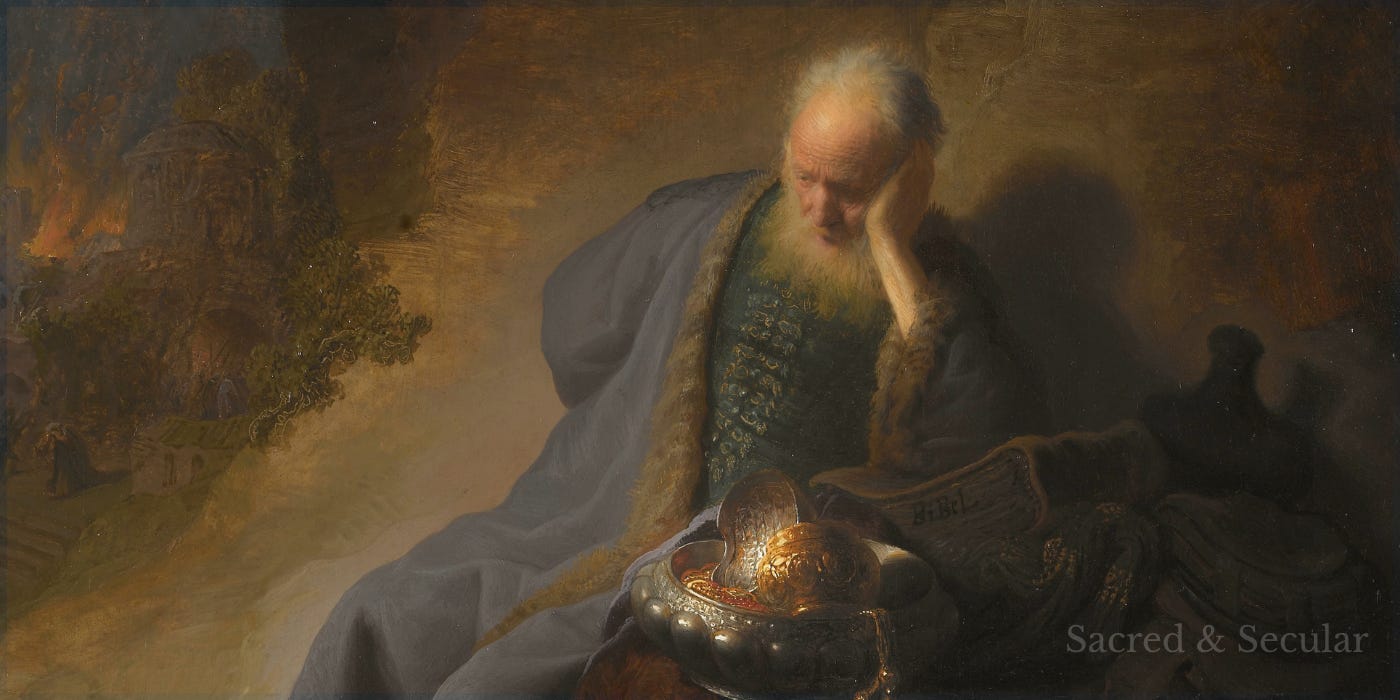
There is a strange moment in the book of Lamentations that I had never really noticed before.
Lamentations comes from one of the darkest periods in Israel’s story. Jerusalem had fallen to the Babylonians, the temple had been destroyed, people had been killed, and many of the survivors had been carried away into exile. The poems seem to emerge from the devastation left behind, so this is not somebody having a particularly miserable week.
The world the writer knew really has fallen apart.
For chapter after chapter, that grief is allowed to speak. By the time we reach Lamentations 3, the writer describes himself as battered, abandoned and exhausted. His language becomes so bleak that he eventually says his endurance has gone, and so has his hope.
Then, only a few verses later, he says something completely different.
“Yet this I call to mind, and therefore I have hope.”
That little word yet stopped me. Because nothing appears to have happened between those two statements. Jerusalem has not suddenly been rebuilt. The temple is still gone. The people who have been taken away have not returned. Nobody arrives with news that the crisis is over.
His circumstances are exactly as bad as they were a few lines earlier.
What changes is what he remembers.
