


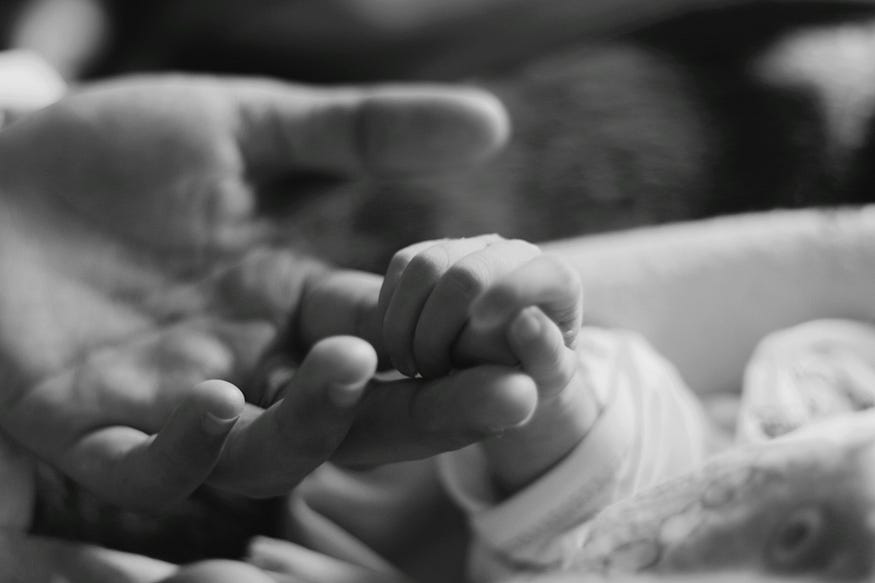
My life changed on the 12th of February 2002 at 3.05pm.
It was at this time that a nurse handed me my baby daughter, born by cesarean section. I looked at her tiny body, covered in goo and listened to her cry as she used her first breath to announce her arrival into our world. It was a special moment for me as a new father, but it was also more than that.
As a new life came into the world, it was sacred.
Our lives are full of sacred moments that defy logical explanation. I do not mean the physical things that happen to us, but the feelings that explode because of them. Deep down, they scratch beneath the surface, showing us that what we experience on this earth is just surface stuff. We may glide like a duck swimming upon a pond, but our legs are kicking frantically underneath. There is much more going on than even we can see.
I can only explain life’s sacred dimension by sharing my own experience, but you will have plenty of your own.
For example, when I stood in awe and amazement at a simple view.
I had been walking with my family in Somerset, in the United Kingdom. My family was made up of different ages, from toddler to teenager, and it was, therefore, inevitable that somebody would not be happy with the walk. In fact, the only person that day who seemed happy was our ever-cheerful spaniel, Charlie, who ignored my children’s protests as he sniffed and ran around the grassy hill, tail wagging.
As we rounded the corner, the moaning instantly stopped, even Charlie’s. I looked up to see what could have had such an effect, and was treated to an awe-inspiring view. On top of that hill, we could see for miles. Villages looked like tiny hamlets as the sun broke over the scene, highlighting rolling hills and cloud shapes, gently casting shadows over the county of Somerset.
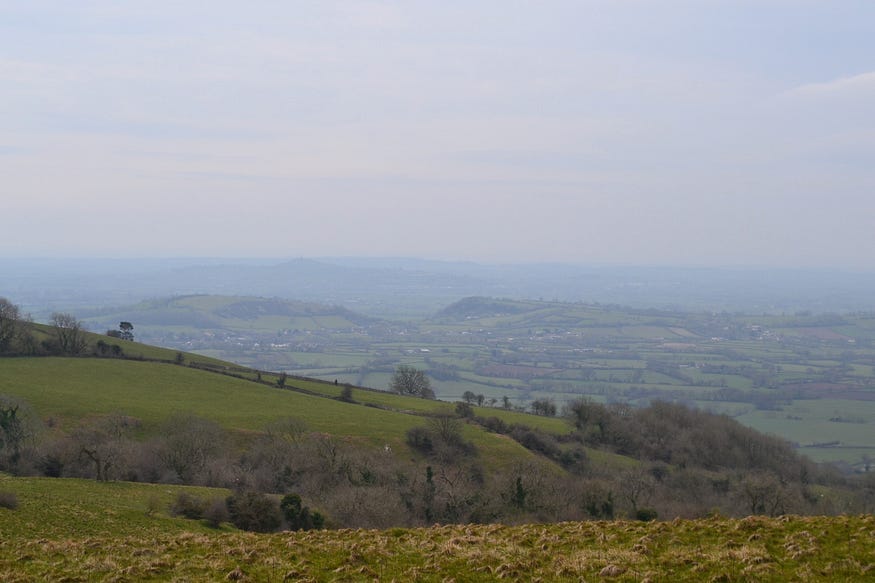
It at once made us feel tiny, insignificant, but beautiful. It reminded us that we were part of something bigger that we could not comprehend or vocalise at that moment. All we could do was stand on that random hill, speechless, as it looked like God had rolled out a giant carpet in his front room.
There is more to life than this. Instinctively, we know it.
Even the most hardened atheists have trouble explaining those sacred moments in purely evolutionary, biological terms. Once we scratch the surface, we face the enormity of our existence on this tiny planet and the fact that there are dimensions that are not immediately visible.
Little wonder, then, that many of us choose to ignore this aspect of life. The truth is, we would probably go mad if all we thought about was the sacred dimension and ignored the material life. We, therefore, tend to do the opposite and only focus on the material world around us.
The other reason we try to ignore the sacred is that sometimes we come upon it for more devastating reasons than a good view or the birth of a child.
My life changed again on 3rd July 2012 at 2.16am.
That girl, whom I held in my arms in the hospital as a new baby, was once again being carried through those doors, but this time, her ten-year-old body was lifeless and her breathing shallow. As the doctors took her from my arms, a bed was produced, and six medical professionals got to work urgently on her little body. I felt numb as a nurse gently ushered me to a seat nearby and told me, ‘She is in a bad way, I am afraid; you need to be prepared for the fact that she might not make it’.
The silence that passed between us was sacred. The air between us was thick and heavy, solemn and ancient. I glimpsed the sacred dimension of life once again.
Against the odds, my daughter survived that visit, eventually being diagnosed with type one diabetes and, some months later, learnt to live with her condition.
I was changed forever. Because once we are exposed to the sacred, we are forever transformed by it.
The death of somebody close to us is always devastating. It is also where we face the sacred most keenly and see into a dimension that is not confined even by death when our earthly remains literally become stardust.
However, reserving our experience of the sacred to only the most significant moments in life makes us spiritually poor. It diminishes our day-to-day life to the material world. It makes us shallow and poor by every important metric we could use to measure ourselves. We should, therefore, attempt to connect with the sacred every day.
But how?
Religion has attempted to make that sacred dimension palatable and attainable. It attempts to paint a picture of its beauty in a way we can comprehend. Religious practices can liberate and connect us with the ‘other’. I often hesitate to use the word ‘God’ because it frequently has negative connotations for people, mainly because they have been exposed to bad religion, that is, religion used to control people rather than provide the freedom it promises.
Let us not confine ‘God’ solely to religion and expect our human understanding of the sacred dimension to be logical and neatly packaged. Glimpsing the sacred is often a messy, soul-searching, and painful experience, but ultimately, it is fulfilling in a way that makes mere happiness seem trivial.
Focusing on the sacred dimension is to reframe our very existence and place our lives and those around us into a supernatural context. We do not exist to earn money, gain fame, or become popular. Those can happen, but it should not give us our meaning or purpose for living. Only a glimpse of the sacred can do that.
Whatever our purpose here on earth is, it is found in the sacred, and we should seek it out whenever we can.