


There are moments in the Gospels that feel familiar enough to pass by without much resistance.
And then, every now and again, a small detail changes the whole thing.
This is one of those moments I’ve found myself coming back to this week.
Most of us know the story of the feeding of the 5,000.
It is one of those moments in the Gospels that feels straightforward, almost too familiar to question.
A hungry crowd.
A tired group of disciples.
A small offering that becomes more than enough.
It is a story about provision, generosity, and quiet power.
And it is all of that.
But there are details in the story that do not quite sit quietly in the background. They are easy to overlook, but once noticed, they begin to shift how the whole moment feels.
Why were people arranged in groups?
Why does the Gospel tell us the number of men, rather than the full crowd?
And why, after the miracle, are we told so precisely that twelve baskets of fragments were collected?
At first glance, these are the forgettable parts. The bits a reader might skim past on the way to the miracle itself.
But the miracle is not only about bread. It is also about what happens when something unmistakable takes place… and we are not quite sure what to do with it.
— • —
The miracle is obvious. The response is not.
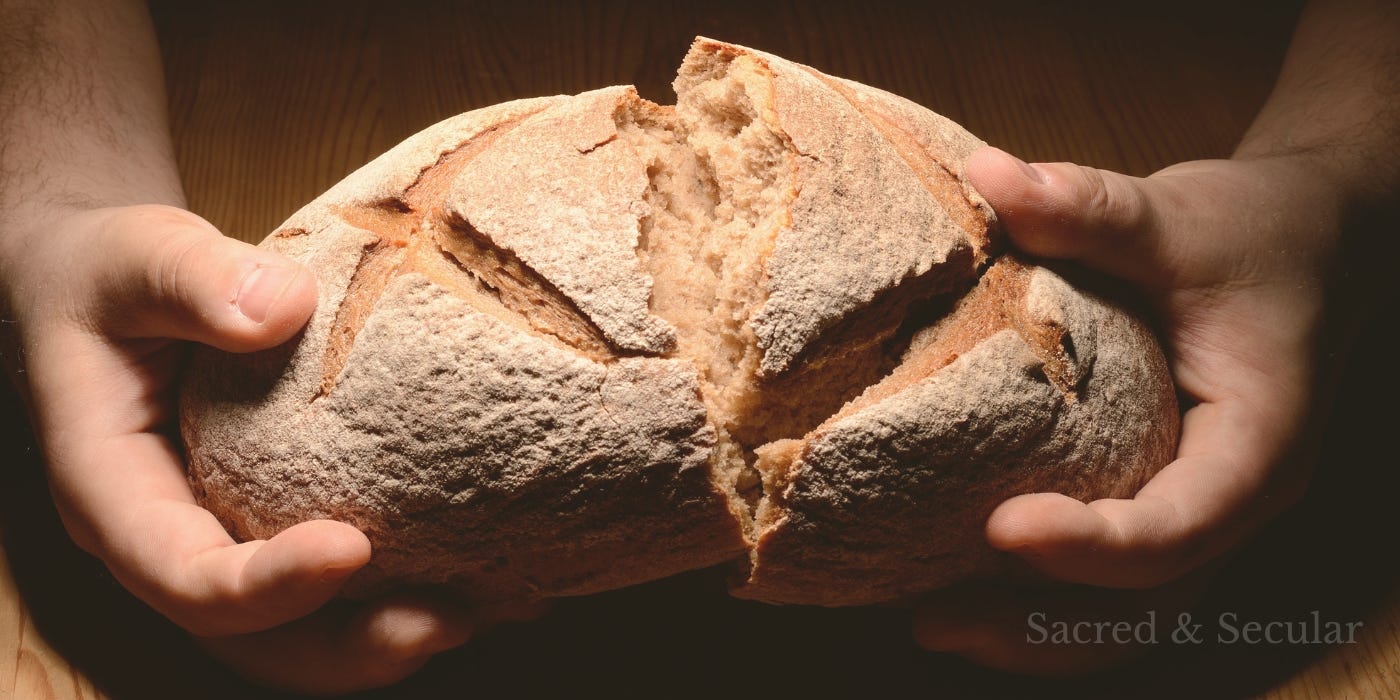
Jesus directs the people to sit down on the green grass, in groups of hundreds and fifties. He takes the loaves and fish, gives thanks, breaks the bread, and hands it to the disciples to distribute.
Everyone eats.
Everyone is satisfied.
Then we are told:
The disciples pick up twelve basketfuls of broken pieces. And the number of the men who had eaten was five thousand.
If you have heard this story often enough, it stops sounding unusual.
But it is.
Why count only the men?
Why organise the crowd so deliberately?
We often read this as if the Gospel writer is simply being precise. But that is our instinct, not theirs.
These details would have meant something to the first hearers. They were not incidental; they were recognisable.
They were, in a sense, table manners.
— • —
Why did they sit in groups?
In Jewish life, meals were not just about food. They were religious moments.
There were blessings before eating and thanks afterwards. The exact form of those prayers could vary depending on the size of the group. Which meant you needed to know how many people you were with before you spoke.
So at large gatherings, people naturally arranged themselves into manageable groups. Not as crowd control, but as instinct. It allowed the meal to take shape properly, with a sense of order and shared understanding.
That is why the Gospel can mention groups of hundreds and fifties without explanation. It would have felt entirely normal.
It also explains why the number of men is recorded.
Only the men were counted for the purposes of public prayer. Within that world, it was simply how things worked. If you knew how many groups of men were present, you could estimate the scale of the gathering.
So the crowd settles itself, not like a restless mass, but like guests at a structured meal.
They are not scrambling.
They are preparing to eat.
They are, in their own way, behaving as if they are in the presence of something significant.
— • —
The part we call “leftovers” might not be leftovers at all
Then comes the detail most of us reduce to practicality:
“They picked up twelve basketfuls of fragments.”
We tend to imagine this as simple tidiness. The disciples are collecting what remains.
A wholesome ending to a generous moment.
But in that culture, bread fragments were not always just scraps.
There were practices connected to food that involved setting aside a portion as an offering. A part of the meal that was treated as holy. Something not casually eaten, but separated as an act of thanks.
In some situations, this would already have been done by the host. A trustworthy host would provide food that had been properly prepared and appropriately set apart.
There would be no need for guests to hesitate.
But in other situations, especially where trust was uncertain, people would act carefully. They would separate a portion themselves, just in case.
Just in case the food had not been handled properly.
Just in case the source was unclear.
Just in case they were participating in something they did not fully trust.
— • —
A quiet moment of uncertainty
This meal is unusual from the start.
The food appears in real time. Jesus begins with five loaves and continues handing out more. There is no obvious moment where anything is formally set aside first.
The crowd is receiving something that appears to come from God… but they do not quite know how to respond.
And when people are unsure in a religious setting, they tend to reach for what is familiar.
They reach for the rules.
Even if those actions miss the moment itself.
Imagine what that looked like.
People sitting in their groups on the grass, holding bread they did not expect to receive. There is a brief hesitation. A quiet awareness that something unusual is happening. Then perhaps someone makes a small gesture.
They tear off a piece and set it aside.
Not dramatically. Not as a statement. Just carefully.
The kind of action that feels respectful… and yet communicates something to everyone watching.
Others begin to follow.
Because uncertainty spreads quickly, and once a pattern emerges, people tend to adopt it.
They separate a portion of the bread.
Not because they reject what is happening, but because they are not entirely sure how to trust it. They are eating, but they are also managing their response.
They are, in a sense, protecting themselves from the possibility that this might not be what it appears to be.
— • —
The tragedy is not the caution
The tragedy is what the caution suggests.
It suggests that even in the presence of something extraordinary, the crowd held back. That they experienced the miracle… and still treated it with a degree of suspicion.
Not openly. Not defiantly. But quietly.
They behaved as though something needed checking. As though holiness might need protecting from the one who was providing it.
They kept the moment within the boundaries of what they understood.
And in doing so, chose correctness over wonder.
— • —
Twelve baskets as a witness
If those fragments were treated as something set apart, they could not simply be discarded.
They had to be gathered.
Which means the twelve baskets are not just a practical detail. They are a visible sign that something significant has taken place. A record that the meal was not ordinary.
It left something behind that could not be ignored, and yet, at the same time, they may also reflect how the crowd responded.
Not with unguarded awe, but with careful, measured behaviour.
They were present at the miracle… and still missed part of it.
— • —
When politeness becomes a shield
It is not difficult to recognise ourselves in that moment.
We may not separate bread in the same way, but we have our own versions of carefulness. We respond with what feels appropriate. Thoughtful. Measured. Controlled.
Sometimes that is faith.
Sometimes it is a way of keeping things manageable.
We can be close to something profound and still hold it at a distance.
We can encounter something that invites trust… and respond by tightening our grip on what we already know.
— • —
The crowd ate in the presence of God… and still played it safe.
They followed the customs and did what was correct. They acted carefully, not because they rejected what was happening, but because they did not yet know how to receive it.
And perhaps that is the question the story leaves with us.
What if the miracle is not only that the bread multiplied…
But that God himself was standing there?
Once you begin to see that, the story refuses to stay at a safe distance.
I am not sure I’ve quite worked out what to do with that yet.
— • —
If this reflection resonated, you are always very welcome here.
Sacred & Secular is a space for noticing the small details that change how we see everything — in Scripture, in faith, and in ordinary life.
I share reflections like this most days, slowly building a body of work that stays with the questions rather than rushing past them.
Paul
I really appreciate the depth of your article. Thank you!