


Welcome to Sunday’s article for all subscribers.
Throughout the week, I write daily reflections for paid subscribers. Sundays are my opportunity to open the doors a little wider and share something with the whole Sacred & Secular community.
Today, I reflect on whether God can still meet us through thoroughly human words and why calling something sacred does not necessarily mean it has to be ancient.
You may also be interested in my new book, Sacred & Secular: Find God in the Ordinary, which brings together some of the most popular and thought-provoking reflections from this journey so far. Amazon UK or USA.
Every so often, I come across a sentence that seems to arrive at precisely the right moment.
It might be something in a book I am reading, a line from a song, a comment somebody makes in conversation, or perhaps a few words written in a message by someone who has absolutely no idea what has been going through my mind. The words themselves are often completely ordinary. They have not been accompanied by thunder, a flash of light or a heavenly voice announcing that I should pay attention.
Yet somehow, they stay with me.
Sometimes they give words to something I have been struggling to express for ages. At other times, they challenge an assumption I had barely realised I was carrying. Occasionally, they simply make me stop and wonder whether, in that particular moment, I have encountered something more than the person speaking could possibly have intended.
Christians can become rather nervous about talking like this.
We can be comfortable saying that God spoke through words written thousands of years ago. We read a psalm and call it sacred, or hear the words of Isaiah and describe them as inspired. We open the Bible expecting that, through these ancient human words, we may somehow encounter God.
Yet when the words were written yesterday, we can become much more cautious.
Why?
❦
They Were Human Words Before They Were Ancient Words
I wonder if part of the difficulty is that the Bible can feel so unlike any other book.
We place it on that particular shelf and read it differently. Churches carry it into worship, place it on lecterns and sometimes process behind it as a sign of honour. Many of us were taught from childhood that these are not simply human words but the Word of God.
There are good reasons Christians have treated Scripture as something distinctive. These writings have inspired and shaped Christian faith for centuries. They have been received, tested and preserved by generations of believers. Nothing I am saying changes that.
Yet we often forget something which sounds rather obvious.
Much of the Bible did not begin with people sitting down to write the Bible.
Paul wrote letters. Luke tells us that he carefully investigated accounts of Jesus and then arranged what he discovered so that someone called Theophilus might understand what he had been taught. The Psalms contain prayers, songs, praise, grief, anger and bewilderment. Proverbs gathers observations about what it means to live wisely. The prophets spoke into particular political, religious and social moments.
These are remarkably human forms of communication: letters, prayers, poems, wisdom and stories, shaped by real human circumstances and human experiences of God. But it is worth remembering that they were human words before they became ancient words.
That does not make them less sacred. In fact, maybe it should make us rethink what we mean by sacred in the first place.
❦
Paul Quoted People Outside the Bible
One of the details I have always been fascinated by appears in Acts 17.
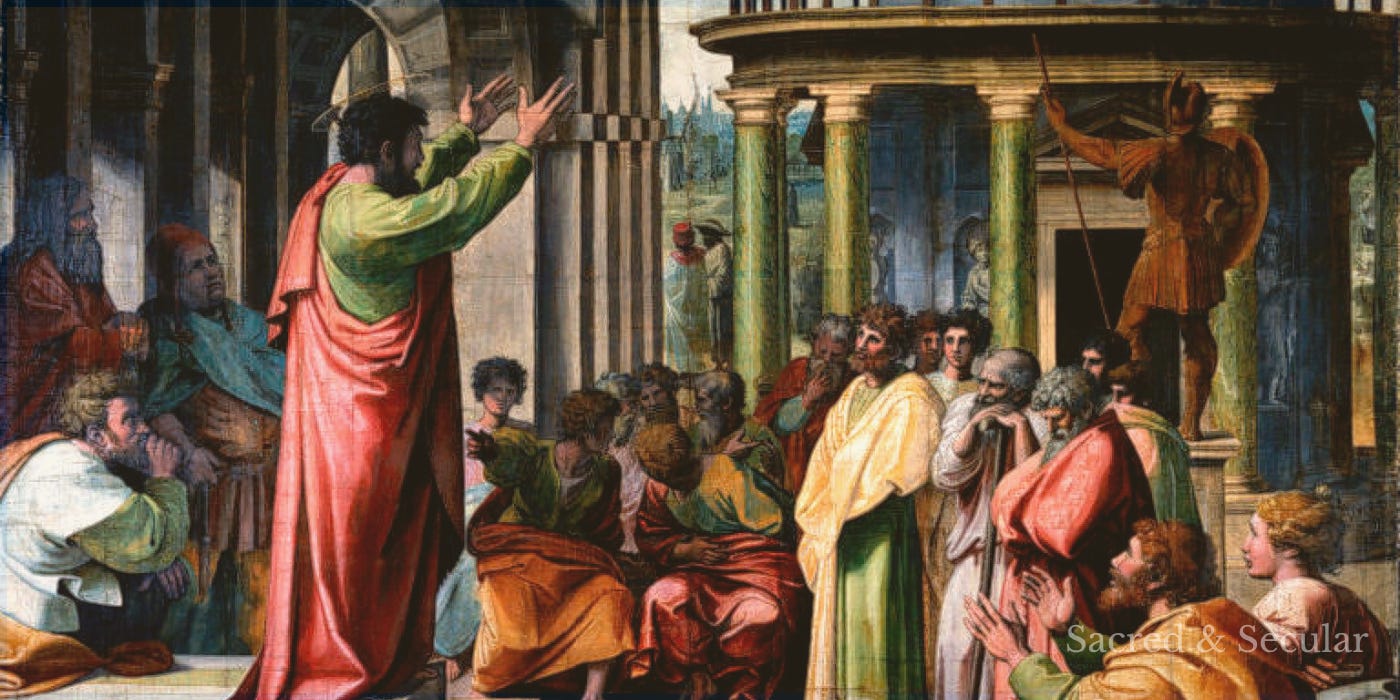
Paul arrives in Athens, surrounded by temples, statues and competing philosophies. Eventually, he is invited to speak at the Areopagus, where he tries to explain the God he worships to an audience who does not share his Jewish Scriptures. Paul could have begun quoting the prophets.
Instead, he reaches into their own world of poetry and thought.
“In him we live and move and have our being.”
Then another:
“For we too are his offspring.”
These were not words from the Hebrew Scriptures. They came from the intellectual and religious world surrounding Paul’s audience. Yet Paul appears perfectly happy to use them.
He does not declare that everything these poets ever wrote was divinely inspired, and he certainly does not add their works to Israel’s Scriptures. He simply recognises that these human beings, from outside his own faith tradition, have said something that contains truth.
Let’s take that in for a moment.
Paul apparently did not think truth stopped being true because the wrong person had written it. He could listen to words from outside his own religious tradition and recognise an echo of something he believed about God.
❦
Sacred Does Not Have to Mean Scripture
One of the problems is that we often assume there are only two categories available.
Either words are inspired by God and therefore belong somewhere near the Bible, or they are simply human and by comparison spiritually insignificant. But the earliest Christians seem to have lived with more room between those possibilities.
They obviously gave particular authority to the writings that eventually became the New Testament. Yet they also believed the Holy Spirit remained active among them. Christians preached, prophesied, wrote letters, offered wisdom and tried to discern where God might be leading them.
Not everything they believed was Spirit-led eventually became Scripture, and that distinction feels increasingly important to me. The fact that Christianity eventually recognised a canon of Scripture does not mean God became silent when the last biblical books were written.
We don’t need to claim a modern poem belongs next to the Psalms to believe God can speak through it. A sermon doesn’t have to be a new letter to the Corinthians to change us, and a novelist doesn’t need to be a prophet to reveal something true about the human heart.
Perhaps sacred does not always describe the words themselves. Maybe sometimes it describes what happens when ordinary words become a place in which we encounter something more.
Even the New Testament does not always use the phrase ‘the word of God’ as shorthand for a book. In Acts, it is something people speak, proclaim and hear. And John goes further still, opening his Gospel by describing Jesus himself as “the Word”.
That does not mean every idea we hear has come from God. It certainly does not mean every preacher, author, or songwriter gets to attach divine authority to their opinions. If anything, I think it calls for greater humility.
Words need testing. They need wisdom. They need to be weighed against what we already understand of the character of God, particularly as Christians see that character revealed in Jesus. If the danger is not being open to hearing God through human words, there is equal danger in assuming too quickly that our words carry God’s authority.
Somewhere between those two extremes is the ordinary experience I began with: words arriving through another person, a book or a song, and somehow reaching us more deeply than we expected.
❦
Some Words Find Us
What are we meant to do with experiences like that? We could dismiss them as a coincidence.
Sometimes, undoubtedly, they are. We could also become so spiritually excitable that every unexpected sentence becomes a coded message from heaven. I have encountered enough of that kind of Christianity over the years to be rather cautious about it.
But perhaps there is another way. We can simply pay attention. There is a huge difference between saying “God told me this” and wondering whether God might have connected with me through something somebody said.
One claims certainty, while the other leaves room for discernment.
I increasingly prefer the second.
❦
When Did Sacred Come to Mean Ancient?
Maybe the mistake is thinking we have to decide which modern words are sacred.
That sounds like an exhausting responsibility, and one I am very happy not to take on. Paul could hear truth in the words of a pagan poet without turning the poet into a prophet. The early Christians could believe that God continued to guide them without assuming every word they spoke belonged in the Bible.
Perhaps we can re-learn to do something similar.
We can read Scripture as Scripture, recognising the unique place these writings have occupied in Christian faith for centuries, while remaining open to the possibility that God has not stopped meeting people through human words.
Sometimes, a few thoroughly human words may simply reach us at exactly the moment we need them.
And perhaps that is sacred enough.
A question to ponder: Have there been words outside the Bible that seemed to reach you at exactly the right moment? What did you do with them?
Thank you for reading today’s reflection.
Paul
Those words from Greek poets in Acts 18 were always a very good rebuttal when someone accused me of using "secular" quotes in sermons (which I did all the time!!)
Well said! We have words in scripture telling us that if all that might have been recorded had been saved that there would not be enough books in the world to hold those stories -- or words to that effect. Jesus said that those who came after him would do greater things than he did. We have some of those stories, a mere sampling of the expansion of his influence. A huge amount of written material in the past 2000 years is of scriptural quality. The Bible has been added to via those libraries, despite warnings not to add to the canon. We have hagiography in many forms, and not only under church imprimatur. Even the church recognizes the blessed pagans. Of course, discernment is needed but it is by that discernment, as you say, that we can receive godly voices and images from many different sources. Perhaps the chief danger is in lapping up merely sentimental slop that quiets turmoil when something more surgical is needed.