


Welcome to today’s reflection.
Today is a public holiday here in the UK. For many people, it is a day for family, walks, gardens and catching up on jobs that have been waiting for attention.
It reminded me of a family walk we took many years ago.
Sacred & Secular is a reader-supported publication. Paid subscribers receive a new reflection every day, exploring faith, meaning and the places where the sacred quietly meets ordinary life.
If you’d like to join that journey, I’d be delighted to have you along.
A few years ago, we were out on a family walk that was proving rather less idyllic than I had imagined.
The children were tired. Somebody’s shoes were inappropriate. Somebody else wanted to know how much further we had to go. The conversation had settled into that familiar rhythm many parents will recognise: a mixture of negotiation, encouragement and mild exasperation.
We were focused on the next few steps, and I was beginning to wonder why we bothered.
Then we rounded a hill and everything changed.
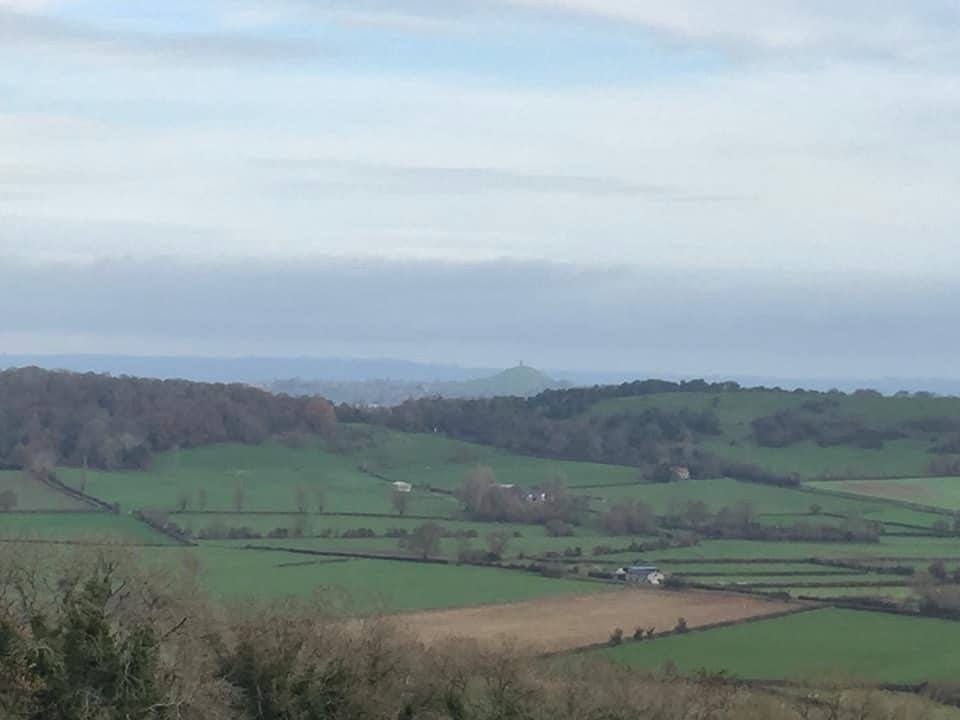
Before us was a view so vast that conversation simply stopped. Villages sat scattered across the landscape. Fields stretched towards the horizon. Roads wound through the countryside like tiny threads. It felt as though God had unrolled a giant carpet across the earth.
For a few moments, nobody said anything.
The complaints vanished. The stress evaporated. Even our dog simply stood there looking.
Nothing about our circumstances had changed. The walk was still long, and the children were still tired. Yet somehow everything felt different.
Scale has a way of doing that.
Sometimes all it takes is a glimpse of something larger than ourselves to rearrange our perspective.
I often think about that moment when I read Isaiah’s extraordinary vision of God in the temple.
— • —
“In the year that King Uzziah died, I saw the Lord...”
This vision begins in a year marked by uncertainty. A long-reigning king has died. The future feels fragile. National security, identity and direction are all in question.
It is precisely at this moment of instability that Isaiah is given a glimpse of something infinitely larger than the crisis before him.
“I saw the Lord, high and exalted, seated on a throne; and the train of his robe filled the temple.”
It is a remarkable detail. Not the throne or the full figure. Not even the glory in its entirety.
Just the hem of the robe fills the temple.
The proportions do not make sense. The temple, the very place where God’s presence was understood to dwell, cannot contain even the edge of what Isaiah sees.
Seraphim call to one another:
“Holy, holy, holy is the Lord Almighty; the whole earth is full of his glory.”
The thresholds shake. The temple fills with smoke. Sound, movement and obscurity combine into a scene that is anything but controlled.
This is not a comforting spiritual thought for the day.
It is sensory overload.
Isaiah encounters a reality that refuses to fit inside ordinary categories.
— • —
There are many points in my life when I preferred a smaller God.
Not because I rejected him, but because small things are easier for all of us to manage.
Modern life trains us to organise, categorise and optimise. We want things to make sense. We want problems that can be solved and questions that can be answered. We value clarity, efficiency and outcomes.
Faith can drift in the same direction.
We want God to reassure us, guide us and support our plans. We want a faith that integrates neatly into the rest of life without disrupting it too much.
Isaiah encounters something rather less convenient.
He does not see a projection of human preferences. He sees a reality so immense that language begins to strain. The word “holy” is repeated three times because once is not enough. In the Hebrew world, repetition intensified meaning. To say something three times was to push it to its absolute limit.
This is not merely goodness.
It is otherness.
A holiness so vast that it resists every attempt to reduce it.
I wonder how often we do exactly that. Faced with mystery, we quickly retreat into explanation. We tell ourselves that God is beyond understanding and then move on to something more manageable.
It sounds humble, but sometimes it is also avoidance.
We prefer mystery acknowledged rather than mystery inhabited.
Isaiah does not look away.
He stands within it.
— • —
Isaiah’s first response is to suddenly realise his place in the universe:
“Woe to me! I am ruined.”
Confronted with immensity, he becomes aware of his own smallness.
This is not self-hatred. It is a response.
The same thing happens when we stand beside an ocean, look up at a mountain range or stare into a sky full of stars. For a moment, we are reminded that we are not the centre of everything.
Strangely enough, that can be deeply liberating.
Much of life is spent focused on what is immediately in front of us. We worry about outcomes we cannot control and become absorbed in concerns that feel all-consuming. Our field of vision narrows until those concerns seem to be the whole story.
Suddenly, Isaiah sees himself differently. He discovers that the temple is not large enough to contain God’s glory.
The seraphim declare that the whole earth is full of it.
The whole earth.
Reality itself is saturated with the presence of God.
Yet most of us move through our days without noticing.
— • —
Only after the vision does the voice ask:
“Whom shall I send?”
Isaiah responds:
“Here am I. Send me.”
The commission comes after the encounter.
Awe precedes action.
We often reverse the order. We want purpose before wonder. We seek clarity about our calling before allowing ourselves to stand in mystery. We want answers before we have learned how to be astonished.
Perhaps that is one reason our faith can sometimes feel thin.
Our imagination narrows.
Our expectations shrink.
Our prayers become limited by what we can already foresee.
Isaiah’s vision refuses all of that. The robe fills the temple. The foundations shake. Smoke obscures the edges of sight. Nothing is easily contained.
The scene restores proportion.
It reminds Isaiah that God is not simply a larger version of ourselves. He is not an extension of our assumptions or a supporter of our existing plans.
He is infinitely more.
— • —
A God we can fully comprehend would be no larger than our own minds.
A God who fits neatly into our categories cannot reshape them.
When we encounter something that feels too large to understand, we stand at a threshold. The question is whether we retreat or remain.
Isaiah remains.
A burning coal touches his lips. There is cleansing, but there is also participation. The vastness does not paralyse him. Instead, it sends him.
Mystery becomes the foundation of mission.
That seems deeply relevant in a culture that prizes measurable achievement. Wonder can feel unproductive because it does not tick boxes or generate immediate results. It often appears inefficient.
I often think back to that family walk. The children still had to walk back down the hill. The journey was not suddenly easier. None of the practical realities had changed.
What changed was our perspective.
For a few moments, we had stopped looking at our feet and started looking at the horizon.
I suspect Isaiah experienced something similar, although on a far grander scale. His circumstances had not changed either. The political uncertainty remained. His future calling would not be easy. Yet after seeing God, those realities no longer occupied the centre of the picture.
Perhaps that is one reason we need moments of wonder.
Not because they solve our problems, but because they remind us that our problems are not the whole story.
Holy, holy, holy.
The words still echo through Isaiah’s vision. They invite us not to shrink God into something manageable, but to stand before the mystery and allow it to enlarge our vision of the world.
Sometimes faith begins there.
Not with explanation, but with wonder.
Thank you for spending a few moments with me today.
In a world that constantly demands our attention, perhaps one of the greatest spiritual disciplines is simply learning to pause and wonder. My hope is that these reflections help create a little space for that.
Paul
Thank you for refreshing my vision. For several days I have been recalling moments similar to Isaiah's vision, when I have stepped into Presence and Holiness. You describe recognizably the expansion of consciousness that resizes everything that had felt crushing and agonizing and that is crushing and agonizing until God breaks through it. With the awareness of enormity comes also a sense of snowflake delicacy or petal softness, acknowledging that I am as fragile as a dragonfly. Thank you for leading me deeper into an appreciation of Isaiah and back into those memories.
Your writing enlarges my vision.