


Welcome to Sunday’s article for all subscribers.
Throughout the week, I write daily reflections for paid subscribers. Sundays are my opportunity to open the doors a little wider and share something with the whole Sacred & Secular community.
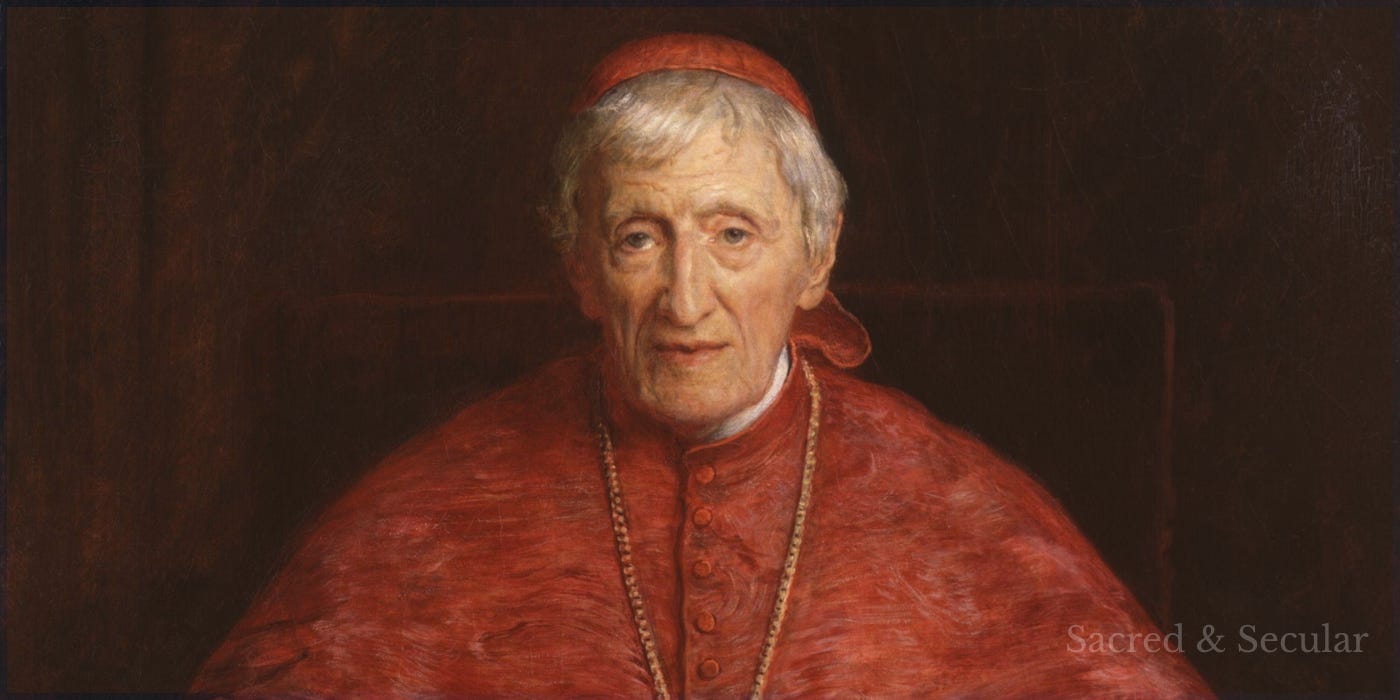
Today, I reflect on John Henry Newman and whether remaining faithful sometimes means being willing to change.
You may also be interested in my new book, Sacred & Secular: Find God in the Ordinary, which brings together some of the most popular and thought-provoking reflections from this journey so far. Amazon UK or USA.
Two days ago, the Catholic Church marked the memorial of John Henry Newman around the world. There is something particularly interesting about the date chosen to remember him. Newman did not die on 9 October, nor was he born on that day. It was 9 October 1845 when, after more than twenty years as an Anglican clergyman, he was received into the Roman Catholic Church.
I find that fascinating.
Newman would eventually become a cardinal and, much later, a saint. Yet the date associated with him commemorates a moment when he crossed one of the largest religious boundaries imaginable in nineteenth-century England. For many of the people around him, this was not simply a theological adjustment. He had left the Church in which he had been ordained, preached, studied and become one of the most influential religious thinkers of his generation.
As someone ordained in the Church of England myself, I am not particularly interested in using Newman to reopen an Anglican-Catholic argument that has already been going on for quite long enough. There are plenty of people willing to do that without my assistance.
What interests me is something much more personal.
What happens when taking your faith seriously leads you to question something you have previously believed just as seriously?
❦
The uncomfortable side of conviction
Christians tend to admire people who stand firm.
We celebrate conviction. We tell stories about people who refused to compromise, held onto their beliefs in difficult circumstances and would not be moved simply because the world around them changed. There is something admirable about that. A faith that changes direction every time the cultural wind blows would not be much of a faith at all.
Yet I wonder whether we occasionally confuse faithfulness with immovability.
Newman had strong convictions. If anything, that was part of his problem. He had spent years trying to articulate a distinctive Anglican position, particularly through what became known as the Oxford Movement. He believed the Church of England could recover something of its ancient Catholic identity without submitting to Rome.
Then he began studying the early Church more closely.
What followed was not a sudden emotional conversion. Newman later described a long and uncomfortable process in which the arguments he had used to defend his Anglican position gradually became less convincing to him. Studying ancient controversies began raising questions he could no longer put back in their box. Even then, he resisted leaving. As late as 1841, he could still write that his duty was to remain where he was.
It took years.
That detail matters because it would be easy to tell Newman’s story as though he simply discovered Catholicism and immediately changed sides, but the truth is he wrestled for some time.
❦
Changing in order to remain the same
A few years later, Newman wrote one of the sentences for which he is now best remembered:
“To live is to change, and to be perfect is to have changed often.”
Taken on its own, that sounds wonderfully modern. After all, you could put it on an inspirational poster and use it to justify almost anything. Changed your theology? Newman approves. Changed your politics? Newman approves. Bought another MacBook because this one has slightly better battery life? I guess Newman probably has nothing useful to say on the matter.
But that is not really what he meant.
The line comes from his Essay on the Development of Christian Doctrine, in which Newman sought to explain how Christian belief could genuinely develop over centuries without simply becoming something different. Just before the famous sentence, he describes a living idea encountering new situations and new questions and says that it “changes with them in order to remain the same.”
That is much more interesting.
For Newman, genuine development did not mean throwing away yesterday’s truth in favour of today’s preference. He described authentic development as change which remains continuous with what came before, protecting and deepening it rather than simply reversing it.
Something living changes because it is alive.
A tree that looks exactly the same at fifty years old as it did when it first broke through the soil would not be a particularly impressive tree. Yet its growth does not mean it has ceased to be the same tree.
Newman wondered whether faith might work something like that.
❦
When conscience becomes inconvenient
There is another part of Newman’s thinking that prevents this from becoming a comfortable celebration of changing our minds whenever we feel like it.
He took conscience extremely seriously.
Today, we sometimes use follow your conscience to mean something close to do whatever feels right to you. Newman meant almost exactly the opposite. He understood conscience as something capable of confronting our preferences rather than simply approving them. He even warned that human reasoning can become very good at supporting what we already want to believe.
I recognise that tendency all too easily.
I can normally construct an excellent argument for something I already want to do. Give me enough time, and I may even be able to convince myself that buying the expensive version was an act of moral responsibility.
The much harder task is allowing something to challenge us when we do not particularly like where it is leading. That is what makes Newman’s story compelling, even if we do not agree with the conclusion he reached.
Becoming Catholic cost him.
His journey towards becoming Catholic had already cost him. He resigned his position at St Mary’s in Oxford. Important relationships became strained. Friends watched painfully as connections which had shaped Newman’s life were gradually severed. One of his contemporaries described how much Newman seemed willing to sacrifice as he moved towards the decision he eventually made.
Whatever else we think about Newman, convenience does not seem a very convincing explanation for what happened.
❦
Peter had a problem like this
This reminds me of a moment in Acts that feels strangely relevant.
Peter is praying when he receives the famous vision of a sheet filled with animals and hears the instruction to eat. His response is immediate: absolutely not, and understandably so.
Peter’s resistance is not based on personal fussiness or some irrational prejudice. He believes he is being faithful to the religious practices he has inherited from Scripture and followed all his life. Then comes the unsettling reply:
“What God has made clean, you must not call profane.”
Peter does not immediately understand what is happening. Acts tells us that he is initially puzzled by the vision. It is only as events unfold and he enters the home of the Gentile Cornelius, that he begins to realise that the question is much larger than food. His understanding of who could be included within God’s people is being stretched.
Peter has not suddenly stopped caring about faithfulness; in fact, it is the opposite. His difficulty is that faithfulness itself is forcing him to reconsider what he thought faithfulness required.
I suspect that is one of the hardest places to stand.
❦
The beliefs we inherit
Of course, most of us are unlikely to face Newman’s particular decision.
We will not spend years studying fourth-century theological disputes before deciding whether Canterbury or Rome has the better claim on us. Most of our mornings present rather less dramatic problems. Yet I suspect many of us know something about discovering that what we once believed no longer seems as simple as it did.
Perhaps we were given a very clear picture of God when we were young. It helped us enormously then, but life complicated it.
Perhaps suffering arrived, and some of our easy answers stopped working.
Perhaps we met someone whose life did not fit the theological category we had carefully constructed for people like them.
Perhaps we read Scripture more closely and discovered passages that refused to behave in the way we had been told they would.
Or maybe we simply got older. I certainly do not believe exactly what I believed twenty or thirty years ago. Some convictions have become stronger while others have become more nuanced. A few have disappeared altogether.
I don’t necessarily see that as evidence that my faith has weakened. In fact, sometimes the opposite has happened.
❦
What are we trying to remain faithful to?
What intrigues me most about Newman’s eventual conversion is the way he described it afterwards.
He did not believe that becoming Catholic had required him to discard everything he previously held sacred. He said that his belief in the Church, bishops, sacraments and Christian doctrine remained. In his words, he had “added Articles to my Creed”, while the old convictions remained.
Of course, an Anglican might tell that story rather differently.
But Newman’s own understanding matters. He believed he had changed precisely because he was trying to remain faithful to something deeper, and perhaps that leaves us with a more interesting question than whether changing our minds is good or bad. What are we actually trying to remain faithful to: our previous opinion, the people who expect us to hold it, the security of knowing exactly where we stand, or the truth, even when following it takes us somewhere we did not expect to go?
There will be times when faithfulness means standing firm, and there will be convictions worth holding when almost everyone around us tells us to let them go.
But perhaps there will also be times when faithfulness means moving. Newman’s life does not tell us that change is always good, and Peter’s story does not tell us to distrust everything we inherited. They simply leave open the possibility that sometimes the most faithful words we can say are:
I may have been wrong.
Maybe faith is not always knowing where the road eventually leads. Sometimes it is simply having enough trust to take the next step.
A question to ponder: Is there something you have always assumed about faith, God or yourself that you may need to look at again, not because you want an easier answer, but because you want to remain open to where truth might lead?
Thank you for reading today’s reflection.
Paul
Join the community!
Paid subscribers get a daily reflection, full access to the archive and a free downloadable devotional.
Thanks for this thoughtful article, Paul. Though I know it has wider implications than feeling “at home” in one’s denomination, many of us have moved from one denomination to another, from one theological perspective to another. I moved from the Presbyterian Church of Scotland to the (more Roman!) Church of England in my thirties. On the face of it, this was brought about by marriage and relocation but the more sacramental, liturgically led Anglican tradition was, and still is, more appealing and more nourishing to my faith.
Nearly 50 years on I find much to criticise within my chosen church but still feel “at home” here. There is a big distinction between one’s faith per se and the organisation one chooses to belong to in order to live out that faith.
But your article addresses a much wider subject than the “fit” of one’s denomination. You’re right to say that as thinking human beings we can rationalise our every action to suit our needs but if we are trying to give ourselves totally to following Jesus, we need constantly to be evaluating our actions/decisions/lifestyle choices. Sometimes I envy Peter his sheet filled with animals. You could hardly miss that. It was not exactly a subtle hint!
You wrote,"His difficulty is that faithfulness itself is forcing him to reconsider what he thought faithfulness required." I have stood there. And made the decision to inquire into Roman Catholicism. However, I stood there not for intellectual reasons but because I wondered if having arrived at that intellectual tilt was a hint that GOD's will for me might lie in that direction. Once you have heard the Word of God (the boy Samuel stood on that brink in 1 Samuel 3:7), your faithfulness is to God, not to the religious institution. That point is made in regard to Samuel as Eli insists that Samuel tell him frankly what he has heard from God directly, although the message may -- and does -- impinge on his priestly office. Equally, God can call a person into or out of particular institutions. I worshiped in the RC church for 25 years before being more or less pushed out of it by the affiliated school officials and a mentally ill priest.
Moving on from Samuel to King Saul shows us the tension between leadership by a "seer" and leadership by a "king." Samuel had some teachings for the people of Israel, as a seer representing God's voice, and the people of Israel had their own notions of what kind of leadership they thought they wanted in order to be protected from the Philistines. Samuel warns them that a mighty economic shift will accompany any revision in their institutional obligations.
Today, leadership in a major religious institution hasn't quite the autocratic effects on members that it did a century or two ago, but the mere fact of institution still has consequences for the individuals trying to follow Jesus and the leading of the Holy Spirit. For one thing, the Anglican and Roman Catholic churches do not follow Jesus' example of pacifism, while wars and rumors of wars are as real today as in the days of the Late Bronze Age collapse. These are not small matters.