


Welcome to Sunday’s article for all subscribers.
Throughout the week, I write daily reflections for paid subscribers. Sundays are my opportunity to open the doors a little wider and share something with the whole Sacred & Secular community.
You may also be interested in my new book, Sacred & Secular: Find God in the Ordinary, which brings together some of the most popular and thought-provoking reflections from this journey so far. Amazon UK or USA.
There are some verses in the Bible that I instinctively want to explain away.
I suspect most of us have them. We read the words, pause for a moment, and think, Surely that cannot mean what it appears to mean. Sometimes another translation helps. Sometimes, historical context makes everything considerably clearer. Occasionally, after enough digging through commentaries and Bible software, the passage begins to look completely different.
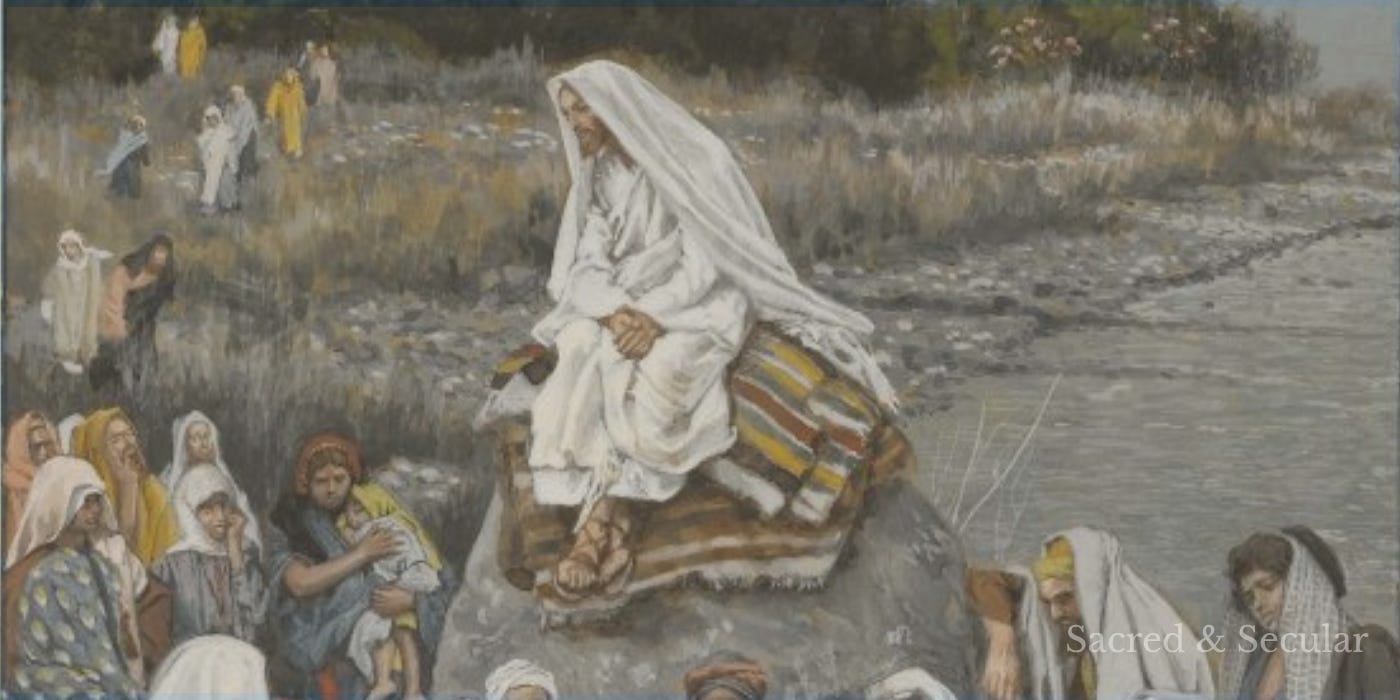
Then there are the sayings of Jesus that remain uncomfortable even after we understand them. One of the most notable appears in Luke’s Gospel, where Jesus is speaking to a large crowd and says:
“If anyone comes to me and does not hate father and mother, wife and children, brothers and sisters, yes, even their own life, such a person cannot be my disciple.”
I have read those words many times, and they still make me stop. This is the same Jesus who tells people to love their enemies, who criticises religious leaders for finding spiritual excuses to avoid caring for their parents, and who, even as he hangs dying on a cross, makes arrangements for his mother to be cared for.
Then, suddenly, he appears to say that anyone who wants to follow him must hate their family.
It is hardly surprising that the verse regularly appears in lists of the Bible’s most difficult passages. Taken on its own, it sounds less like the teaching of Jesus and more like the entrance requirements for a particularly unhealthy religious cult. For a long time, I simply assumed there must be an explanation somewhere beneath the surface.
There is.
But the trouble is that I am not sure it makes the passage easier.
❦
The first problem is that we hear the word hate through modern ears.
If I tell you that I hate somebody, you would probably assume there is something seriously wrong between us. The word suggests hostility, resentment, anger, or perhaps even a desire to avoid that person altogether.
But words do not always carry exactly the same meaning across languages and cultures. Throughout parts of the Bible, the language of loving and hating is sometimes used to describe preference rather than emotion. It tells us who or what comes first.
One of the clearest examples appears in Jacob's rather complicated family life. Jacob famously loved Rachel, but through a sequence of events that would make a modern family therapist consider early retirement, he ended up married to both Rachel and her sister Leah.
The biblical story makes it clear that Jacob loved Rachel more. Some older translations, however, describe Leah as being “hated.” That sounds appalling until we look at what is actually happening in the story. Jacob does not treat Leah as an enemy. He continues to live with her, has children with her, and remains part of the same household. The comparison is about preference. Rachel has the first place in his affection, while Leah is loved less by comparison.
That way of speaking appears elsewhere in the ancient world, too. Love and hate could describe loyalty, commitment and allegiance. To “love” a king, for example, did not necessarily mean feeling particularly warm whenever his name was mentioned. It meant remaining loyal to him and recognising his authority.
That helps considerably when we return to Jesus. It helps even more when we look at Matthew’s Gospel, which records a very similar saying in a different form:
“Anyone who loves their father or mother more than me is not worthy of me.”
Suddenly, Luke’s disturbing sentence begins to make more sense. Jesus is not commanding his followers to become hostile towards their parents, abandon their children or despise their spouses. He is talking about priority.
At that point, it would be tempting to breathe a sigh of relief and move on. Jesus does not actually want us to hate our families. Problem solved.
Except I think that is where the passage becomes properly interesting, because once we remove the meaning Jesus probably didn’t intend, we are left with one that may be even more demanding.
❦
Family in the world of Jesus was rather different from the way many of us experience it today. Of course, family remains hugely important. Most of us are deeply shaped by the people who raised us, the people we share our lives with and the complicated network of relationships that surrounds them.
But in modern Western culture, we also expect to possess an identity of our own. Children grow up and move away. They choose careers their parents might never have imagined and might marry people their families may not have selected. They change their political opinions, religious beliefs and lifestyles. Sometimes parents approve. Sometimes they don’t.
The first-century world was far more tightly connected. Family was not simply where you found affection. It was where you found identity, economic security, social standing and protection. Your place within the community was inseparable from your household and wider kinship network.
Breaking with family expectations could therefore cost far more than an awkward Christmas dinner. It might mean losing your livelihood, your reputation and the people upon whom you depended for survival. Against that background, Jesus’ words begin to regain their original strength.
Imagine hearing him say that loyalty to him must come before loyalty even to the people who provide your security, identity and place in the world. That was not a conceptual theological statement. For some of the people listening, following Jesus really did create division within families. Some were rejected by those closest to them. Others found themselves belonging to this strange new community of disciples precisely because their previous communities no longer understood them.
Jesus never pretended that following him would be easy. In the verses surrounding this saying, he talks about carrying a cross and counting the cost before beginning. He uses the image of someone starting to build a tower and making sure they can actually finish it.
This is not Jesus trying to attract as many followers as possible by making the terms sound appealing. Quite the opposite. He appears to be saying: Before you follow me, understand what you are choosing.
That is where I begin to feel the discomfort of this passage again, because perhaps the shocking part is not the word hate after all. Perhaps the shocking part is the place Jesus claims for himself.
❦
Most of us will never be asked to choose between following Jesus and remaining part of our family, but competing loyalties have not disappeared. We simply have different ones.
We have careers, ambitions and reputations. We have financial security and political identities. We have communities whose approval matters enormously to us. We have opinions we have defended for so long that changing our minds can feel like losing part of ourselves. I sometimes suspect comfort may be one of the strongest allegiances of all in Western culture.
Of course, I am not saying that any of those things is necessarily wrong. Family is good. Work can be deeply meaningful. Financial security matters. Being part of a community is one of the things human beings need in order to flourish.
The problem begins when something good quietly becomes the most important thing.
That is the challenge I hear in Jesus’ words. He is not asking us to love everyone else less in the sense of becoming colder or less generous towards them. If anything, the rest of his teaching calls us towards a deeper love. But he refuses to become merely one more thing we fit into an already crowded life.
Jesus does not seem particularly interested in occupying the religious section of our identity: a little faith alongside our family, work, politics, money, ambitions and hobbies. He claims something much more fundamental.
Perhaps a better way of thinking about it is not to imagine Jesus sitting at the top of a list. Jesus first, family second, work third, and everything else arranged neatly underneath. Life rarely works in such tidy categories anyway.
I think the image of a foundation works better. The foundation is not simply the first part of the building. It is the thing upon which everything else rests.
If faith becomes foundational, it changes the way I hold everything else. It changes how I love my family, what success means, how tightly I hold money, status and reputation, and what I am prepared to sacrifice. It may even change the things I once assumed could never be questioned.
That is much harder than simply adding Jesus to the top of a priority list. It means allowing him to shape the list itself.
❦
I find that challenging because it is easy to say that God comes first when nothing particularly important is asking us to choose. The real test comes when two loyalties pull in different directions.
What happens when doing what we believe is right risks disappointing someone we love? What happens when our faith begins to challenge a political identity, an ambition, a comfortable habit or a version of ourselves we have spent years protecting? What happens when following the path we believe is right actually costs us something?
Perhaps those moments reveal our deepest allegiances more clearly than anything we say we believe.
That may be why Jesus chose language strong enough to stop a crowd in its tracks. He was not offering another spiritual interest to add to an already busy life. He was asking people to reconsider what their lives were built around.
Two thousand years later, that question has lost none of its power.
Family matters. Work matters. Friendship, security, belonging and achievement all matter. The challenge comes when any of them begins to shape our lives so completely that we stop noticing what is driving us.
Perhaps that is the uncomfortable gift hidden inside Jesus’ words. They force us to look beneath the things we say matter and ask what is actually guiding our decisions, ambitions and loyalties.
Perhaps the question is not simply, What matters most to me?
It is something more searching.
What am I doing this for?
A question to ponder: What is really shaping the choices I make, and what am I doing it for?
Thank you for reading today’s reflection.
Paul