


Welcome to Sacred & Secular, my writing home, here on Substack.
Today I reflect on an early attempt to tidy up the story of Jesus, and why Christianity eventually kept four different versions instead.
If you enjoy these reflections, my new book, Hidden in Plain Sight, is out today. It explores the overlooked details, surprising questions and ordinary moments that can change how we see Scripture and faith.
It is now available in paperback and on Kindle in the UK, USA and all other markets.
Paul
I have spent enough time writing by now to feel the irritation of having two versions of the same thing in front of me.
Perhaps one paragraph says something slightly better, while another contains a detail I do not want to lose. Usually, I end up moving sentences around, deleting the repetition and producing one version that hopefully says everything I wanted to say in the first place. It all takes time, but I love the process of moving from irritation to something I am finally pleased with.
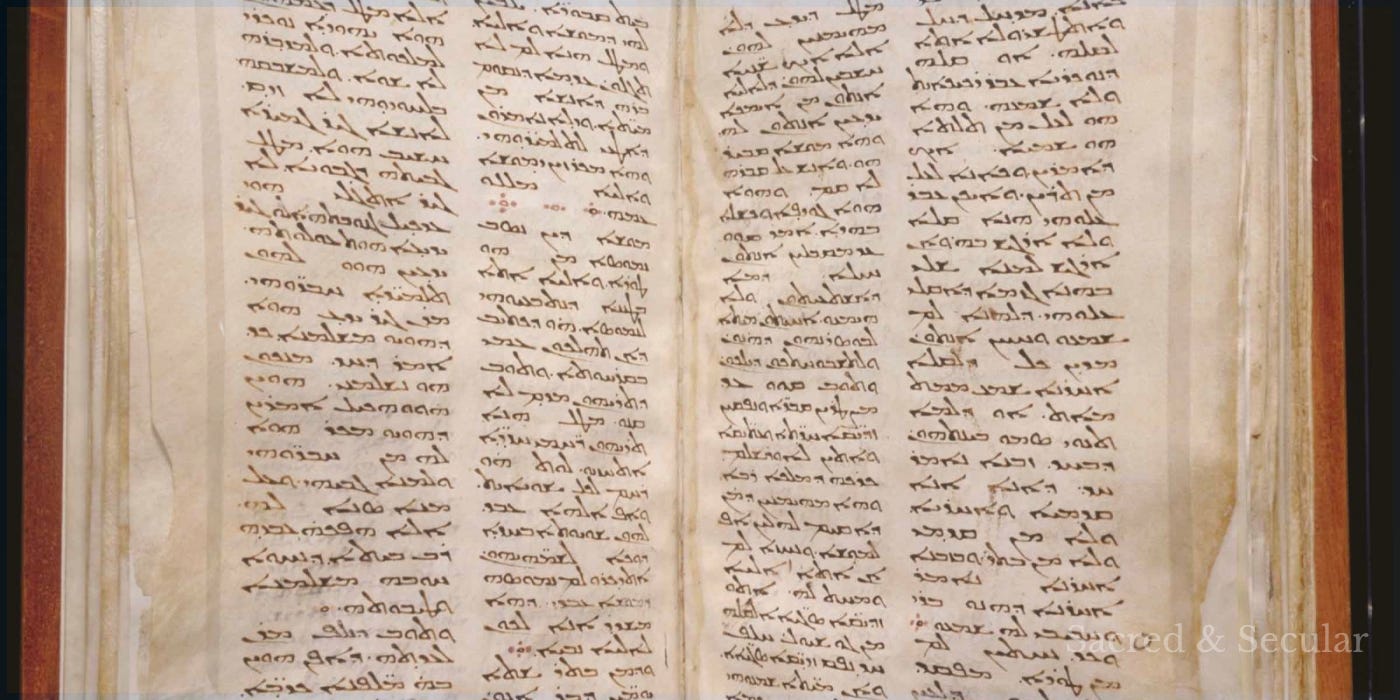
Sometime during the second century, a Christian writer called Tatian did something similar with the Gospels. He took Matthew, Mark, Luke and John and brought them together into a single continuous account of the life of Jesus. Instead of four beginnings, four journeys through Jesus’s ministry and four accounts of his final days, readers were given one story. It was called the Diatessaron, meaning roughly “through the four”.
On the surface, you can probably see why this would make sense.
It was not a failure. In parts of the Syriac-speaking Christian world, Tatian’s combined Gospel became extremely influential. Christians read it, churches used it, and one of the most important early Syriac Christian writers, Ephrem, even wrote a commentary on it. For generations, there were Christians for whom this combined Gospel was simply the normal way they encountered the story of Jesus.
That left me wondering something I had never really thought about before.
Why do we still have four?
❦
Let’s be honest, four Gospels can be inconvenient.
We tend not to notice that inconvenience at Christmas because we have become very good at fixing it ourselves. Ask most Christians to picture the nativity, and they will probably see Mary, Joseph and Jesus, with shepherds nearby and wise men arriving sooner or later.
Except Luke gives us the shepherds, while Matthew gives us the visitors from the east. Matthew also gives us Herod, the slaughter of the children and the flight into Egypt. Luke gives us the census, the manger and the angels filling the sky. Mark has none of that and begins with John the Baptist, while John begins even further back with those epic words: “In the beginning was the Word.”
Somewhere along the way, most of us have taken those very different openings and built one Christmas story in our imagination. There is nothing particularly wrong with that; it would be a very poor crib service if I had to explain the differences throughout. But it does mean we can stop noticing how differently each writer has chosen to tell the story.
The differences continue.
John places Jesus clearing the Temple near the beginning of his ministry, while Matthew, Mark and Luke place it towards the end, shortly before his death. The resurrection accounts contain details that are not always easy to fit neatly together. Even Jesus’s final words from the cross differ depending on which Gospel we are reading.
Christians have been trying to make sense of such differences for a very long time, and Tatian’s solution was wonderfully practical: bring everything together.
We should be careful not to claim too much about why he did it. His original text has not survived intact, and scholars still debate some of the details. A single account could also have been easier to copy, carry and use than several separate books. Perhaps bringing the accounts together also helped remove some of the awkwardness when they appeared to disagree.
❦
Whatever Tatian intended, people clearly liked the result. At roughly the same time, however, another Christian leader was arguing in a very different direction.
Irenaeus was bishop of Lyon in what is now France, and around AD 180 he wrote that there could be neither more nor fewer than four Gospels.
Expecting a robust theological argument for this, I was surprised by his explanation. There were four principal winds, he said, and four regions of the world. The mysterious creatures surrounding God’s throne in Ezekiel and Revelation also had four faces. For Irenaeus, the number four seemed woven into the order of creation itself, and the four Gospels belonged within that pattern.
I did not see that one coming.
But underneath the symbolism, something more serious was happening. Christians were arguing about who Jesus was and which accounts of him could be trusted. Some groups preferred one Gospel. Marcion famously used an edited form of Luke. Other Christians were producing or appealing to additional writings that claimed to reveal truths about Jesus.
Irenaeus wanted Matthew, Mark, Luke and John held together. He was resisting both the temptation to reduce the Gospel to one preferred account and the growing collection of alternative writings claiming authority.
It would be tempting at this point to turn the story into an epic contest between Tatian and Irenaeus, but history, inconveniently, refuses to cooperate. There is no evidence that Irenaeus was directly arguing against Tatian’s Diatessaron in the passage where he defends the four Gospels, nor was there a single meeting where representatives from across Christianity voted to keep Matthew, Mark, Luke, and John as separate books.
Things developed much more slowly than that. In fact, Tatian’s combined Gospel remained in use for centuries.
❦
That became clear to me when I reached a fifth-century bishop called Theodoret. He was responsible for churches in part of Syria, and he records finding more than 200 copies of the Diatessaron used in churches in his region. By then, Tatian had been dead for generations, yet his combined version of Jesus’s story was still sitting in churches and being treated with respect.
Theodoret was not happy about this. He believed Tatian had removed passages that mattered, particularly the genealogies of Jesus and material showing his descent from David. Tatian himself had also acquired a theological reputation that made later church leaders suspicious. So Theodoret gathered the copies and replaced them with Matthew, Mark, Luke and John.
Centuries after someone had produced a simpler, combined version of the story, a bishop was going around churches replacing it with the four separate accounts.
Eventually, the four separate Gospels became the norm. There are many reasons why. By the end of the second century, they were already widely recognised as particularly important witnesses to Jesus. They were associated with apostolic authority, used in worship, copied and circulated, and increasingly gathered together in the same manuscripts.
❦
My instinct is to say that Christianity kept all four Gospels because each offered a different and valuable perspective on Jesus.
I still think there may be something in that as a theological reflection, but the history will not let me claim it as the reason they survived. The process was too gradual and too complicated for that.
What we can say is that they did keep them, and perhaps that is enough to make us look at them differently. I think I have often treated the four Gospels as though they were pieces of a jigsaw. Matthew has one piece, Luke has another, John has something else, and if I arrange them carefully enough I can reconstruct the complete picture.
Sometimes that is useful thinking, but a Gospel is more than a collection of missing details.
Mark has chosen how to tell his story. Luke has chosen what to emphasise. Matthew repeatedly connects Jesus with Israel’s story in ways that matter to him. John tells the story in such a different voice that there are moments when it almost feels as though we have walked into another room.
If I merge them immediately, I might miss that. Perhaps one of the simplest things we can do with the Gospels is also one of the hardest: allow each writer to finish speaking. Read Mark without constantly adding Luke. Read John without trying to make every event appear in precisely the same place as it does in Matthew. Notice what each writer slows down for, and what he passes quickly by.
The strange thing is that Tatian’s instinct has never really disappeared.
Most of us still carry a Diatessaron around in our heads, a combined Jesus story made from years of Christmas plays, sermons, films, Bible readings and memories. We rarely notice when we have moved a detail from one Gospel into another because the finished version feels so familiar.
Perhaps that is why this old argument still matters. Not because differences between the Gospels are unimportant, or because every difficulty can be turned into a virtue. Some passages remain difficult, and I think Christians should be honest about that.
But sometimes, before asking how four accounts can be made to say exactly the same thing, there may be another question worth asking: what was this writer trying to show me?
In a couple of months, when I read Luke’s Christmas story, I might leave the wise men outside for a while. They can come back when I open Matthew. After all, Luke has some shepherds he would like me to meet first.
A question to ponder: When you picture a familiar story about Jesus, how much of what you see actually comes from the Gospel you are reading, and how much have you added from the others?
Enjoy being part of Sacred & Secular?
Sacred & Secular is my writing home, where I share personal reflections on life, faith, doubt, and the things I’m still discovering about God.
If you enjoy these reflections, becoming a paid subscriber gives you access to my weekday writing in full, while helping me continue creating this space for conversation and exploration.
I’m enormously grateful to everyone who reads, shares or supports my work. You’re all part of what makes this community possible.
If you are already a paid subscriber, thank you. Your support means a great deal to me. And if you are reading on the free tier and would like to receive the daily reflections as well, you are very welcome to join us.