


Welcome to today’s reflection.
Today I explore how people once believed terrible illnesses were punishment from God, and why, even today, we still struggle with the idea that suffering might not be deserved.
In the middle of the fourteenth century, as the Black Death swept across Europe, people were dying in numbers that are difficult now to imagine. Families lost children, towns lost neighbours, and communities watched helplessly as a disease they could neither understand nor stop moved relentlessly from one household to the next. There were doctors and treatments, of course, but very little that could effectively prevent the devastation.
For some, the explanation was terrifyingly clear. God was angry, and the plague was his punishment. If that was true, then perhaps the only hope was to demonstrate just how sorry humanity was.
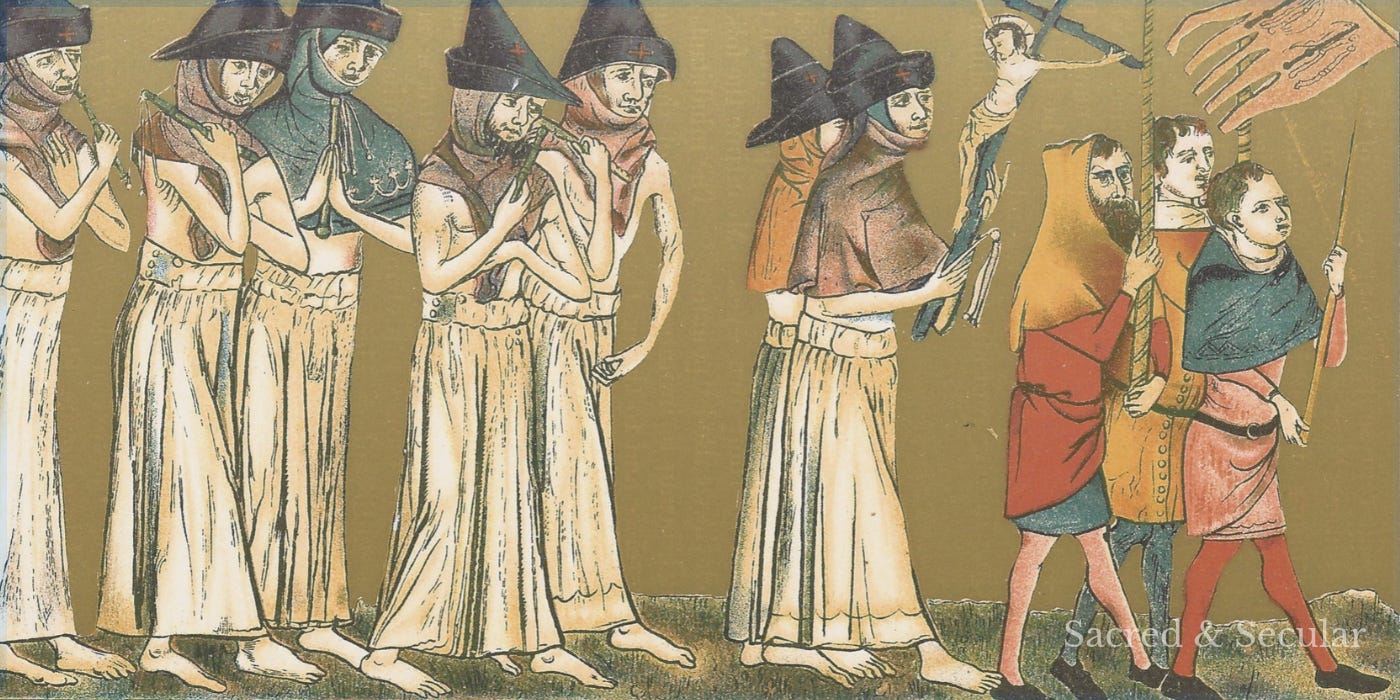
Groups known as flagellants travelled between towns, whipping themselves publicly as an act of penance. They believed their suffering might help appease God’s anger and bring the plague to an end. It is a disturbing picture: people surrounded by unbearable suffering, convinced that inflicting more suffering was the only way to escape it.
Of course, not everyone agreed with them, even at the time, but their response tells us something about the desperation people felt.
Imagine becoming seriously ill and believing that God might be responsible. Not only are you frightened by the illness itself, but you now have an additional worry:
What have I done to deserve this, and what must I do to make God change his mind?
❦
Of course, we have moved on from this way of thinking these days.
Or have we really?
We know so much more about illness today. We can identify bacteria and viruses, understand inherited conditions and, in many cases, offer treatments that would have seemed miraculous to our ancestors. Most Christians I know would be horrified by the suggestion that someone developed cancer because they had displeased God.
Yet listen to the things people say when life takes a terrible turn.
What have I done to deserve this? Why do bad things happen to good people? It’s just not fair.
Often these are simply expressions of grief or frustration. I don’t think someone saying them has necessarily decided that God is handing out punishments. But they do reveal something about our expectations. Somewhere buried deep inside us, there is still a sense that goodness ought to offer a little protection, that suffering should have a reason, and that life should distribute its joys and sorrows with some kind of regard for who deserves what.
