


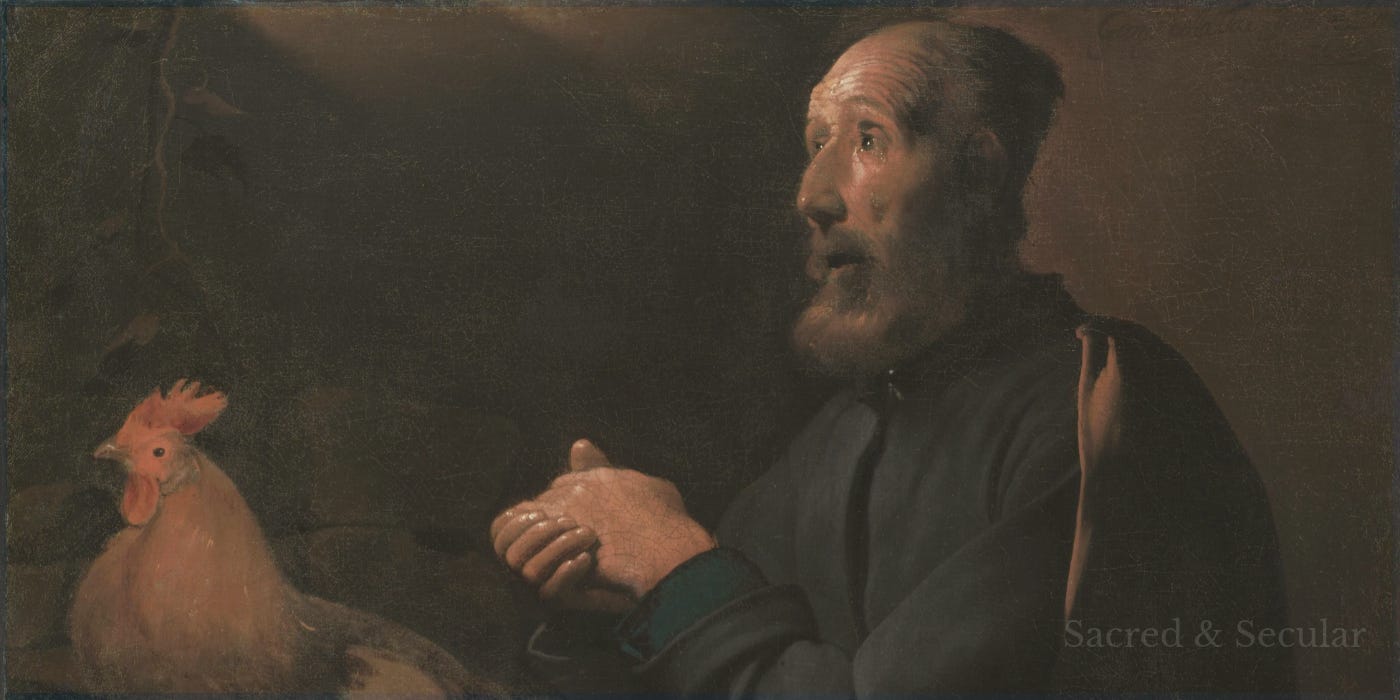
Welcome to Sacred & Secular, my writing home, here on Substack.
Today I reflect on the difference between knowing what is right and living by it, and why Peter’s failure might encourage us to be a little more understanding of our own shortcomings and those of others.
If you enjoy these reflections, my new book, Hidden in Plain Sight, is now out. It explores the overlooked details, surprising questions and ordinary moments that can change how we see Scripture and faith.
It is now available in paperback and on Kindle in the UK, USA and all other markets.
Some of the most influential people in my life would probably be astounded if I told them just how much they have shaped me.
They quietly go about their business, getting on with everyday life, and most have never held positions of particular importance or influence. Yet, they are people of deep faith, and what has always struck me is just how evident that faith is in the way they live.
I have never seen them pray privately or read their Bibles, and I couldn’t tell you much about their theological beliefs. But there is something about the way they treat people, respond to difficulties and conduct themselves that makes their faith unmistakable. It is almost as though their relationship with God has become so deeply embedded in their lives that it naturally shapes what they do.
Just trying to put this into words is difficult, but I suspect you may know somebody like this yourself. Deep, gentle but steely people of faith who inspire everyone they meet. I have always found such people very inspiring, perhaps because they demonstrate what Christian faith can look like when it becomes part of someone’s everyday life.
Of course, even these people get things wrong. They have moments when they lose their temper, make poor decisions or behave in ways that seem completely out of character. When that happens, we tend to notice, precisely because it is so out of character.
Perhaps this is why I find one particular incident involving the apostle Peter so interesting.
❦
Peter was one of the most influential figures in the early church, although his journey to becoming that person had hardly been straightforward.
He had spent years following Jesus, witnessing his miracles, listening to his teaching and slowly discovering that the Kingdom of God was very different from anything he could have ever imagined. He had also experienced failure, publicly denying that he even knew Jesus on the night of his arrest.
Yet that failure had not come to define him. Peter became one of the leading voices of the early Christian movement, preaching at Pentecost and helping the first believers understand what it meant to follow the risen Jesus.
Then something happened that once again challenged his understanding of God.
In Acts 10, Peter encounters a Roman centurion named Cornelius. To cut a long story short, through a vision and the events that follow, he comes to understand that God’s welcome is not restricted by the religious and cultural boundaries he has always known. Gentiles, people outside the Jewish faith, are all being welcomed into this new community without first having to become Jews.
Peter witnesses the Holy Spirit being given to them, and later defends what has happened before other believers who are understandably struggling to make sense of it.
“God has shown me that I should not call anyone impure or unclean,” he explains.
We should not underestimate how life changing this was for Peter and the others. These are people whose entire lives had been shaped by Jewish religious identity. Peter had not simply learnt something new; he had experienced something that changed the way he understood other people, and he had been brave enough to act upon it.
You might imagine that, having reached this understanding, the matter was sorted quickly.
But as we know, human beings are never that straightforward.
❦
Some time later, we read that Peter is visiting the Christian community in Antioch. We see progress, in that Jewish and Gentile believers are sharing meals together, something that would previously have been deeply uncomfortable for many of them. Peter joins them happily, apparently living out the very thing he has come to believe.
Then some visitors arrive from Jerusalem, and suddenly, everything changes. Paul describes what happens in his letter to the Galatians:
“Before certain men came from James, he used to eat with the Gentiles. But when they arrived, he began to draw back and separate himself from the Gentiles because he was afraid of those who belonged to the circumcision group.”(Galatians 2:12)
This is a fascinating observation. Peter does not suddenly announce that he has changed his mind about Gentile believers, or present a new theological argument to explain why his earlier convictions were mistaken.
He simply becomes afraid.
We don’t know exactly what frightened him. Some biblical scholars have suggested that he may have been worried about criticism from more conservative Jewish Christians. Others wonder whether he feared that his behaviour might create difficulties, or even danger, for Jewish believers back in Jerusalem.
Whatever the precise reason, something about the arrival of those visitors caused Peter to behave differently.
And the thing is, I think we sometimes underestimate how easily this can happen.
❦
We like to imagine that our convictions are fixed, particularly when they concern things we consider important. We can tell ourselves that we would never compromise our principles, unfairly exclude someone, or remain silent when something needs to be challenged. Yet circumstances have a habit of testing those convictions in ways we hadn’t anticipated.
If I am being really honest, I can think of occasions when I have said or done something and subsequently wondered why I behaved that way. I really did know better at the time. The thing is, I could probably have explained exactly what the right response should have been, and might even have offered somebody else sensible advice in the same situation.
But knowing better didn’t stop me from getting it wrong at the time.
I think that is what happened to Peter, and the uncomfortable thing is that it affected other people. Imagine being one of those Gentile believers in Antioch. You have become part of a community where people who would previously have kept their distance are now sitting together, sharing food and recognising one another as members of the same family.
Peter himself has been eating with you. This is one of Jesus’ closest disciples, a man whose reputation and influence are extraordinary. Then some visitors arrive, and suddenly he withdraws.
Nobody has to tell you that something has changed; after all, his actions communicate that message well enough. I am sure you would begin to wonder whether you really belong after all. Paul tells us that the other Jewish believers followed Peter’s example, and even Barnabas was drawn into their behaviour.
What began with one man’s fear was now affecting an entire community.
❦
Paul was, of course, furious and does not pull any punches.
“When Cephas came to Antioch, I opposed him to his face, because he stood condemned.” (Galatians 2:11)
He challenged Peter publicly because the consequences of his behaviour were public. People were being hurt, and the example of such an influential leader was encouraging others to behave in the same way.
Paul was right to challenge him, because understanding why somebody behaves badly doesn’t mean pretending their behaviour doesn’t matter, especially when other people suffer as a result. But there is something else I find myself thinking about whenever I read this passage.
Peter was still Peter.
He was still that same man who had followed Jesus, preached with courage, welcomed Gentile believers and helped shape the earliest Christian communities. His failure in Antioch was serious, but it didn’t erase everything that had gone before.
❦
I wonder whether we sometimes forget that when judging other people.
We can be remarkably quick to reach conclusions about somebody’s character based on a single action, particularly when their behaviour disappoints us. We see something we believe is wrong and begin to assume that it tells us what the person is really like, without knowing very much about the circumstances that led them there.
Of course, that doesn’t mean we should ignore wrongdoing or pretend that the consequences don’t matter; Paul definitely didn’t. But I think there is a difference between recognising that somebody has behaved badly and deciding that their behaviour defines who they are.
Which is perhaps where we need to apply the same grace to ourselves as well.
I suspect that, like me, most of us can remember things we have said or done that we would dearly love to change. Sometimes those memories stay with us for years. We can replay conversations, wish we had behaved differently, or wonder how we could have made such a poor decision when we knew perfectly well what was right.
The trouble is that we can begin to see ourselves through those moments, as though our worst decisions somehow reveal the person we really are, while all the good things about us are just the exceptions.
I wonder if Peter ever felt like that.
He had already experienced the shame of denying Jesus, and now here he was, years later, being publicly challenged by Paul for behaving in a way that contradicted everything he had come to believe.
Galatians doesn’t tell us how Peter responded, or what he thought about the incident afterwards. But what we do know is that his failure in Antioch was not the whole story of his life, any more than his denial of Jesus had been.
Perhaps knowing the truth and allowing it to shape our lives takes much longer than we imagine. Even the people whose faith has inspired me so much will have had their struggles along the way. We learn, we change, we make progress, and occasionally discover that we are still capable of making mistakes we thought we had left behind.
I’m increasingly convinced that we need to take those mistakes seriously without allowing them to become the final word about who we are.
We are so much more than the moments we most regret.
Question to ponder:
Are you still defining yourself by something you did wrong, rather than recognising the person you've become since?
Enjoy being part of Sacred & Secular?
Sacred & Secular is my writing home, where I share personal reflections on life, faith, doubt, and the things I’m still discovering about God.
If you enjoy these reflections, becoming a paid subscriber gives you full access to my weekday writing while helping me continue to create this space for conversation and exploration.
I’m enormously grateful to everyone who reads, shares or supports my work. You’re all part of what makes this community possible.
If you are already a paid subscriber, thank you. Your support means a great deal to me. And if you are reading on the free tier and would like to receive the daily reflections as well, you are very welcome to join us.
Such important teaching! I had no idea that someone whose experiences I respected and was learning from also was looking to things I said, when I was expressing immature opinions, as actual advice about life-altering decisions that she was acting upon. I am not sure any of those decisions were bad ones. It was the casualness of my sharing and the seriousness of her acceptance that horrified me. I would like to say I have been much more careful since then. But the truth is that the walk of faith is a learning experience no matter how old and weather-worn you become. Being in fellowship means sharing what you've got, whether or not it's perfect. Which is why we continually return to the teachings of Jesus and to the scripture we have. Each of us has the responsibility of discerning guidance with the Holy Spirit in the awareness that our advisors are not perfect.