


Welcome to Sunday’s article for all subscribers.
Paid subscribers receive a daily reflection and access to the complete archive. I would love to welcome you today.
If you’ve recently joined us, you may also be interested in my new book, Sacred & Secular: Find God in the Ordinary, which brings together some of the most popular and thought-provoking essays from this journey so far.
When people ask why God allows suffering, my mind does not first turn to theology or philosophy.
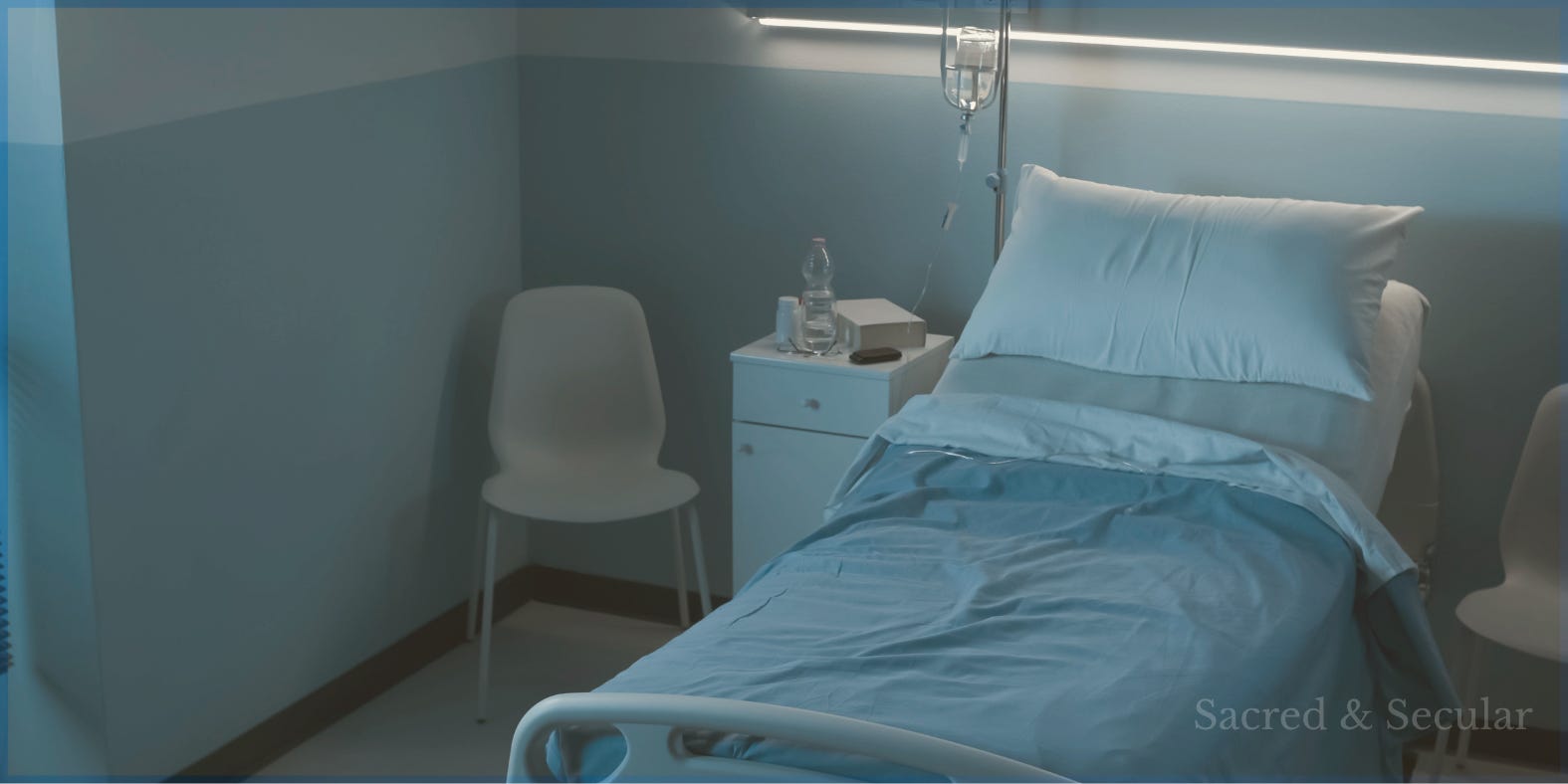
It returns to a hospital bed in the intensive care ward.
My daughter was ten years old when I carried her through the hospital doors in the early hours of the morning. She had barely been conscious for the last twenty minutes of the car journey. Her breathing had become frighteningly shallow, and by the time we arrived, I was carrying far more than her weight. I was carrying every fear a parent can imagine.
The doors burst open, and suddenly everything moved at once.
Doctors and nurses surrounded us. A bed appeared almost instantly. They gently took her from my arms and began attaching monitors, inserting tubes and calling out observations I barely understood.
Then one of the nurses quietly took me aside.
“She’s in a bad way.”
She didn’t need to say anything else. The look on her face said the rest. For a few terrible moments, I genuinely wondered whether I was about to lose my little girl.
Thankfully, over the next few hours, she began to stabilise. The doctors quickly realised that her blood chemistry was dangerously out of balance. She would later be diagnosed with Type 1 diabetes, a condition that would mean insulin injections, careful eating and constant monitoring for the rest of her life.
But those hours beside her hospital bed remain etched into my soul.
I can still picture the wires and tubes. I can still hear the rhythmic beeping of the monitors and remember how utterly powerless I felt, like it was yesterday.
It was one of the most agonising experiences of my life. In those hours, I wasn't looking for a clever explanation. I simply wanted my daughter to live.
Perhaps that is why I have always struggled with neat explanations for suffering.
Questions about suffering are rarely asked from comfortable armchairs. They are whispered beside hospital beds, cried out in hospice rooms and carried home from the funeral wake.
They are asked by parents watching their children suffer, by people living with chronic illness, by those who wake in the middle of the night, wondering whether life will ever feel normal again.
The question is ancient.
Why suffering?
Every worldview eventually has to answer it. Christianity certainly has. Across two thousand years, theologians, philosophers, pastors and ordinary believers have offered explanations that are thoughtful, compassionate and often deeply beautiful.
Yet if I am honest, none of them has ever completely satisfied me.
Not because they are wrong. But because suffering itself feels so profoundly wrong.
— • —
One explanation points to freedom.
Love cannot be forced. If God desires a genuine relationship rather than programmed obedience, then human beings must be free to choose. That freedom makes love possible, but it also makes cruelty possible. War, abuse, exploitation and injustice all become tragic consequences of human choices rather than God’s desires.
There is real wisdom here. It preserves human responsibility and explains much of the suffering we inflict upon one another.
Yet it cannot explain everything.
Free will may explain genocide, but it does not explain earthquakes. It may explain betrayal, but not childhood cancer. It cannot explain why some are born into unimaginable suffering before they have made a single moral choice.
Freedom explains part of the picture, but it does not explain the whole canvas.
Another explanation suggests that suffering shapes us.
Many of us can recognise this in our own lives. Hard experiences often deepen compassion. Loss can make us gentler, and failure can strip away our illusions and leave us wiser than success ever could.
There are parts of my own life that have undoubtedly been transformed through suffering. Long Covid changed my world in ways I never wanted, yet it also slowed me down enough to notice things I had spent years rushing past. It reshaped my writing. It deepened my compassion for those living with invisible illness. I would never have chosen it, but I cannot deny that it changed me.
Yet even this explanation has its limits because not everyone is refined by suffering. Some people are crushed by it and have wounds that never seem to heal. What of the child who dies before any character can be formed? What of those whose suffering leaves permanent trauma rather than wisdom?
If suffering is God’s classroom, the lessons often seem painfully uneven.
Others look beyond individual lives altogether.
Christianity has long spoken about a fallen creation. The world, it says, is not operating as it was intended. Disease, decay, natural disasters and death are not evidence that God delights in suffering but signs that creation itself has been fractured.
There is something compelling about that vision.
Anyone watching the evening news can sense that something is deeply broken about the world we inhabit. Yet another question quickly follows.
If God is able to heal creation, why has He allowed the fracture to remain for so long? Why does redemption seem to unfold so slowly while generation after generation continues to suffer?
— • —
Eventually, most conversations arrive at a mystery. There is much we simply do not know. Our perspective is painfully limited. We see only fragments of a story whose ending remains hidden from us.
There is humility in admitting that.
Sometimes, mystery is the only honest answer we have.
Yet mystery is also difficult to live with.
It reminds us that we are not God, but it rarely comforts the parent sitting beside a hospital bed. It protects God’s transcendence but cannot remove our grief.
Then Christianity says something altogether different. Rather than simply explaining suffering, it claims that God enters it.
The centre of the Christian story is not a philosophical argument. It is a crucified man. Jesus experiences betrayal, injustice, abandonment, torture and death. Christianity does not picture God observing suffering from a safe distance. It pictures Him stepping into the middle of it.
That has always mattered to me. Especially during the darker seasons of my own life. The Cross has never answered all my questions, but it has stopped me believing that God remains untouched by human pain.
Christianity ultimately offers something more relational than intellectual. Not an explanation, but a companion. Yet even here, the tension remains.
The Cross gives suffering meaning for many Christians, but it does not remove suffering itself.
Hospitals remain full.
Funerals continue.
Graves are still dug.
We continue to wait.
— • —
Perhaps that is why none of these explanations ever fully satisfies us.
Perhaps our outrage at suffering is exactly as it should be.
After all, we instinctively protest against suffering because something deep within us recognises that this is not how the world ought to be.
We recoil from death because we were made for life. We grieve because love tells us that separation is unnatural.
Maybe that persistent ache is not evidence against hope but evidence for it.
Christianity does not end with explanations. It ends with a promise of a renewed creation. A world where death, mourning, crying and pain are no more. Not because suffering was finally explained, but because suffering was finally undone.
I still do not have satisfying answers to every question I asked beside my daughter’s hospital bed all those years ago.
I suspect I never will.
But I have slowly come to believe that faith is not about pretending those questions no longer exist. It is about continuing to ask them while trusting that we do not ask them alone.
As I continue through life, the less interested I am in finding the perfect explanation for suffering. I find myself longing instead for the day when explanations are no longer needed. The Christian hope has never simply been that one day everything will make sense. It is that one day everything will be made new.
Until then, perhaps the most honest response is not certainty, but compassion.
Not tidy answers, but faithful presence.
Not pretending suffering is acceptable, but continuing to believe that it is temporary.
Because perhaps the deepest truth is this.
We do not struggle to accept suffering because our faith is weak.
We struggle because, somewhere deep within us, we know we were made for something better.
Perhaps that longing is one of the clearest signs that suffering was never meant to have the final word.
Thank you for being a Sacred & Secular subscriber. I really appreciate it.
Paul.
As I get older, and accumulate more suffering, I find the Christian explanations to suffering more and more demeaning and horrible. It is easy to come up with theories when doing well and getting a lot of accolades which preaching from a pulpit. Some theories may even help those who go through terrible times with a lot of real support from fellow Christians, and then can claim victory as things get better. But when I look at most of the suffering in the world, be it in war torn areas, or tragedies closer to me, or my own (untreatable medical conditions mostly caused by wrong diagnosis decades ago, unfathomable emotional suffering mostly caused by Christian family members out of pure greed and supported by their Christian church, plus too many additional losses), all these explanations for suffering and attempts to find positive things in it and twist them into a blessing just fall apart, and the contradictions become too big. Yes, we can learn to not totally to despair and to try to live on, one day at a time. But there is no explanation for the suffering that holds up. Suffering is probably the biggest unsolved problem in our Christian faith. To deny that and just trampling on those already down does not change that, though it may give good feelings to those doing well. Suffering is simply a horrific tragedy. Thanks for your article on it!
By the way: One of the worst effects of the typical Christian explanations of suffering is that it absolves Christians of actually doing all they can to relieve and avoid suffering. There is no need to take a stand against the current war in the middle east (oh - it is God's will anyway, bad luck for those whose lives are destroyed forever), or by coming along people around us who are suffering (here are some explanations and tips - now I am busy with my own life). I know there are exceptions to it, but when looking at the gospels, relieving suffering should be our fundamental life style in every decision and not just an add-on from time to time.
And we are not alone “For all creation is waiting eagerly” for the next step. “For we know all creation has been groaning as in the pains of childbirth right up to the present time. And we believers also groan…” I have to wonder if creation would function as it does with earthquakes and storms if sin had not entered the world. I believe those would not exist.
God never wanted pain, suffering and a broken creation, but he uses it in ways we can’t understand for His perfect purpose.
The more scientists discover about life on earth the more precarious any life here appears at all. Physics also indicates more and more that the universe is a complex creation out of nothing. Our true being is spiritual not physical.
We will never fully understand creation and how God’s plan is being cared out. The hardest is to see children with deformities and diseases that are long term. Yet what amazes me is how often they are the ones most comfortable in their situation. They are often happier than kids with every advantage. The same goes for people who are poor. I believe God is in their situation with them more than we understand.
The most growth I ever experienced as a believer happened when my wife and I had cancer within a year of each other. It was also the time I felt the most peace. Far more than I feel today. I believe God was there.
No answers just thoughts.