


Welcome to Sunday’s article for all subscribers.
Throughout the week, I write daily reflections for paid subscribers. Sundays are my opportunity to open the doors a little wider and share something with the whole Sacred & Secular community.
Today, I reflect on an ancient church uncovered on an abandoned island, and what it might tell us about the things we leave behind without ever knowing what will become of them.
You may also be interested in my new book, Sacred & Secular: Find God in the Ordinary, which brings together some of the most popular and thought-provoking reflections from this journey so far. Amazon UK or USA.
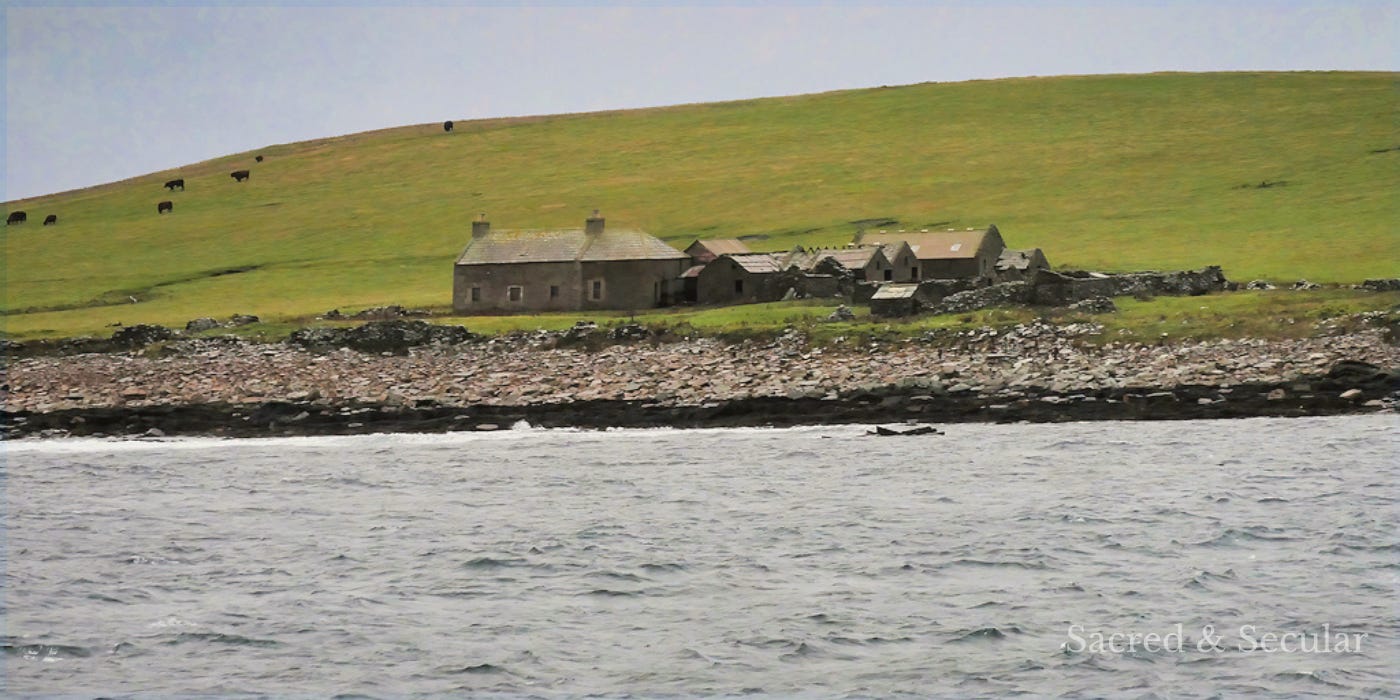
There is a tiny island between the northern coast of Scotland and the Orkney Islands called Swona.
Nobody lives there anymore. The last permanent residents left more than fifty years ago, leaving behind houses, the remains of a school and the traces of a community that had lived there for generations. Today, there are seabirds, ruins and a small herd of feral cattle wandering across an island where human life has almost entirely disappeared.
Then, this summer, a group of students arrived with archaeologists and began investigating one of the old ruins.
What they uncovered appears to be the remains of a church.
Archaeologists from the Orkney Research Centre for Archaeology found a stone structure that they believe may have been an early medieval chapel. Its construction, orientation and layout resemble churches from around the tenth or eleventh centuries, and beneath the surface, they uncovered what appears to be the foundation of an altar. There is still work to do, including the possibility of radiocarbon dating, so nobody can yet put an exact date on it with complete confidence.
Even so, the possibility is rather wonderful. Somebody may have built a church on that little island around a thousand years ago.
I haven’t been able to stop thinking about that this week.
We know almost nothing about the people who might have built it. We do not know who first decided that a church was needed or who carried the stones. We do not know the name of the person who led prayers there, the families who gathered inside it, or the children who grew up knowing that little building as part of the landscape of home.
Yet somebody thought it mattered enough to build a place for worship.
I have found myself imagining ordinary people doing ordinary work. Stones being carried and placed. Someone deciding whether a wall was straight. Someone else probably pointing out that it wasn’t. Meals eaten afterwards. Children getting in the way. People arguing about how something ought to be done because, even a thousand years ago, I suspect human beings were quite capable of turning a building project into a committee meeting.
Eventually, though, there was a church.
People prayed there. Perhaps they gathered in times of celebration and grief. Someone may have walked through its doorway, desperately worried about something we will never know, and prayed about a situation whose outcome has disappeared entirely from history.
Life happened within those walls.
Then the generations passed.
By the late nineteenth century, there were still dozens of people living on Swona, and the island had its own school. Over time, the population dwindled. The school closed. Families left. Eventually, the last two permanent residents departed in 1974.
The people went, but those stones remained.
❦
There is something about that which I find strangely moving, perhaps because most of us occasionally wonder what will remain when our own lives have moved on.
It becomes more noticeable as we grow older. When we are young, life can feel almost limitless. There will always be another year, another opportunity, another chance to get around to the things we have been meaning to do. Gradually, we become more aware that this is not true. Life has edges, even if most of us would rather not spend too much time looking at them.
That awareness can make us think about legacy.
What will people remember about us? What will we have achieved? Will anything we have done still matter when we are no longer around to explain why we did it? I am beginning to wonder whether those are the wrong questions.
There is an ancient prayer in Psalm 90 that feels particularly appropriate here. The psalm is preoccupied with the passing of time and the brevity of human life. God is pictured as enduring from generation to generation, while human beings come and go. We are compared to grass that appears in the morning and is gone by evening.
It is not exactly the sort of psalm you would put on a motivational meme.
Yet it ends with an extraordinary prayer:
“Establish the work of our hands for us — yes, establish the work of our hands.”
I used to hear words like that mainly as a prayer for success. Bless what I am doing. Make it work. Let my efforts produce the outcome I am hoping for. But perhaps there is something deeper going on.
The people praying Psalm 90 already know that they will not last. That is the entire point of the psalm. They are not asking God to make them immortal or ensure that their names are remembered. They are asking that, despite the brevity of their lives, what they do might somehow have substance and meaning. That their limited years might still count for something.
The prayer is not really "Make sure people remember me."
It is, “Establish the work of my hands.”
There is a considerable difference between the two.
❦
Much of what shapes other people’s lives happens without our ever knowing about it.
We probably remember conversations that the other person has completely forgotten. A teacher may say something to a child that becomes part of how that child understands themselves for decades. Someone offers encouragement at precisely the right moment and then carries on with their day, completely unaware that the words landed.
Parents discover this all the time. Ask an adult child which parts of their childhood they remember, and there is a fair chance it will not be the expensive day trip or carefully planned birthday. It will be something bizarre involving a sandwich, a rainy afternoon and a joke nobody else remembers.
Our lives leave traces in places we cannot see.
Something we write may reach someone years later. A kindness might alter the way somebody treats the next person they encounter. A friendship may give another person the confidence to attempt something they would otherwise have avoided. Perhaps even an apology can travel further than we realise, because somebody learns that relationships do not always have to end when people get things wrong.
None of that is particularly headline-worthy, which may be why we underestimate it.
The Bible is full of stones that become reminders. They mark places where something happened, where people encountered God, crossed a river or made a promise. Yet the emphasis is rarely on remembering the person who carried the stone. The stone points beyond its builder towards something larger.
That seems especially appropriate on Swona.
If that little building really was a church, we may never know who built it. Their names may have disappeared completely. There may be no plaque listing the people responsible, no photograph of the opening ceremony and certainly no archived social media post showing everybody smiling beside the finished wall.
Perhaps that doesn’t diminish what they did at all. Those stones tell us that faith mattered to somebody. They tell us that people gathered there. They tell us that on an island that must often have felt exposed to the weather and the sea, human beings created a place where they could pray.
The builders have disappeared, but something of what mattered to them remained.
❦
There is another lovely detail in the Swona story. Not all the students who travelled there were working on the archaeological excavation. Some were helping to repair one of the abandoned cottages so that it could continue to be used.
One of them, seventeen-year-old Iona Fell, left a small plaque beneath the floor of one of the rooms they had worked on. She said she wanted to leave something behind and become part of the island’s continuing story.
I love that.
A thousand years ago, people came to this island and built something. In 2026, a young woman came to the same island, repaired something and deliberately left a small trace behind.
Most of us will never build anything that survives for a thousand years. Given the quality of some of my DIY attempts, I would be delighted if anything I constructed survived until Tuesday afternoon.
But perhaps that is not really the point. We do not need to know which parts of our lives will remain. In fact, perhaps we are not supposed to, and I am finding a strange freedom in that.
If my task is to create a legacy, then I need to think constantly about myself. I need to make sure the right things carry my name, measure whether I have achieved enough and worry about whether anybody will remember it. That all sounds very stressful.
But if my task is faithfulness, the question becomes much simpler.
What is mine to do today?
Who is in front of me?
What can I build, repair, write, encourage, forgive or love while I have the opportunity?
And perhaps the rest is not mine to control.
❦
That does not mean everything we do will last. Of course, many things won’t. Buildings fall down, this article will be forgotten on the internet somewhere, and conversations disappear from memory. Even things that once seemed terribly important eventually become footnotes, if they are remembered at all.
Psalm 90 does not pretend otherwise. Human beings are temporary.
But temporary does not have to mean meaningless.
Perhaps that is why I kept returning to the church beneath the grass on Swona this week. The people who may have built it could not possibly have imagined that, a thousand years later, students would arrive with archaeologists and uncover the stones. They could not know that photographs of their little place of worship would travel around a world they could never have imagined.
They simply built what they believed was worth building.
Perhaps that is enough for us as well.
To love the people in front of us. To build what is worth building. To repair what we can. To offer whatever gifts we have while they are ours to give. To be faithful to the things entrusted to us without demanding to know how important they will eventually become.
And then, eventually, to let go.
Establish the work of our hands.
What remains after that may no longer be ours to decide.